Policy, Justice, Public Health
UK Cannabis Policy, evidence, costs, and why Class B fails
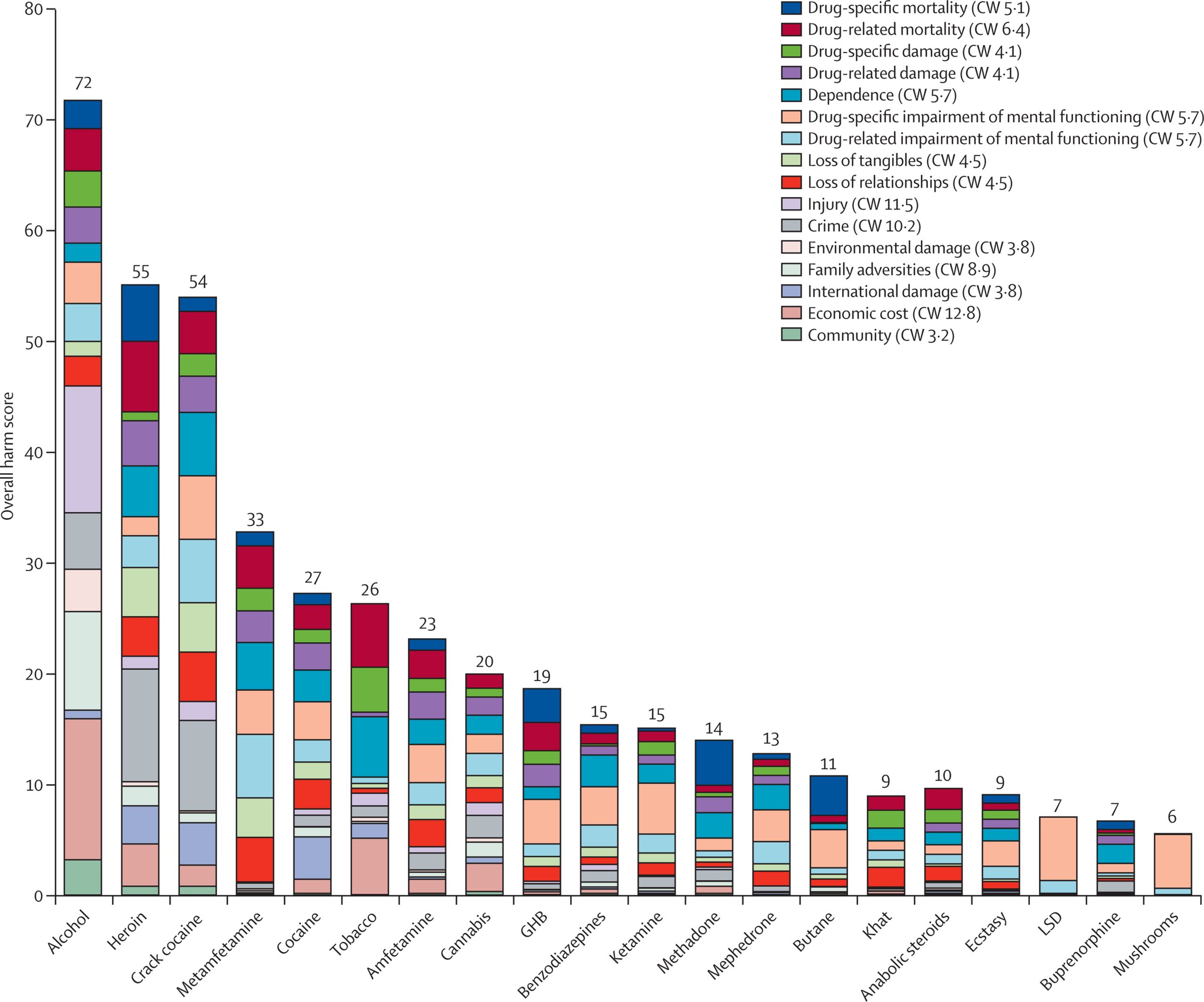
Britain reclassified cannabis back to Class B in January 2009. The government did this against the advice of its own scientific council. The evidence on relative harms has only strengthened since then. Alcohol is consistently ranked as the most harmful drug to society. Cannabis is not close. The result is predictable. We waste criminal justice resources, we criminalise the wrong people, and we gift a tax free market to organised crime.
What actually happened
- In 2004, cannabis moved to Class C after ACMD advice, to free up police time and better match harms. [8]
- In 2008, the ACMD advised that cannabis should stay Class C. The Home Office reclassified it back to Class B anyway. The change took effect on 26 January 2009. [1] [8] [4] [5]
- Professor David Nutt, then ACMD chair, presented comparative harm analyses showing alcohol and tobacco cause more overall harm than many illicit drugs, including cannabis. He was removed as chair in October 2009 after publicly restating those findings. [2] [6]
The evidence on harms is not controversial anymore
Using a multicriteria decision analysis, Nutt and colleagues ranked alcohol as the most harmful drug overall when you combine harm to users and harm to others. Cannabis ranks far lower on that composite measure. [2]
Nutt also illustrated risk perception with the well known horse riding comparison. The point was simple. Society tolerates risky activities like horse riding. It criminalises other risks like ecstasy and cannabis. The comparison was provocative, but it was grounded in data, and it forced the question of proportionality. [3]
The price tag of enforcing cannabis prohibition
We can estimate the criminal justice spend on cannabis by combining official statistics with published costings.
Conservative annual estimate, criminal justice system, excluding driving
- All drug enforcement spend in England, about £1.4 billion per year, split roughly into policing at £690 million and courts, prisons, probation at £733 million. [7]
- Cannabis share of drug offences, about 63 percent of recorded drug offences are possession of cannabis. [9]
Two complementary approaches give a sensible range:
- Proportional share method. Apply the cannabis share to the criminal justice side of spend. About 63 percent of £733 million gives roughly £460 million for courts, prisons, and probation attributable to cannabis cases. This is a broad brush estimate, and it is intentionally conservative because supply cases for other drugs are more resource intensive. [7] [9]
- Micro cost cross check. Separate analyses have priced direct cannabis policing and custody at roughly £40 to £45 million per year in England and Wales combined. [10]
Central takeaway. A cautious total for England is in the region of £480 to £500 million per year, combining the proportional share for courts, prisons, probation with the micro cost policing check. Scaling to the UK gives a rough £550 million per year. This is a conservative picture. The true figure is likely higher when you include legal aid, case preparation, family and employment impacts, and lost taxes.
Notes. The proportional share method uses recorded offence mix as a proxy for resource demand, which likely understates the cannabis share of lower level court time and probation supervision, and overstates it on complex supply cases. That is why we include the micro cost cross check.
Imagine spending that money where it actually matters
- Serious violence, exploitation, and high harm offending that create real victims.
- Proactive neighbourhood policing that reduces harm before it happens.
- Youth services, housing stability, and treatment that cut offending at the root.
Then add the upside. Legal regulation would move money out of the illicit market and into public budgets. Transform’s 2025 economic analysis estimates a net Treasury benefit of up to £1.5 billion per year from a regulated market, combining new revenue with criminal justice savings. Earlier work suggested tax receipts of £1 to £3.5 billion per year depending on the model. [11] [12]
Science has been clear for years
The government asked for expert advice. It then ignored it. The Misuse of Drugs Act classification system has drifted away from evidence. Meanwhile, alcohol remains the single most harmful drug to society, fully legal and aggressively marketed. [2]
We are not just criminalising cannabis users. We are starving communities of policing and prevention, while leaving a tax free market to criminality. That is a choice, not a fact of nature.
How we calculated the costs
- Baseline spend. Transform’s review of enforcement spend in England, about £1.4 billion per year, with a breakdown between policing and the wider criminal justice system. [7]
- Offence mix. House of Commons Library shows about 63 percent of recorded drug offences are cannabis possession. [9]
- Policing cross check. Micro cost estimates for cannabis policing and custody give about £40 to £45 million per year in England and Wales. [10]
- Prison context. Recent parliamentary answers report around 1,073 prisoners with a cannabis offence as their main offence in England and Wales at year end 2024, which supports a non trivial custodial burden even before accounting for cases where cannabis is a secondary factor. [13]
Limitations. These are transparent ballpark figures to anchor debate. They exclude legal aid, CPS preparation time outside courtroom hours, probation housing, and community impacts. The range is intentional to avoid overstating precision.
References
- UK Parliament, Delegated Legislation Committee, Draft Misuse of Drugs Act 1971 (Amendment) Order 2008, confirms reclassification effective 26 Jan 2009. Link
- Nutt DJ, King LA, Phillips LD. Drug harms in the UK, a multicriteria decision analysis. The Lancet, 2010. Alcohol ranked most harmful overall. Link
- Nutt DJ. Equasy, an overlooked addiction with implications for the current debate on drug harms. Journal of Psychopharmacology, 2009. The horse riding comparison. Link
- The Guardian, 7 May 2008, government upgrades cannabis to Class B against expert advice. Link
- House of Lords Hansard, 25 Nov 2008, confirms implementation date and rationale. Link
- Home Secretary removes Professor David Nutt as ACMD chair, Oct 2009. Parliamentary and press records. Link
- Transform Drug Policy Foundation, Misuse of Drugs Act, Counting the Costs, 2022, estimates of £1.4 billion enforcement spend in England, with £690 million policing and £733 million wider CJS. Summary | PDF
- ACMD, Cannabis, classification and public health, 2008, recommended remaining in Class C. PDF
- House of Commons Library, Drug crime, statistics for England and Wales, 2021, shows 63 percent of recorded drug offences are cannabis possession. PDF
- TaxPayers’ Alliance, Potential savings from the legalisation of cannabis, 2018, policing and custody micro cost estimates used as a conservative cross check. PDF
- Transform Drug Policy Foundation, High Returns, The economic benefits of UK cannabis legalisation, 2025, net Treasury benefit up to £1.5 billion per year. Summary | PDF
- The Guardian, 2 June 2018, report suggesting tax revenues of £1 to £3.5 billion under legal regulation. Link
- Parliamentary written answer, 18 Mar 2025, 1,073 prisoners with cannabis as main offence at 31 Dec 2024. Link


Be First to Comment