
FOI / Records Governance
Councils can keep education and SEND records for decades. Once you start asking how those decisions are documented, explained and disclosed, the picture gets a lot uglier.
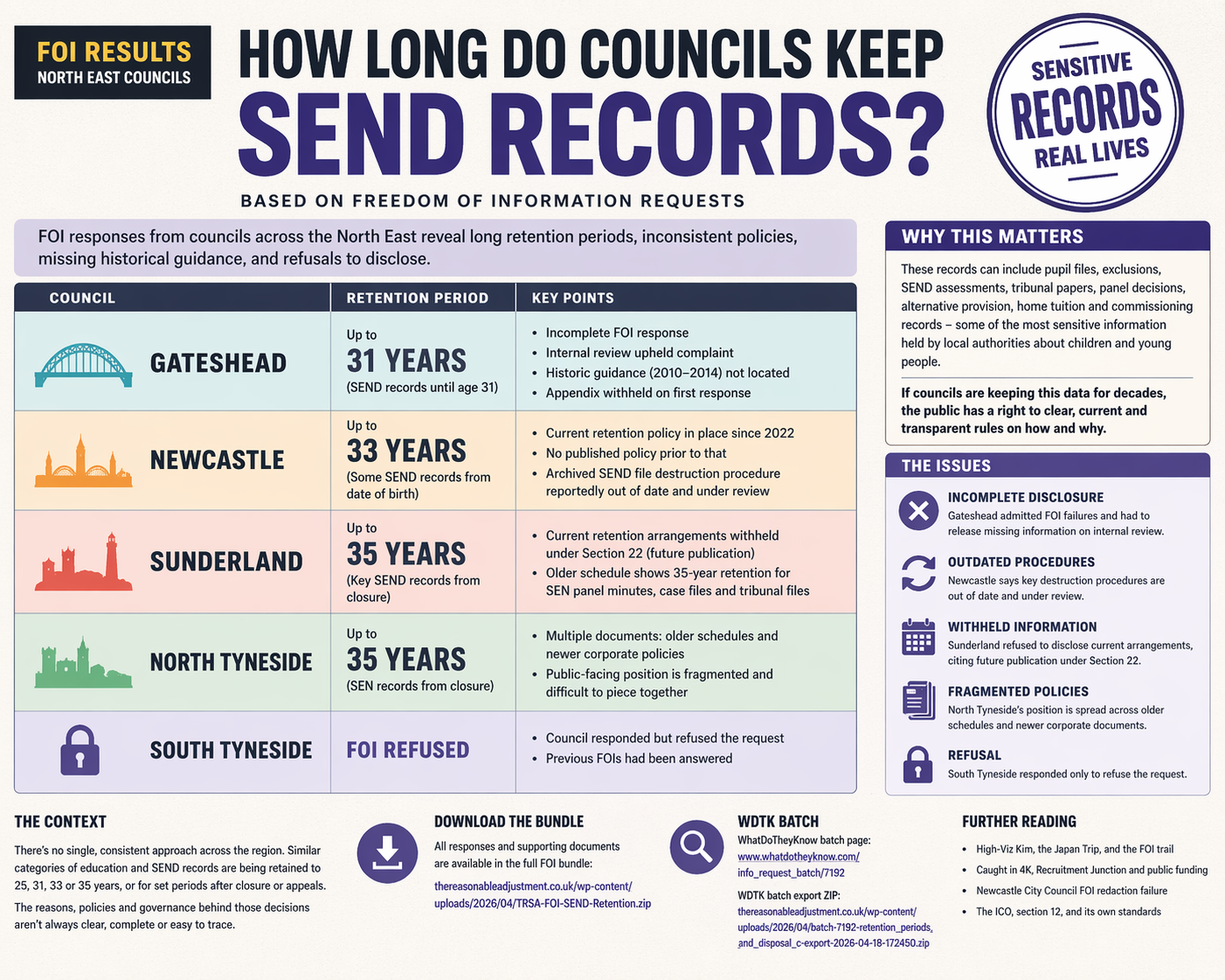
A batch of Freedom of Information requests on retention periods and disposal arrangements for education and SEND records has turned up a familiar public-sector mess. Long retention periods. Missing historic guidance. Out-of-date procedures. One council forced to concede an incomplete response on internal review. Another refusing outright. No sign of a clean shared standard.
If you want the full bundle, you can download it here: TRSA FOI SEND Retention bundle. The WhatDoTheyKnow batch page is here: WDTK batch 7192, and the WhatDoTheyKnow export ZIP is here: WDTK batch export ZIP.
What the batch was testing
The requests asked a pretty basic set of questions. How long are councils keeping education and SEND records? What retention schedules or policies govern those periods? What destruction or disposal procedures exist? Can councils still show the older rules if you ask about historic practice?
That shouldn’t be a difficult area to explain. These records can cover pupil files, exclusions, SEND assessments, tribunal papers, panel decisions, alternative provision, home tuition, commissioning records and other sensitive material tied to childhood, schooling and vulnerability. Councils have every right to say some of it must be retained for years. They should also be able to show the paperwork without needing to be dragged over broken glass first.
Gateshead had to be pushed into a proper answer
Gateshead produced the strongest example in the batch, and not in a good way.
Its original FOI response was incomplete. On internal review, the council admitted that Appendix 1 of its Common Corporate Retention document hadn’t been disclosed. It also accepted that it had failed to comply with section 1(1) of FOIA by not providing all of the requested information, and section 10(1) by missing the statutory time limit.
Only after that review did Gateshead clearly set out the retention periods for the categories being asked about. It said maintained school pupil files or educational records, records held by the local authority relating to an individual pupil’s education, exclusion records, and EOTAS or alternative provision records are retained until the child’s 25th birthday. SEND records held by the local authority are retained until the child’s 31st birthday. Education finance and commissioning records relating to alternative provision or tuition are retained for seven years.
Then came the bit that really gives the game away. Gateshead said it had searched by speaking with staff from the relevant teams and by carrying out intranet searches, but no documented retention policies, schedules or guidance for council-held education records during 2010 to 2014 could be located.
That’s rough. Either the historical governance trail is weak, the retrieval is weak, or both. None of those options are flattering.
Gateshead also said it didn’t hold guidance, circulars or communications issued to maintained schools on SARs, educational records requests, and retention expectations, saying those issues fell under the schools’ own data protection arrangements.
So the Gateshead picture is straightforward enough. The first response was incomplete. The internal review upheld the complaint. The missing appendix had to be supplied later. The older documentary basis for key education retention decisions couldn’t be located when tested.
Newcastle gave more process detail, but it still looks untidy
Newcastle comes off better in some respects because it seems to have provided more practical detail. There’s material about destruction reports, authorisation by section heads, retained audit evidence, contractor disposal of confidential waste, and certificates of destruction. Fine. That’s more than some councils managed.
But the same response reportedly said Newcastle’s current retention document was dated November 2024 and had been in place since 2022, with no published policy before that point, only internal guidance. It also said the archived SEND file destruction procedure was out of date and under review.
That takes the shine off things pretty quickly. If the procedure governing destruction of archived SEND files is out of date and under review, the broader control environment doesn’t look settled. It looks like something still being patched while sensitive records keep piling up in the background.
The retention periods disclosed also show how uneven the wider picture is. Some education-related categories reportedly run to age 25, some SEND-related material to 33 years from date of birth, and some appeal-related records to six years after the end of the appeal process.
Maybe each of those periods has a proper basis behind it. Councils should still be able to explain the lot cleanly. That doesn’t seem to be happening here.
Sunderland used future publication to dodge the current position
Sunderland took a different route. Rather than disclose its current retention and disposal information, it relied on section 22 and said the material was intended for publication by July 2026.
That exemption exists, but it still looks evasive in this context. We’re talking about retention and disposal arrangements for children’s education and SEND records, not the recipe for Coca-Cola.
What Sunderland did disclose was an older SEND retention schedule. Even from the visible entries, the periods were long. SEN panel minutes and decisions, SEN case files, and SEN tribunal files were shown as retained for 35 years, with destruction triggered by date of closure.
So Sunderland’s position is awkward on its face. It withheld current arrangements on a future-publication basis while older material already showed that some core SEND categories were being kept for 35 years anyway.
North Tyneside had more paperwork, but not a cleaner answer
North Tyneside supplied a heavier bundle, including older schedules and newer corporate records-management documents. At first glance that sounds more solid. Once you read through it, it mainly shows how layered and clunky this stuff gets when no one’s forced to present it in a single coherent way.
The older schedules include entries such as admissions and transfers retained for seven years, education welfare records destroyed on a child’s 21st birthday, school exclusions retained for 25 years from last action, and special educational needs records retained for 35 years from closure.
The newer policy material is broader and more generic, saying records should follow the council’s retention schedule and that material outside those schedules should be destroyed when obsolete or dealt with under wider records-management rules.
That leaves readers doing the assembly work themselves. If you want to know how long a particular category of education or SEND record might be kept, you’re piecing it together from multiple documents from different years with different levels of detail. That’s workable for an internal records manager. It’s rubbish for public transparency.
South Tyneside did reply, just not usefully
South Tyneside Council is missing from the substantive comparison because it didn’t provide the same kind of disclosure. It did respond to the FOI request, but only to refuse it.
That changes the character of the omission. This wasn’t silence. It was a deliberate refusal.
And in context, that looks worse. Numerous previous FOI requests to South Tyneside Council had been answered. Once the subject became more awkward, cooperation seems to have dried up. Readers can make of that what they will.
The retention periods don’t line up cleanly
Put these responses side by side and the variation is obvious. Similar categories of records are being retained to different ages and under different triggers. Some councils refer to a child’s 25th birthday. Some SEND categories run to 31. Others go to 33 years from date of birth. Others go to 35 years from closure. Finance or commissioning material may sit at seven years. Appeal-related material may be shorter.
That doesn’t automatically prove anything improper. It does raise a fair question. If councils are applying different retention logic to similar categories of sensitive records, can they show the basis for those differences clearly, consistently and historically?
This batch doesn’t inspire much confidence.
The governance trail looks patchy
You’ve got one council admitting an incomplete FOI response on internal review. Another says a key destruction procedure is out of date and under review. Another withholds current arrangements on future-publication grounds. Another gives you a stack of old and new material that has to be stitched together by hand. South Tyneside responds only to refuse.
None of that screams disciplined records governance.
And none of it sits comfortably with the underlying subject matter. These aren’t harmless admin scraps. They’re records about children, education, disability, exclusions, tribunal disputes, and support needs. If local authorities are going to hold them for decades, the public shouldn’t have to excavate the rules like amateur archaeologists sifting through a collapsed archive room.
Why this batch deserves attention
Retention schedules aren’t glamorous. Most people won’t think about them unless a dispute, complaint, SAR or tribunal has already landed. But they shape how long public bodies keep some of the most sensitive records they hold, and how confidently they can account for those decisions later.
This batch shows councils keeping education and SEND records well into adulthood and, in some cases, far beyond it. It also shows disclosure that’s incomplete, fragmented, outdated, withheld or refused.
That’s enough to justify scrutiny on its own.
If councils want public trust in this area, they need cleaner schedules, clearer history, better disclosure and a lot less fumbling once questions are asked.
Source material and further reading
Full bundle of council responses: TRSA FOI SEND Retention bundle
WhatDoTheyKnow batch page: Batch 7192 on WhatDoTheyKnow
WhatDoTheyKnow export ZIP: WDTK batch export ZIP
Further reading:



Be First to Comment