Plenty of people know when something is wrong. The harder part is saying so clearly, sticking to the point, and not being knocked off course once an organisation starts getting slippery.
That happens more often than it should. A straightforward complaint is minimised. A clear question gets a vague answer. An avoidable mistake is dressed up as a misunderstanding. A simple apology is avoided because somebody would rather protect the organisation than deal honestly with the problem.
If you have dealt with that sort of response before, you are not imagining it, and you are not overreacting.
The awkward truth is that many organisations do not respond well to being challenged, even when the challenge is fair. Some will answer only part of the issue. Some will ignore the strongest point and focus on something easier. Some will try to make you feel as though you are the problem for noticing that their explanation does not stack up.
That is precisely why it is worth learning how to complain properly.
Start with the facts, not the adrenaline
The most effective complaints are usually the least theatrical. That does not mean passive. It means clear.
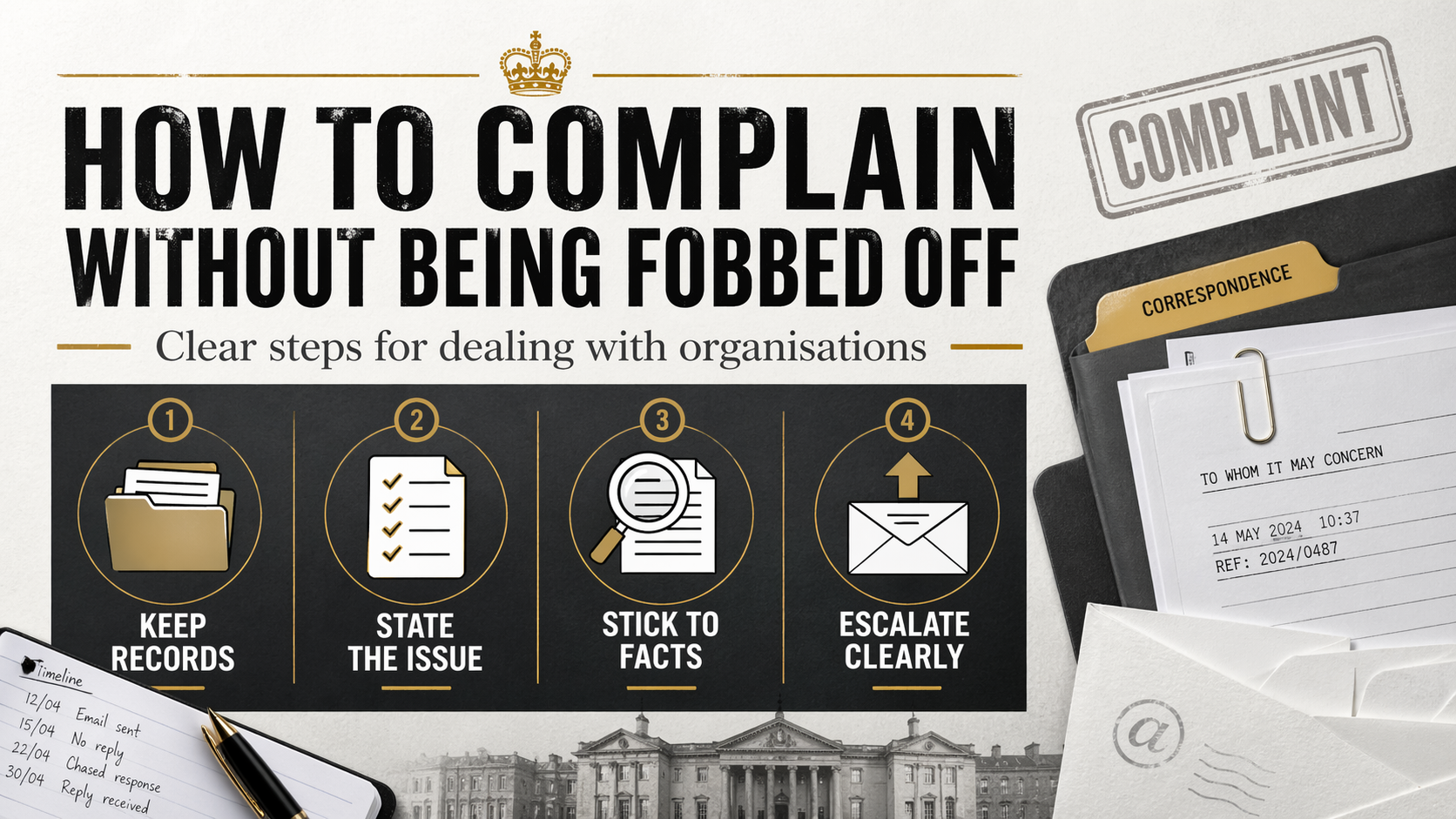
Write down what happened, when it happened, who said what, and what the practical effect was. Save emails. Keep screenshots. If a timeline matters, set it out plainly. If the issue developed over time, update the record as it developed.
A lot of people start doubting themselves once an organisation begins to wriggle. A written timeline helps cut through that. It gives you something more solid than memory and something harder for the other side to blur.
Be specific about what is actually wrong
One of the easiest ways for an organisation to dodge a complaint is to answer the wrong point.
If your complaint is about inaccurate information, say so. If it is about delay, say so. If it is about being brushed off once the problem was raised, say so. Keep separating the issues out until there is nowhere left for them to hide.
Many people are not ignored because their complaint is weak. They are ignored because the organisation thinks it can answer something adjacent to the complaint and hope that will do.
Do not let them turn it into a tone debate
This is a familiar move. An organisation gives poor information, avoids the main issue, or refuses to admit fault. Once the person on the receiving end becomes frustrated, the focus quietly shifts. Suddenly the organisation wants to talk about the tone of the emails rather than the conduct which caused them.
If your underlying point is sound, bring the discussion back to it. Keep asking the question that has not been answered. Keep pointing to the part of the record that does not fit what they are now saying. Calm repetition is often more effective than long emotional explanation.
Expect defensiveness, not instant honesty
Many people still assume that if they present a fair complaint politely enough, the organisation will simply hold its hands up and sort it out.
Sometimes that happens. Often it does not.
Organisations tend to think first about risk, workload, optics and containment. That can mean an obvious mistake is not acknowledged when it should be. It can mean a person is left chasing a basic answer they should have been given at the outset. It can mean the complaint itself becomes harder work than the issue that caused it.
That does not mean speaking up is pointless. It means people should not be naive about how these things are often handled.
You do not need to sound like a solicitor to be effective
A strong complaint is usually built from ordinary language used properly. You do not need inflated legal phrasing. You do not need to act as though every problem is a landmark case. You do need a clear record, a steady point, and enough confidence to keep going when the response is weak.
That confidence is often the hardest part. A lot of people know they are being treated badly, but they hesitate because they worry they will sound difficult, emotional, or out of their depth. That hesitation is understandable, and organisations benefit from it more often than they should.
If that sounds familiar, you are exactly the sort of person we try to support through The Reasonable Adjustment Advocacy. We cannot fix every problem for people, but we can help you think clearly, organise the facts, and build the confidence to challenge poor treatment properly.
You are not causing a fuss by expecting basic standards
There is a cultural habit in this country of treating complaint as embarrassment. People worry about making a fuss. They worry about being seen as awkward. They worry about being judged for not simply putting up with things.
That instinct protects poor practice far more than it protects ordinary people.
If an organisation has given you inaccurate information, delayed something unnecessarily, ignored a clear point, or treated you as though your complaint itself is the inconvenience, you are entitled to say so. Expecting competence is not unreasonable. Expecting honesty is not excessive. Expecting an organisation to answer the point put to it is not aggression.
Support exists, even if confidence does not come naturally
Some people are comfortable pushing back. Others are not. Some freeze when they are being dismissed. Some know exactly what is wrong but struggle to set it out cleanly under pressure. Some are worn down long before the issue is resolved.
That does not mean the issue is not worth raising. It means support can make a real difference.
The mission of The Reasonable Adjustment is rooted in that reality. Too many people are left dealing with systems that are opaque, defensive or casually dismissive. Our work exists because being right is often not enough on its own. People also need language, structure and confidence.
If you are dealing with an organisation that is avoiding fault, dodging the point, or making you feel as though you are the problem for speaking up, keep going. Keep records. Stay close to the facts. Ask direct questions. If you do not yet have the confidence to do that on your own, there is no shame in building it step by step.
That is how standards are defended in practice. Not by waiting for institutions to behave perfectly, but by refusing to let them lower the bar without being challenged.


Be First to Comment