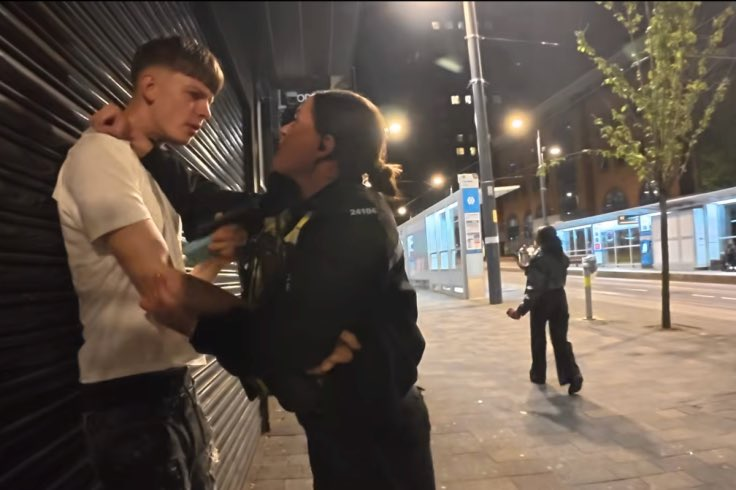
The CPS has ended the prosecution of Cody Harper after reviewing the evidence from his viral arrest on Birmingham’s Broad Street. West Midlands Police had already cleared its own handling and asked people to stop sharing the footage.
The Crown Prosecution Service has dropped the charge against Cody Harper after deciding there wasn’t a realistic prospect of conviction.
The decision has been reported by The Telegraph and GB News.
For once, the CPS appears to have reviewed a questionable prosecution and reached the right decision.
The official explanation refers to “insufficient evidence”. That’s the usual legal wording, although it gives a strange impression in this case.
The incident was recorded clearly from close range. The footage showed Harper being attacked, getting back to his feet and reacting when an officer moved in to restrain him. Few arrests during street disorder are captured in that much detail.
Reports suggest the recording raised doubt over whether Harper immediately realised that the person taking hold of him was a police officer.
Someone reading “insufficient evidence” might picture blurred CCTV, missing witnesses and contradictory accounts. Prosecutors had a clear recording of the wider sequence. After reviewing it, they no longer believed the charge had a realistic prospect of success.
West Midlands Police had already cleared itself
West Midlands Police said it had reviewed the officer’s actions and had no concerns. It described the force used as reasonable and proportionate.
The force also asked people to stop sharing the footage while the prosecution remained active.
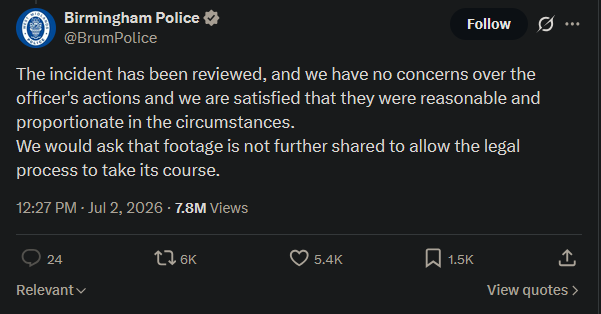
As we explained in our original report on the Broad Street arrest, police had already published their own account, defended the officer and announced the result of their internal review.
The public was then warned against circulating the recording which allowed that account to be examined.
Rules against prejudicing criminal proceedings serve a proper purpose. Police forces still need to exercise some restraint when commenting on cases which haven’t yet been tested independently.
Their first statement is usually repeated across local news reports and social media. The person arrested is quickly presented as the offender, while the surrounding context may receive far less attention.
An internal review carried out by the same force won’t settle every concern. Its conclusions deserve even closer examination when the related prosecution later falls away.
West Midlands Police’s network accessed our report
West Midlands Police was aware of the criticism being made about its handling of the arrest.
Traffic records held by The Reasonable Adjustment show repeated visits to our original Broad Street article from internet addresses attributed to West Midlands Police by the network information available to us.
The article was opened through several separate browser sessions. One visit carried a Microsoft Teams referrer, which is consistent with the link having been opened from Teams.
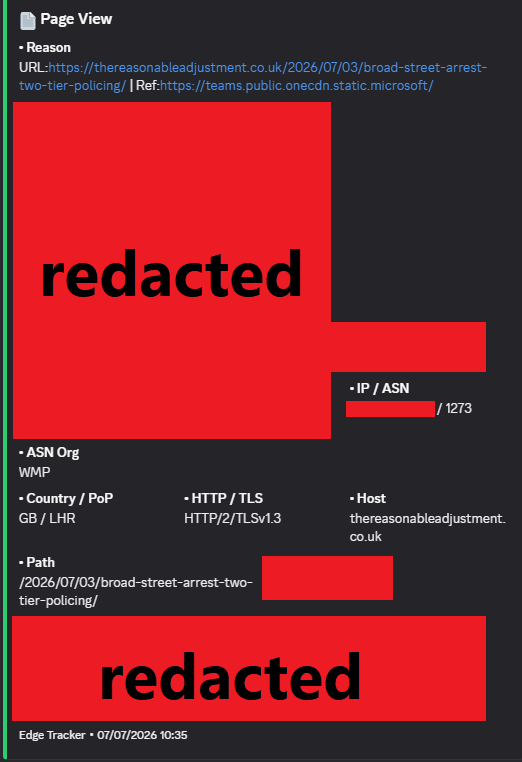
The records don’t identify any named visitor. They don’t reveal the person’s role, department or reason for reading the article.
They do show that our coverage reached the force whose conduct it questioned.
The original article set out concerns about the force’s description of events, the speed of its internal clearance and the request that people stop sharing the video. Those concerns were available to West Midlands Police before the charge was dropped.
The CPS got this one right
The CPS receives plenty of justified criticism. Charging decisions can be slow, difficult to understand and heavily reliant on the case presented by the police.
Here, prosecutors reviewed the evidence and stopped the case. They deserve credit for doing their job properly.
Institutions can become reluctant to change course once somebody has been arrested and charged. Time and resources have already been committed. Public statements may have defended the arrest. Ending the case can create uncomfortable questions about the original decision.
Those concerns shouldn’t keep a weak prosecution alive.
The CPS is supposed to provide an independent check before someone is put through a criminal trial. Continuing with a doubtful charge to avoid embarrassing a police force would be a serious failure.
Our earlier coverage of the Henry Nowak case examined what can happen when evidence and official decisions emerge in fragments. The Broad Street footage gave prosecutors the wider sequence in one clear recording.
Most people won’t have somebody filming
Broad Street attracted national attention because people could watch the incident for themselves.
Most people who dispute a police account won’t have that advantage, particularly during drunken nights out.
Incidents around pubs and clubs develop quickly. People may be frightened, angry, confused or heavily intoxicated. Very few will remember to take out a phone and record everything while it’s happening.
Someone who does capture useful footage may have no idea how to preserve it or make effective use of it. They might post a short clip, send it to the police or leave it sitting on their phone.
Unless the incident reaches court or attracts wider attention, nobody independent may ever examine the complete recording.
By the following morning, memories may be fragmented. Witnesses may have disappeared. The person arrested may struggle to explain the order of events. Police notes, custody records and officer statements can then become the main written account.
Challenging that account without independent evidence is extremely difficult.
Auditors sometimes record what everybody else misses
Police auditors and nightlife channels are often criticised for filming officers and intoxicated members of the public.
Some deliberately provoke reactions. Some chase views. Some have dreadful judgement.
They’ve also recorded poor or questionable police conduct around the UK which may otherwise have received little scrutiny.
Unlike most bystanders, these channels often have a camera running before an incident begins. Their footage may show the build-up, the atmosphere, the language used and the events leading to an arrest.
A phone recording made by someone nearby will often begin halfway through, after the shouting or use of force has already started.
We made a similar point in our article about Knockout Audit’s Wigan nightlife footage. People often become more interested in whether they like the person holding the camera than in the conduct the camera has captured.
Independent footage may support an officer’s account. It may also reveal missing context, mistakes or poor conduct. Either outcome helps establish what happened.
Police don’t control every camera
Body-worn cameras are valuable, although they won’t always show the full incident.
An officer may arrive after the confrontation has begun. The camera may be activated late, point away from the main action or capture only the moments immediately before an arrest.
A separate recording can fill those gaps.
Anyone trying to challenge an official account may also need to act quickly to preserve relevant footage. Our guide to requesting body-camera footage explains the basic process for obtaining recordings held by public authorities.
Broad Street was an unusual case because the recording was clear, widely shared and difficult to ignore. Most people arrested during a chaotic night out won’t have a large audience examining the footage on their behalf.
The CPS deserves credit for reviewing the case against Cody Harper and bringing it to an end.
West Midlands Police had already cleared its own handling, and visitors using the force’s network repeatedly reached our earlier coverage. The concerns surrounding its account and its early confidence were there for it to read.
The force should now explain why it reached such a firm conclusion so quickly and whether it intends to reconsider that conclusion following the CPS decision.
Sources and further reading
- The Telegraph: White man in Birmingham two-tier policing row has assault charge dropped
- GB News: Charges dropped following viral Birmingham Broad Street arrest
- Broad Street Arrest: West Midlands Police Cleared Their Own Officer
- MC Viper, Sam Shackleton and the Wigan Knockout Audit Video
- Why Did the Henry Nowak Case Reach the Public in Pieces?
- Caught on Camera? How to Request Body-Camera Footage
Be First to Comment