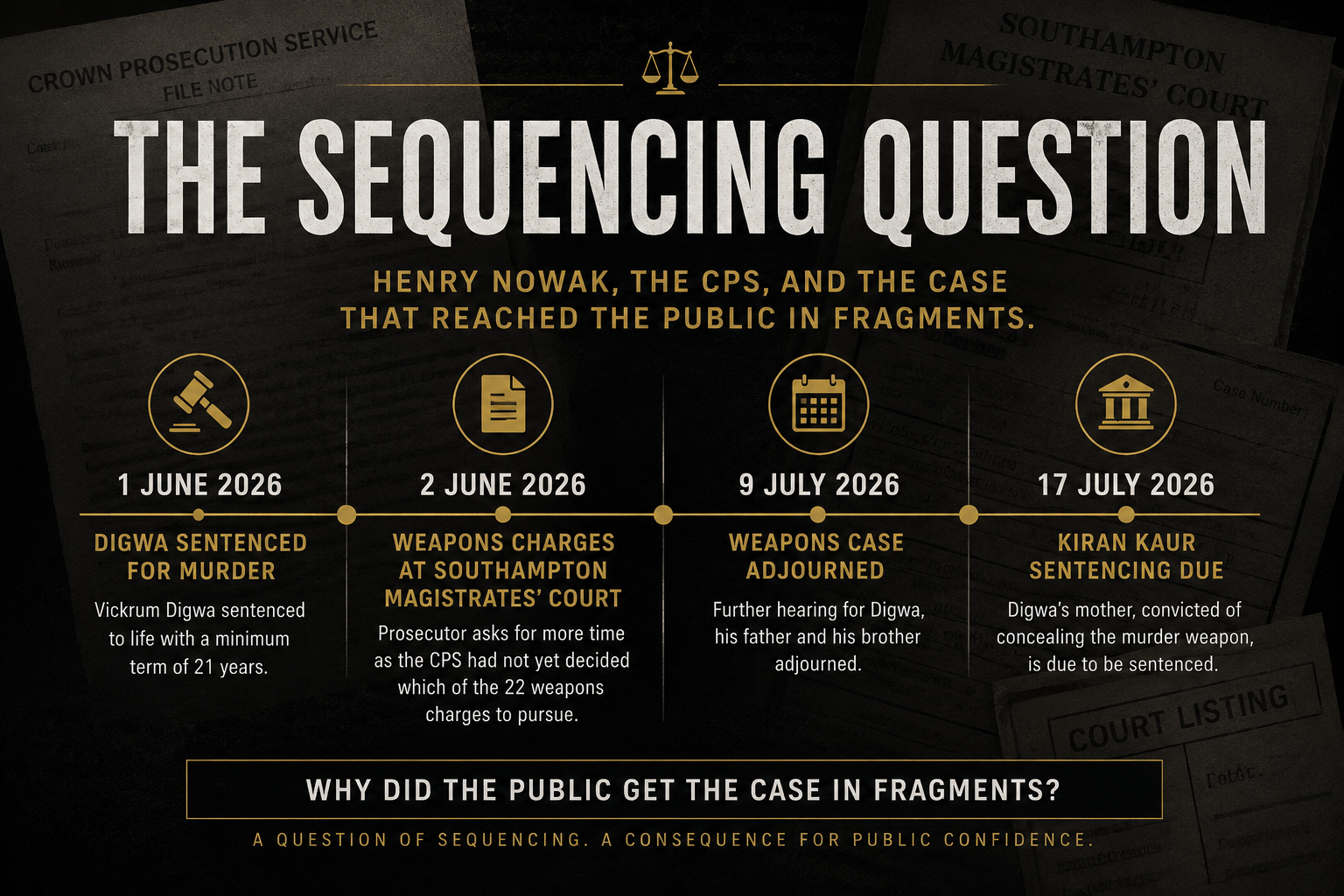
The day after Vickrum Digwa was sentenced to life for murdering Henry Nowak, a prosecutor stood up in Southampton Magistrates’ Court and asked for more time, because the Crown hadn’t yet decided which of the 22 weapons charges against Digwa, his father and his brother it was actually going to pursue.
That’s worth sitting with for a second. One of the most closely watched murder sentencings in years had happened the previous day, the city was already on edge, and the CPS still couldn’t tell a court what it was charging the killer’s own family with.
I should head off one misreading before it happens, because I’m not saying courts should slow things down whenever there’s a risk of trouble. They can’t run their lists around the weather or the mood of a crowd, and they shouldn’t.
My problem is more basic than that, and it’s about sequencing. A case this obviously volatile should have been managed as one connected thing, and instead it was allowed to leak out in fragments.
None of the surrounding parts were a surprise to the CPS, which is the bit that bothers me. Digwa’s mother, Kiran Kaur, was convicted alongside him for taking the murder weapon from the scene and hiding it at the family home, and she isn’t sentenced until 17 July. The further charges against the father and brother, 22 counts between the three of them over an alleged flick knife, an ASP, knuckledusters, a machete, swords and weighted chains, were authorised by the CPS itself.
The Attorney General is now reviewing whether the 21-year minimum was too lenient. The IOPC is investigating the officers who handcuffed Nowak while he was dying. All of that was either already known or already set in motion by the Crown before Digwa was sentenced on 1 June, and yet the public got the murder, the sentence and the bodycam footage first, with the further weapons charges, the mother and the rest of the family dribbled out over the following days.
If the connected cases genuinely weren’t ready, and the prosecutor asking for time on 2 June suggests they weren’t, then the obvious question is why the murder sentencing was allowed to go ahead first. A sentencing date isn’t fixed by God, it’s scheduled.
Had the linked proceedings been completed properly, the whole thing might naturally have run past the summer, and that would have been fine. Nobody’s asking for justice to be delayed to keep a mob happy, only for it not to be served up as a national flashpoint in instalments.
There may well be lawful reasons for the gap, evidence still coming in, disclosure unfinished, charges deliberately kept separate to protect fair trials, all of which is reasonable enough, but if that’s the explanation then the CPS can say so. What it can’t reasonably do is claim the wider case was too unfinished to present as a whole while also insisting it was right to fire off the single most inflammatory part on its own.
I should say this isn’t an abstract point for me, because I was on probation during 2024, the year the whole system got hollowed out to stop the prisons bursting at the seams. Probation Reset cut supervision for most people by a third, SDS40 was releasing prisoners at 40 per cent of their sentence instead of half, and caseloads were already running at something like a hundred people per officer before the summer disorder dumped a wave of arrests, remands and recalls on top of all of it.
My own probation officer told me straight that the riots were the reason supervision was being cut back. That’s what it actually looks like on the ground when a system with nothing left in reserve takes a shock it should have seen coming, and the people who feel it are rarely the ones who caused the trouble, they’re just whoever happens to already be inside the machine when it seizes up.
The 2024 disorder cost tens of millions and clogged the courts for years afterwards, and everyone working in policing and justice knows that figure, because they lived through it.
So when I say the CPS should have understood what it was holding in June 2026, I’m not asking it to have predicted the future. I’m asking it to remember something that happened within the last couple of years. It watched, at first hand, exactly what a single flashpoint does to a justice system that’s already running on empty.
There was a way to take some of the heat out of this that would have cost nothing and prejudiced nobody, because you don’t have to reveal evidence or wreck a trial to tell the public the plain truth, which is that the murder was one part of a larger set of proceedings, that further charges were coming, and that the picture wasn’t finished yet. Saying that much starves the people who organise around these cases of the empty space they rely on.
I don’t think the CPS broke any law here, and I’m not suggesting it did. The trouble is that an organisation holding the entire picture chose a sequence that any honest look at the conditions would have flagged as a serious fire risk, the height of summer, the memory of 2024, a case already soaked in race and religion and footage of a handcuffed dying lad.
The disorder that followed was the entirely predictable behaviour of the material the CPS was handling, and leaving the gas on in a room you know is full of it carries some responsibility even if you never meant to light the match.
Somebody decided how this case reached the public, or failed to decide, which in practice comes to the same thing. The Attorney General is reviewing the sentence and the IOPC is reviewing the police, but nobody in authority has yet been asked who in the CPS owns the sequencing of this prosecution, why the murder was sent out ahead of everything bolted to it, and what gets done differently the next time the Crown is sitting on something this dangerous.
Because there will be a next time, and the bill, exactly as in 2024, will land on the people who were nowhere near the trouble.
Rest in Peace Henry Nowak.
Vickrum Digwa was sentenced to life with a 21-year minimum on 1 June 2026. He, his father Moga Singh (52) and brother Gurpreet Digwa (27) appeared on 22 weapons charges on 2 June, adjourned to 9 July. The father and brother have entered no plea and the charges are unproven. Kiran Kaur (53), convicted of assisting an offender, is to be sentenced on 17 July. The Attorney General is reviewing the sentence under the unduly lenient sentence scheme; the IOPC investigation into Hampshire Police remains ongoing.
Related on The Reasonable Adjustment


Be First to Comment