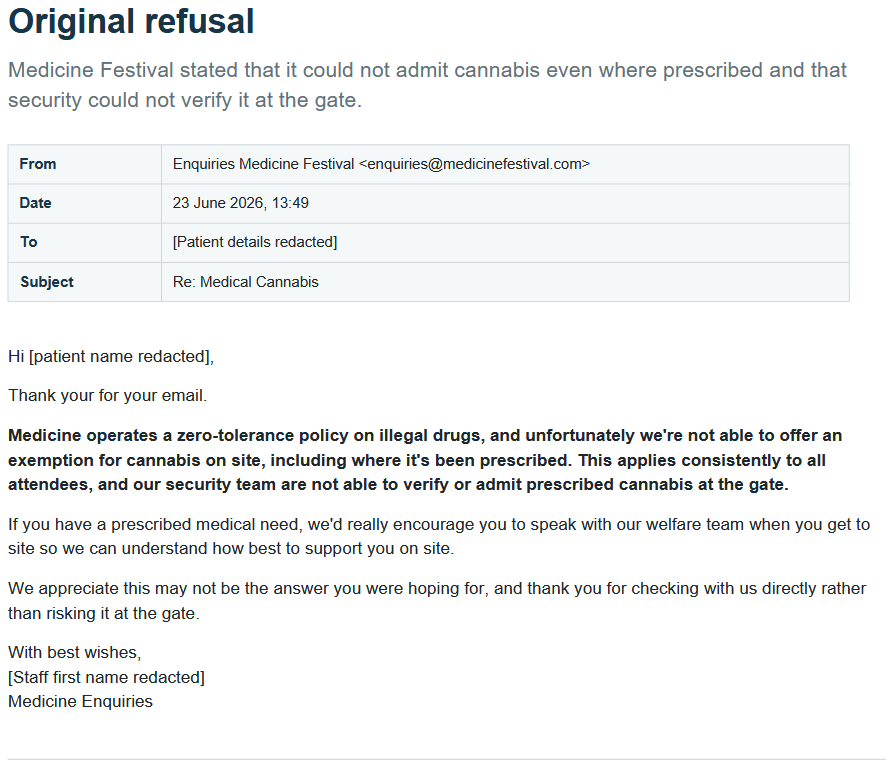
A disabled attendee was told that Medicine Festival would not admit prescribed cannabis because of its “zero-tolerance policy on illegal drugs”. After weeks of uncertainty and a media enquiry from The Reasonable Adjustment, the festival apologised, reversed its decision and changed its published medication policy. Its response also introduced Cancard as supporting evidence, despite the private card not proving that someone has a prescription.
Email evidence: Read Medicine Festival’s original refusal, reversal and apology (redacted PDF)
By Kieron JH
Medicine Festival has reversed a policy which treated prescribed medical cannabis as an illegal drug and would have prevented a disabled ticket-holder from bringing their medication to the event.
The patient first contacted the festival on 8 June 2026 to ask what documentation they would need to bring legally prescribed medical cannabis onto the site. Medicine Festival took 15 days to reply.
On 23 June, its enquiries team told the patient:
“Medicine operates a zero-tolerance policy on illegal drugs, and unfortunately we’re not able to offer an exemption for cannabis on site, including where it’s been prescribed.”
The response continued:
“This applies consistently to all attendees, and our security team are not able to verify or admit prescribed cannabis at the gate.”
Medicine Festival encouraged the patient to speak to its welfare team after arriving, despite saying that security could refuse to admit their medication at the entrance. The proposed support would therefore have been available only after the patient had passed through the gate with medicine they had been told could not be admitted.
A prescribed medicine treated as an illegal drug
The original response failed to distinguish illegal recreational cannabis from a cannabis-based product lawfully prescribed for medicinal use.
Cannabis-based products for medicinal use were moved to Schedule 2 of the Misuse of Drugs Regulations 2001 on 1 November 2018. Specialist doctors can prescribe them where clinically appropriate. Recreational cannabis generally remains illegal, but that does not make possession of cannabis medicine dispensed under a valid prescription unlawful.
The change in law and associated government guidance can be found in the Home Office and Department of Health and Social Care medicinal-cannabis collection.
A festival can make proportionate arrangements for checking identification, labelled packaging and prescription documentation. It can also set reasonable rules about where medicines delivered through a vaporiser may be used. The concern in this case was not that Medicine Festival wanted to verify the medication, but that its original response said security could not verify it at all and provided no process through which the patient could demonstrate that it had been lawfully prescribed.
The position also raised questions under the Equality Act 2010. Section 20 sets out the duty to make reasonable adjustments, while section 29 applies discrimination and reasonable-adjustment duties to service providers.
Whether a particular refusal is unlawful depends on the circumstances. However, where a disabled person needs medication in order to attend an event, an organiser should consider whether a practical adjustment can be made rather than simply applying a general rule intended for illegal drugs.
The effect on the ticket-holder
The ticket-holder is prescribed medical cannabis for severe insomnia and pain connected to a lower-disc injury. They told The Reasonable Adjustment that without the medication they find sleep almost impossible, while walking and movement can become excruciatingly painful. Attending the festival without it was not a realistic option.
There was also a substantial financial consequence. Including the adult tickets, children’s tickets and parking, the patient estimated that being unable to attend could leave them responsible for £821.
“This ordeal is causing me a lot of stress and I don’t know what to do,” they wrote after the festival stopped responding.
The patient replied to Medicine Festival on the day of the refusal, explaining the legal distinction and offering to bring the medication in its original pharmacy packaging with a dispensing label bearing their name, matching photographic identification and a copy of their prescription letter. They also offered to speak to the festival’s welfare or medical lead in advance.
The following day, the patient sent a formal reasonable-adjustment request to several festival addresses. They asked for written confirmation that they would not be refused entry and that their prescribed medication would not be seized, but received no substantive response at that stage.
The Reasonable Adjustment contacts the festival
The patient contacted The Reasonable Adjustment on 23 June and later gave permission for the correspondence and their experience to be reported anonymously. They initially wanted to allow Medicine Festival time to reconsider its position without outside pressure.
By 9 July, however, more than two weeks had passed since the refusal and the patient said the festival had ignored their subsequent correspondence. The Reasonable Adjustment then sent a media enquiry to Medicine Festival and its public-relations representative.
The enquiry asked whether the refusal reflected the festival’s official 2026 policy, why prescribed cannabis was being classified as an illegal drug, whether the festival had considered its Equality Act duties and whether any verification procedure was available. Medicine Festival was also asked whether it intended to review the policy before the event. A response deadline of 16 July was provided.
Those questions were particularly relevant because Medicine Festival presents itself as an event centred on care, inclusion and community. Its website says it wants to make the gathering accessible to people with disabilities and other access requirements, and advertises a dedicated accessibility lead, accessible facilities and support for people with hidden disabilities and neurodivergent differences.
Medicine Festival’s transparency report also acknowledges that participants from marginalised groups reported lower levels of safety, voice and trust in escalation routes. It records calls for clearer communication and accountability so that care does not depend on good intentions alone. The report can be read on the festival’s transparency page.
The festival reverses its decision
Two days after The Reasonable Adjustment sent its media enquiry, Medicine Festival co-founder and co-director Zak Avery contacted the patient directly. He apologised for the delay and confirmed:
“You will not be refused entry for carrying your prescribed medication, and it will not be seized.”
Avery said this expressly included cannabis-based medicinal products prescribed to the patient. He asked them to bring the medication in its original pharmacy packaging with a dispensing label bearing their name, matching photo identification and a copy of their prescription letter. These were substantially the same safeguards the patient had already offered when asking the festival to reconsider its refusal.
Medicine Festival said its accessibility lead would act as the patient’s named contact and that the access team would check the documentation discreetly at the box office. Its security contractor would be briefed in writing, secure refrigerated storage would be available if required, and the medication could otherwise remain with the patient. Prescribed cannabis used through a vaporiser could be consumed in designated smoking areas.
Avery accepted that the previous position had been deficient:
“Our written policy did not reflect how we want to treat disabled attendees.”
He added:
“We fell short here, both in the policy and in the speed of our response.”
The response reversed the original claim that security could not verify or admit prescribed cannabis. The process eventually adopted was relatively straightforward: staff would check pharmacy packaging, identification and evidence of prescription, then ensure security had received the correct instructions.
Cancard introduced as supporting proof
Medicine Festival also told the patient:
“A Cancard is also accepted as supporting proof.”
Cancard is a private identification scheme. It is not a prescription, statutory licence or government-approved method of proving that cannabis has been lawfully prescribed.
A person does not need to hold a medical-cannabis prescription to qualify for the scheme. Cancard says it is also available to some people who have a diagnosed condition and use cannabis for symptom management but have been unable to obtain or afford prescribed treatment. Cancard itself states that its card does not make cannabis legal and does not replace a prescription.
Possessing a Cancard therefore does not establish that the cannabis someone is carrying was prescribed or dispensed to them. Evidence connected to a lawful prescription is different. Government guidance advises patients to retain their medicine in its original pharmacy packaging with the dispensing label and to carry prescription documentation or a letter from the prescribing clinician. Matching identification may also be required. This is explained on the government’s medicinal-cannabis information page.
Medicine Festival requested those documents in the same email, so its reference to Cancard appears to mean that the card would be considered as additional material rather than as a substitute for proof of prescription. It would therefore be inaccurate to say that the festival expressly accepted Cancard alone as sufficient evidence.
Even as supporting evidence, however, its inclusion may reinforce the mistaken belief that prescribed patients need a special cannabis card or that Cancard establishes prescription status. Neither is true. The patient’s labelled pharmacy packaging, prescription documentation and matching identification provided the relevant evidence, while Cancard added nothing necessary to the process.
There is also a notable inconsistency in the festival recognising a private card which can be held by people without prescriptions as supporting material after initially rejecting documents connected directly to a lawful prescription.
The public policy is changed
Medicine Festival also promised:
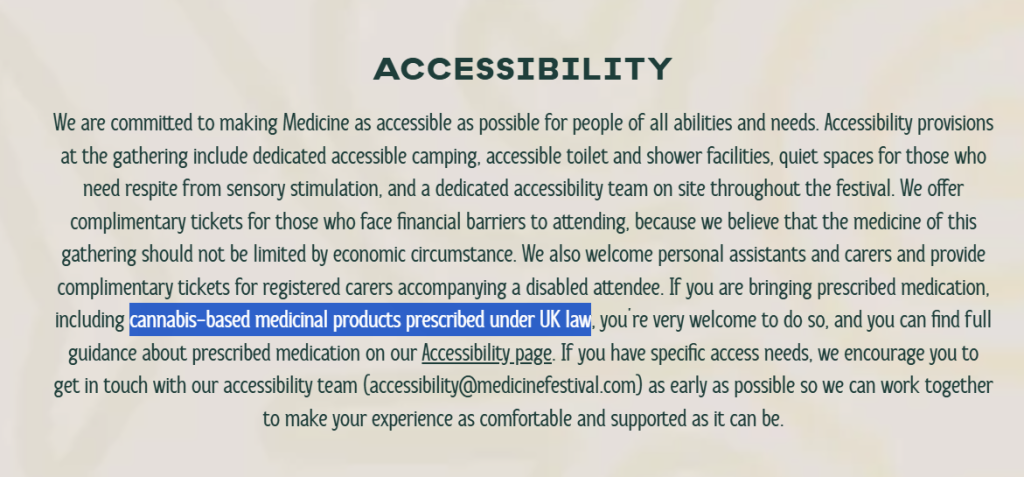
“We are updating our published medication policy so that it explicitly covers prescribed medication, including medical cannabis, and this will be live on our website before gates open.”
The festival subsequently amended its public accessibility material. The revised wording says that people bringing prescribed medication, “including cannabis-based medicinal products prescribed under UK law”, are welcome to do so and directs attendees to its accessibility guidance. A captured copy of the updated wording has been retained by The Reasonable Adjustment.
The amended policy now recognises the distinction that was missing from the original response: cannabis medicine lawfully prescribed to a patient is not automatically an illegal drug. It also shows that verification did not present the insurmountable security problem first suggested by the festival.
Patients can bring labelled pharmacy packaging, evidence of prescription and matching identification. Staff can check those documents discreetly, record any agreed arrangements and make sure security has received accurate instructions. This was essentially the process the patient proposed from the beginning.
A welcome correction after an avoidable dispute
Medicine Festival deserves credit for eventually giving the patient a clear apology, establishing practical arrangements and changing its public policy before the event. The result was not simply an informal exception for one persistent ticket-holder, as the revised website wording now gives other prescribed patients a policy they can rely on before arriving at the gate.
The correction does not remove the problems which preceded it. The patient was initially given a categorical refusal which placed prescribed cannabis within a zero-tolerance policy on illegal drugs. They faced the possible loss of hundreds of pounds and had to explain repeatedly that their medication was lawfully prescribed. A workable process was introduced only after weeks of correspondence and shortly after outside scrutiny began.
The inclusion of Cancard as supporting evidence also suggests that some confusion remains between proof of prescription and private cannabis-identification schemes. A Cancard may indicate that its holder reports using cannabis for medical reasons, but it does not show that the cannabis in their possession was lawfully prescribed.
Medicine Festival did not respond directly to The Reasonable Adjustment’s media enquiry by the 16 July deadline. Its co-director’s written response to the patient and the subsequent website changes have therefore been included as the festival’s recorded position.
The eventual outcome is positive. The patient can attend with their prescribed medication, security will be briefed and future attendees now have a public policy they can cite. Medicine Festival acknowledged that it had fallen short and changed its approach, although a disabled ticket-holder had to pursue the issue for several weeks before that happened.
Email evidence: Read Medicine Festival’s original refusal, reversal and apology (redacted PDF)
Further reading
- Glastonbury Recorded Fewer Festival Arrests Than Leeds
FOI disclosures covering police deployments, arrests, searches and drug seizures at Glastonbury between 2022 and 2025. - Leeds Festival FOI reveals 203 arrests and 3,088 police deployments
An examination of four years of policing data from Leeds Festival, including arrests, drug offences and the limits of the records disclosed.
Medical-cannabis policy
- Three councils were asked about staff using lawful medical cannabis. They sent back drug misuse policies.
How public bodies can wrongly place prescribed cannabis within policies written for illegal or harmful drug use. - FOI Reveals British Medical Cannabis Clinics Set Their Own THC Limits
FOI responses from national bodies found no general statutory THC cap for prescribed medical cannabis, raising questions about restrictions presented as legal requirements.
Be First to Comment