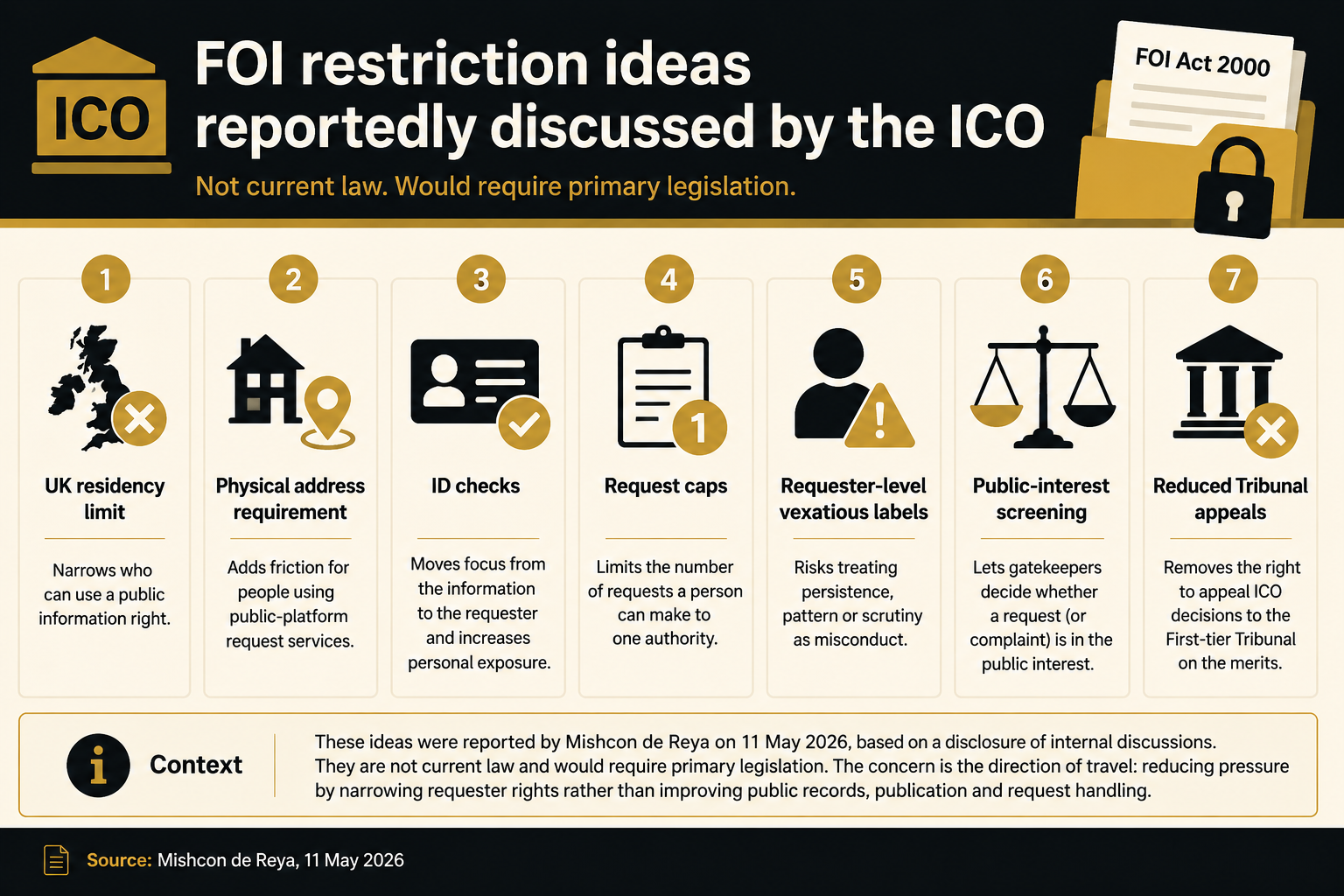
The Information Commissioner’s Office appears to have been considering ways to reduce the pressure Freedom of Information requests place on public authorities and on the ICO itself. A disclosure reported by Mishcon de Reya on 11 May 2026 described an internal discussion about possible changes to the Freedom of Information Act 2000, including ideas such as limiting FOI rights to UK residents, requiring requesters to provide a physical address, requiring identity checks, limiting the number of requests a person can make to one authority, allowing individuals rather than only requests to be labelled vexatious, introducing a public-interest test for requests or complaints, and removing the right to appeal ICO decisions to the First-tier Tribunal on the merits.
Those ideas are not current law and would require primary legislation. They are still significant because they show how the pressure around FOI is being discussed. The emphasis appears to be on requesters, request volume and institutional workload, with less attention on the condition of public records, the quality of proactive publication, and the way public authorities already handle requests.
The timing is also relevant. On 6 May 2026, the ICO published guidance for public authorities dealing with AI-generated FOI requests. The guidance said authorities were reporting more requests drafted using AI tools, including requests that may be broader, more complex, legally confused, or harder to clarify. That is a legitimate operational concern. Some AI-assisted requests will be poor. Some will quote the law badly. Some will ask for too much information at once, or fail to separate a complaint from a request for recorded information.
However, AI can also help people make better requests. It can help someone turn a vague concern into a request for recorded information. It can help remove unnecessary emotion, narrow the scope, identify the relevant body, and avoid asking for explanations where the legal right is to recorded information. For many people, especially those without legal confidence or institutional experience, that makes FOI more usable.
That distinction is important. Poor AI-assisted requests may create extra work, but better AI-assisted requests can make FOI more accessible to people who would otherwise struggle to frame a request properly.
This is not a new issue for The Reasonable Adjustment. We have already covered how section 12 can reward poor record-keeping, how the Ministry of Justice has tried to impose passport-style identity checks on FOI requesters, and how the ICO’s own FOI handling raises questions about whether it follows the standards it expects from others. Those examples are relevant because they show that FOI pressure is not only caused by requesters asking too much. It is also caused by public bodies holding information in ways that make it difficult to find, difficult to publish, and difficult to explain.
Public authorities can use better tools as well
If requesters are using modern tools to draft requests, public authorities can also use modern tools to handle them more efficiently. That does not mean allowing AI to decide whether information should be disclosed. FOI decisions require human judgment, legal reasoning and accountability. But technology can still support the administrative parts of the process, including deadline tracking, identifying similar previous disclosures, locating the relevant internal team, preparing search plans, flagging requests that need clarification, and improving consistency across responses.
There is also a much simpler way to reduce FOI pressure: publish more information before people have to ask for it. Public authorities could make better use of disclosure logs, routinely publish policies and datasets, keep grant documents and monitoring arrangements accessible, publish retention schedules, and make commonly requested information easier to find. In many cases, FOI requests are not the source of the administrative burden. They are a symptom of information not being available in the first place.
This is where the debate around AI-assisted requests can become distorted. A requester may now be able to draft a structured request in minutes. A public authority may then say it would take days to work out what it holds. In some cases, that may reflect a request that has been drafted too broadly. In other cases, it may reflect poor records management, weak search systems, inconsistent publication practices, or a lack of internal ownership over information.
Section 12 already shows the problem
Section 12 of FOIA allows a public authority to refuse a request where compliance would exceed the statutory cost limit. Used properly, it is a necessary protection. Public bodies should not be expected to spend unlimited time on requests that are genuinely too broad or too burdensome to answer.
The problem is that section 12 can also expose poor information management. If records are badly labelled, scattered across systems, held by different teams, or only retrievable through manual searches, it becomes easier for an authority to argue that a request is too costly to answer. The legal test may be about cost, but the practical difficulty may come from the authority’s own systems.
That is why the current focus on AI-generated requests needs care. A request does not become unreasonable simply because it is well structured, legally aware, or drafted with assistance. Authorities are entitled to refuse genuinely excessive requests, but they should not be able to treat every increase in requester capability as a problem with the requester.
Public bodies have had many years to improve records management, disclosure logs and publication schemes. If FOI teams are under pressure, part of the response should be investment in better systems and publication practices, not only discussion about reducing the public’s ability to ask.
ID checks would alter how FOI works
One of the most concerning ideas reported by Mishcon is the possibility of requiring requesters to provide identity evidence. That should not be treated as a neutral administrative step.
FOI is meant to be largely applicant-blind. In most cases, the identity, motive or personal background of the requester is not the point. The authority’s task is to decide whether it holds recorded information and whether any exemption applies. Requiring identity documents would shift attention away from the information and towards the person asking for it.
That has obvious practical consequences. Some requesters have legitimate reasons for keeping their legal identity separate from public FOI activity, particularly where requests are published online, indexed by search engines, or connected to sensitive disputes. This could include journalists, whistleblowers, campaigners, workers, residents in local disputes, people challenging public bodies, or people with personal safety concerns.
The risk is not only that ID checks create extra admin. It is that they deter people from making requests at all. Some people will avoid sensitive topics. Some will decide the personal exposure is not worth it. Some will simply not trust the authority they are scrutinising with more personal information than the law currently requires.
That would change the practical character of FOI. A right designed to allow access to public information would become more dependent on a requester’s willingness to identify themselves to the body they are questioning.
Public-interest screening would need serious scrutiny
The reported idea of refusing requests, or declining complaints, where they are not considered to be in the public interest also needs careful scrutiny. The difficulty is that many useful FOI requests begin with something specific, local or personal. A disabled person trying to understand an access failure, a resident asking why a council made a decision, a worker looking at recruitment data, a patient asking about policy, or a campaigner comparing public statements with recorded evidence may all begin from a particular concern.
That does not mean the request lacks wider value. A request can begin with one person’s experience and still reveal something important about how a public body operates. Some of the most useful FOI work starts with a narrow question and becomes significant because the answer exposes a wider pattern, gap or contradiction.
FOIA already has mechanisms for dealing with genuinely unreasonable requests. Section 14 covers vexatious requests. Section 12 covers requests that exceed the cost limit. Authorities can seek clarification where a request is unclear. Exemptions exist where disclosure would cause specific harms recognised by the Act. Any new public-interest screening mechanism would need to be judged against those existing powers and the risk of discouraging legitimate scrutiny.
Requester labels carry their own risk
The idea of allowing individuals, rather than only requests, to be labelled vexatious would also need close attention. We have previously written about vexatious FOI handling and lessons from Scotland, including the risk that persistence, pattern recognition or repeated challenge can be treated as improper when the underlying issue may be poor handling by the authority.
There are people who misuse FOI. Some requests are abusive, commercially motivated, impossible to process sensibly, or written in a way that creates unnecessary burden. Public authorities need workable tools for those cases. But there is a difference between misuse and persistence. A requester who compares authorities, challenges weak section 12 estimates, asks about search methodology, or follows up on previous disclosures is not automatically behaving improperly.
Any move towards requester-level labelling would need safeguards to prevent it being used against people who are simply more informed, more persistent, or more capable of identifying contradictions in public authority responses.
Better publication would reduce unnecessary requests
The most practical way to reduce unnecessary FOI pressure is to make more information available without requiring a request. That includes better publication schemes, usable disclosure logs, clearer datasets, accessible policies, published retention schedules, recorded decision-making, and better organisation of information across internal systems.
AI-assisted requests may increase volume and complexity, but they also reveal how much of the FOI system still depends on public bodies manually locating information that could often be better managed, better published, or easier to retrieve. The public’s use of technology should not become the main justification for narrowing access rights while public authorities continue operating with weak records and limited publication practices.
There will always be bad requests and difficult requesters. The Act already contains tools for dealing with them. The more important question is whether the wider system is being improved so that fewer people need to use FOI to obtain information that could reasonably have been published already.
If public bodies want fewer FOI requests, they need to make more information available without forcing people through the FOI process in the first place.
Further reading and source links
For readers who want to follow the source material and related FOI background, the links below include the original Mishcon de Reya article, a public Reddit discussion of the issue, and earlier coverage from The Reasonable Adjustment on section 12, ID demands, ICO handling and vexatious FOI concerns.
- Mishcon de Reya: Is the ICO exploring ways to gut the FOI Act?
- Reddit discussion: Is the ICO exploring ways to gut the FOI Act?
- The Reasonable Adjustment: FOI cost limit explained, section 12
- The Reasonable Adjustment: MoJ FOI ID requirement and passport demands
- The Reasonable Adjustment: ICO section 12 FOIA and its own standards
- The Reasonable Adjustment: FOI Daily, Tim Turner and 2040 Training
- The Reasonable Adjustment: Vexatious FOI lessons from Scotland


Be First to Comment