West Midlands Police Cleared Their Own Officer Over the Broad Street Arrest, Then Asked Everyone to Stop Watching
A 90-second clip filmed on Broad Street on 21 June has been watched tens of millions of times, drawn comment from Reform UK MP Robert Jenrick and Tommy Robinson, and been rewritten by content farms across Europe.
A young white man was knocked to the ground outside a Broad Street bar at about half one in the morning, then arrested by a female officer while the men who appear to have attacked him walked off. West Midlands Police reviewed themselves within about a week, cleared the officer, and asked the public to stop sharing the footage while the man they arrested is prosecuted. Their response, more than the clip, is what kept the story running.
The clip comes from Knockout Audit’s YouTube upload “Birmingham | One Mad Saturday”, filmed in the early hours of Saturday 21 June and reposted to X on 2 July. Cut-downs of it have taken several million views on X and, across TikTok, Facebook, Instagram and YouTube, probably tens of millions more. Knockout Audit’s channel, which sat at around 187,000 subscribers in mid-June according to CreatorDB’s tracking, has since passed 220,000.
Several outlets covering this treat @BrumPolice as a separate force. It is not. West Midlands Police runs area-branded accounts for local policing, so @BrumPolice is its Birmingham feed, the same as @CoventryPolice or @SolihullPolice.
What West Midlands Police have said
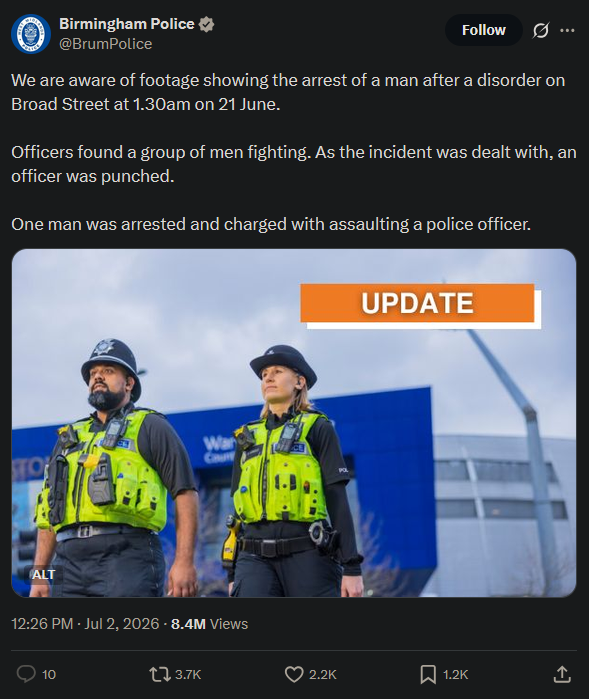
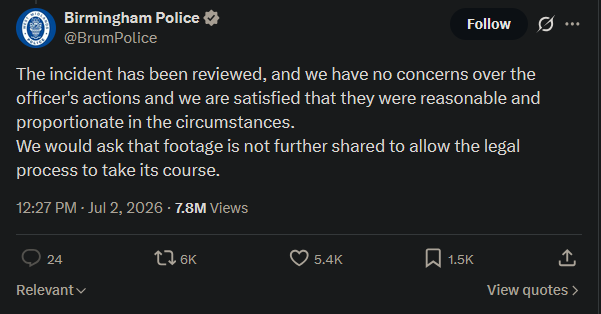
The force put out two statements on 2 July, both under the @BrumPolice account. The first said officers responded to a disorder on Broad Street at 1.30am on 21 June, found a group of men fighting, that an officer was punched while the incident was dealt with, and that one man was arrested and charged with assaulting a police officer. The second, posted shortly after as the footage spread, said the incident had been reviewed, the force had no concerns about the officer’s conduct, and the force used was reasonable and proportionate. It asked people not to keep sharing the footage while the prosecution is live.
A Community Note on the force’s post disputes the “group of men fighting” framing. It says one man was surrounded, thrown to the ground, punched while down, and then put against a wall by the officer while his attackers were allowed to flee. That reflects what a large number of viewers believe they are seeing. It is not, on its own, a verified account either. Community Notes are written and rated by X users, not by anyone with the full footage, the custody record or the CPS file. It pushes back on the force’s summary with no more independent standing than the force’s summary has.
The force’s second statement does not engage with that note. It repeats “reasonable and proportionate” and asks for the footage to stop circulating, without answering the specific claim sitting directly beneath its own post. Restating a conclusion is not the same as defending it, and treating an internal review completed in a week as the end of the matter is a stretch when the public cannot see the review, the bodycam, or the officer’s account.
The footage
The footage doesn’t show how the fight began. It does show a young white man being surrounded, knocked to the ground and struck while down. It then shows a female officer grabbing hold of him, him reacting, and him being detained while the men who appear to have attacked him are allowed to leave.
That is the part West Midlands Police have not properly explained. The force says officers arrived to find “a group of men fighting”. The clip appears to show something more one-sided: a white man on the floor after being attacked by several men, then treated by police as the person requiring restraint.
The missing lead-up may be relevant to the criminal charge. It does not explain why the apparent victim of the violence was the only person visibly detained, or why those who appear to have put him on the ground were not stopped in the same footage.
Race is part of why the video has travelled as far as it has. The man arrested is white; the men appearing to attack him are not. That does not prove that the officer acted because of race, and pretending it does would be lazy. But neither is it remotely unreasonable to ask whether the same intervention would have unfolded in the same way had the racial roles been reversed.
West Midlands Police cannot settle that question by saying its own internal review found “no concerns”. It needs to explain who officers believed had committed the initial assault, what action was taken against them, and why the man who appears to have been attacked ended up in handcuffs.
Knockout Audit and why the clip travels
The footage exists because of Knockout Audit, the channel run by former boxer Greg McGuinness, who films nightlife and street disorder around the country. Broad Street at half one on a Saturday is public space, and filming there is lawful and often useful: it records what official statements tend to smooth over. I made the same point about his Wigan footage in an earlier piece.
The incentives cut the other way too. The format runs on confrontation, and confrontation involving police, race and an arrest is the highest-value material the genre produces. CreatorDB, which tracks his growth, notes he has himself been filmed in confrontations and arrests, and that outlets including Novara Media have criticised parts of this scene for goading vulnerable or drunk people for content. That does not mean this clip was staged or dishonestly cut. It does mean the person who filmed it, edited it and timed the repost into an already hot news cycle has a direct financial stake in the most inflammatory version being the one that travels furthest, which is what happened.
The two-tier framing
The reason this clip landed as hard as it did is timing. Hampshire Police released the Henry Nowak bodycam on 2 June, roughly a month earlier. That footage showed officers handcuffing an 18-year-old who was bleeding to death and repeatedly saying he had been stabbed, while the man who had stabbed him was initially treated as the victim. The IOPC has since served gross-misconduct notices on two of the officers, and has said openly it is examining whether their decisions were affected by assumptions or prejudice tied to community tensions and to how the two families were treated. That is a watchdog, on the record, treating differential treatment by race as a live question in a death in custody.
Against that backdrop, a clip of a white man being arrested after apparently being attacked by black men was always going to be read as the sequel. Some of the accounts pushing it have gone well past the evidence: one viral post attributes an aggressive line to the officer sourced to a single tweet with no clean audio, and plenty have flatly declared the arrest racially motivated on the strength of a short clip. Calling this “Henry Nowak Mark II” borrows the credibility of a case with a confirmed independent investigation and lends it to one that, so far, has no IOPC referral, no bodycam release and no named officer.
It would be easy, and wrong, to stop there and treat “two-tier policing” as a pure invention of people who want it to be true. The underlying concern is not baseless. I have looked at part of the evidence separately in a piece on how forces record the nationality of sex-offence suspects, and the data questions there are real and mostly unanswered. The honest position is that the general concern has enough grounding to be taken seriously, and that this particular clip does not, on its own, prove it. Collapsing the two lets the police wave away the specific case and lets the loudest accounts overclaim it.
The request to stop sharing
The stated reason for asking people to stop circulating the footage is that the man is charged and the case is heading to trial. Once proceedings are active, publishing material that could prejudice a jury engages the Contempt of Court Act 1981, so the underlying caution is legitimate.
The execution was poor. The force delivered a public verdict on the officer’s conduct in the same breath as asking people not to prejudice the case. And asking millions of people to stop sharing a clip already past eight million views on one post achieves nothing except signalling there is something worth looking at, which is the opposite of what they wanted. The request added a second grievance, a suspected cover-up, which is the angle several of the pieces covering it took. The force had a legitimate point to make about an active prosecution. It had no way to make a blanket public request look like anything other than suppression.
Where this leaves things
Stripped to what is on the record, the facts are thin. One man has been charged with assaulting a police officer. Nobody else has been charged with anything. An internal police review found no fault. A large section of the public disputes that review. Nobody outside West Midlands Police currently knows enough to say who is right, because the material that would settle it, the bodycam and the full sequence, has not been released. Anyone claiming certainty in either direction is filling that gap with something other than what is on the record.
The reasonable asks are narrow and specific. Release the bodycam, subject to the contempt rules that apply to everyone. Say plainly whether the men who assaulted the arrested man are being pursued, and if not, why. And let something other than the force that employs the officer decide whether the force used was reasonable, because a week-long internal review that will not engage with the most obvious objection is not going to convince anyone who was not already convinced.
Sources
- West Midlands Police (@BrumPolice), first statement on the Broad Street incident, 2 July 2026.
- West Midlands Police (@BrumPolice), follow-up statement clearing the officer, 2 July 2026.
- Knockout Audit, “Birmingham | One Mad Saturday”, YouTube. Source footage.
Be First to Comment