Last updated on April 23, 2026
If you’re coming to this fresh, it’s worth reading the earlier background piece first, Newcastle City Council’s FOI redaction failure involving The Recruitment Junction. The live FOI thread behind this latest dispute can also be read here, Monitoring and oversight of Newcastle Fund grant NFSGR24/59 to The Recruitment Junction.
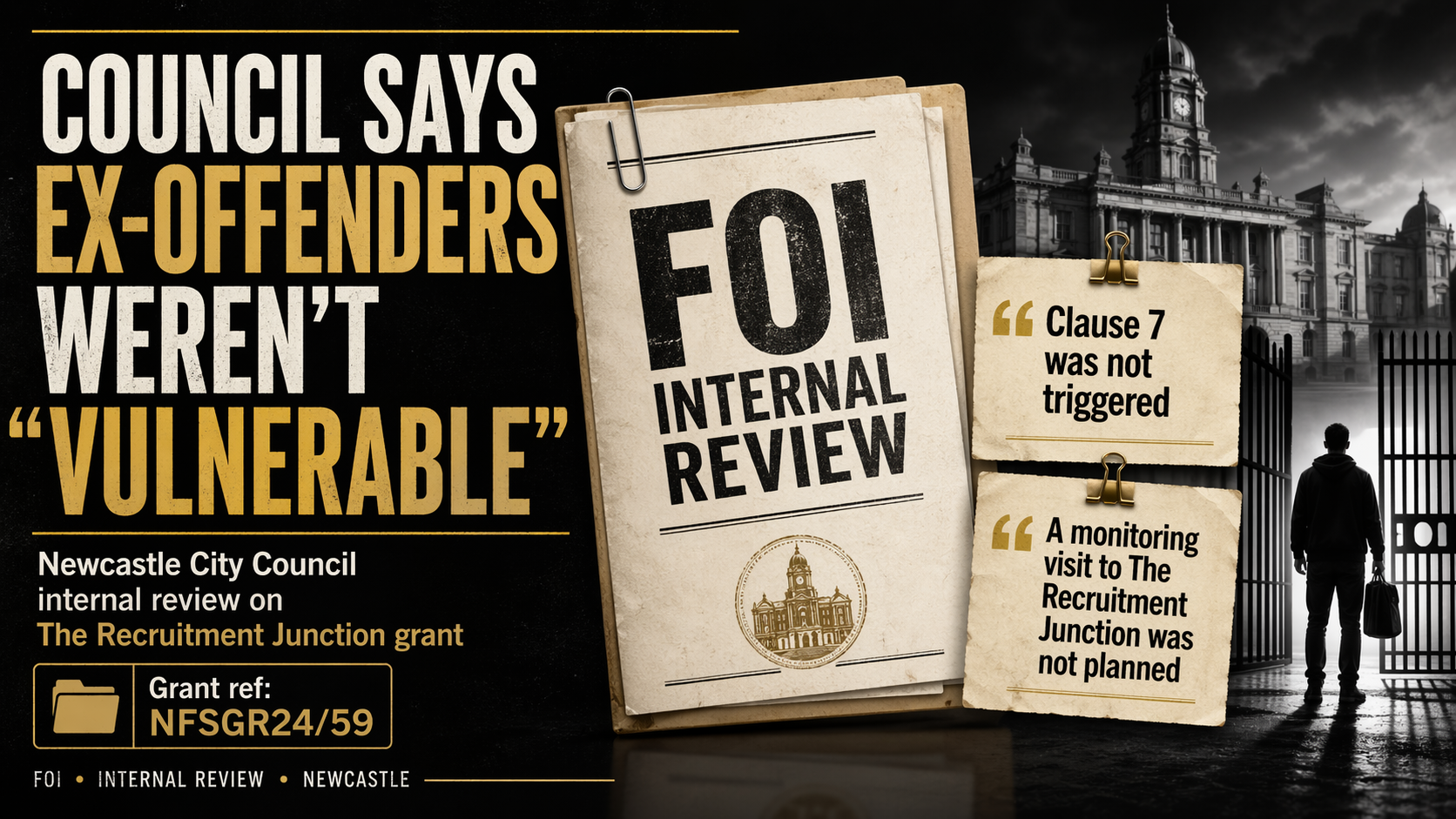
Newcastle City Council has said, in an internal review under the Freedom of Information Act, that it didn’t treat The Recruitment Junction’s publicly funded ex-offender project as involving “vulnerable clients”.
That’s not a paraphrase. That’s the Council’s actual position.
The charity received Newcastle Fund money for an “Ex-offender Job Finder” project under grant reference NFSGR24/59. The project was aimed at ex-offenders and prison leavers. Earlier disclosure also referred to hardship support including rent arrears, deposits, food parcels, utility top-ups and travel costs.
Most people reading that would assume this was exactly the sort of work that might attract closer oversight.
Apparently not.
What the Council said
In its internal review response to FOI reference 25961, dated 20 April 2026, Newcastle City Council said that while people leaving custody may face “complex personal and financial challenges”, that didn’t automatically mean they met the Council’s threshold for “vulnerable clients” under the grant conditions.
It then made its position even clearer.
The Council said Clause 7 was not triggered.
It also said a monitoring visit to The Recruitment Junction was not planned.
This isn’t just a case of the Council saying it couldn’t find the paperwork. It’s saying the extra monitoring requirement never applied in the first place.
What Clause 7 actually says
Clause 7 is part of the signed Grant Aid Conditions Form for Newcastle Fund grants. It says that if a funded organisation is providing services to clients the Council deems “vulnerable”, the organisation agrees to be subject to a monitoring visit by an appropriate Council officer at least once during the life of the grant.
It also says that this visit is additional to any usual reporting or monitoring returns.
So Clause 7 isn’t just loose wording about keeping an eye on things. It’s a specific safeguard written into the funding conditions. If the Council decides a project involves “vulnerable” clients, there should be at least one monitoring visit during the grant period.
The issue here is not that a visit should have happened but the records have somehow vanished. The issue is that the Council says the clause never kicked in at all.
That means the real question is the classification decision. Newcastle City Council is saying this project did not fall into the category that would trigger that extra layer of oversight.
Some people will bristle at the idea that ex-offenders or prison leavers should automatically be treated as “vulnerable”. In some cases, that objection will be fair enough to a point. Not every person with a conviction fits neatly into that label, and there’s no need to pretend otherwise. But that still ducks the harder fact. Criminal justice populations overlap heavily with groups that are vulnerable for other obvious reasons, including disability, learning difficulties, neurodevelopmental conditions, mental ill health, addiction, trauma and acute financial hardship. Plenty of people who end up in the system aren’t just dealing with a criminal record. They’re also dealing with autism, ADHD, poor literacy, unstable housing, substance dependence, mental illness, or a long history of being failed by institutions. So even without turning this into an argument about whether “criminal” by itself implies vulnerability, it remains striking that a publicly funded project for ex-offenders and prison leavers was treated as falling outside the clause for work involving “vulnerable clients”.
An answer with very little behind it
The internal review gives a conclusion, but not much of the reasoning behind it.
The Council said it carried out searches across relevant mailboxes using terms such as “Recruitment Junction”, “TRJ” and “NFSGR24/59”. But the disclosed response doesn’t appear to show any clear assessment explaining why this project sat outside the “vulnerable clients” threshold.
This wasn’t a generic community project with low stakes and no obvious support needs. This was publicly funded work aimed at ex-offenders and prison leavers, with project reporting that referred to hardship support and emergency-style practical help.
Yet the Council’s line is that none of that was enough to trigger the vulnerable-client monitoring clause.
That is a remarkable line for a council to take.
What exactly counts, then?
The awkward question for Newcastle City Council is a simple one.
If an ex-offender charity running a job-finder project for prison leavers doesn’t count, for these purposes, as working with “vulnerable” clients, then what does?
The internal review doesn’t really answer that.
No one’s saying every ex-offender automatically falls into one neat category. That would be sloppy. But councils use the language of safeguarding, hardship, inclusion and support all the time. Once the FOI requests go in, the question becomes much simpler.
What did you actually class this project as, what oversight followed from that decision, and where’s the recorded reasoning?
In this case, the answer appears to be that Clause 7 wasn’t triggered, no monitoring visit was planned, and the Council is content to leave it there.
That shouldn’t just be waved through.
Part of a bigger pattern
This doesn’t sit in isolation. It lands in the middle of a wider trail of reporting and disclosure around The Recruitment Junction, its public funding, and the way public bodies have handled records linked to it.
Earlier reporting on Newcastle City Council’s FOI redaction failure involving The Recruitment Junction already raised questions about disclosure standards, missing oversight records, and the gap between what the grant paperwork appeared to promise and what the Council was actually able to show.
That sat alongside earlier coverage of the Charity Commission’s response concerning The Recruitment Junction.
There was also the earlier piece, Caught in 4K, The Recruitment Junction and public funding, which looked at the money side of the story and why scrutiny of this charity didn’t come out of nowhere.
More broadly, this fits a recurring pattern in FOI work. Institutions often sound confident in public, but when the paperwork is tested, the answers narrow fast. That same pattern cropped up in other reporting, including High-Viz Kim and the Japan trip FOI, where the official line and the underlying records didn’t sit together nearly as neatly as they should’ve.
Fresh questions now sent to the Council
Following this internal review, a fresh FOI request has now been submitted to Newcastle City Council seeking to pin down the basis of its Clause 7 approach more generally.
That request asks how many Newcastle Fund grants were actually treated as falling within Clause 7, how the Council decides whether a project involves clients it deems “vulnerable”, who makes that decision, how it is recorded, and what a Clause 7 monitoring visit by an “appropriate officer” is supposed to involve in practice.
Because if the Council is going to say this ex-offender project sat outside that category, the obvious next step is to ask what does fall inside it, and on what basis.
What’s now on the record
After this internal review, three points are now clearly on the record.
- Newcastle City Council didn’t automatically treat the ex-offender beneficiaries of this project as meeting its threshold for “vulnerable clients”.
- The Council says Clause 7 wasn’t triggered.
- The Council says no monitoring visit to The Recruitment Junction was planned.
That leaves a fairly obvious question.
If this sort of project didn’t qualify for vulnerable-client monitoring, what exactly would?
Because once you strip away the grant jargon, that’s what this comes down to. A charity received public funding for work with ex-offenders and prison leavers. The project reporting referred to hardship support. But the Council’s own internal review says that still didn’t amount to work with “vulnerable clients” for the purpose of triggering a monitoring visit.
That goes straight to the heart of how Newcastle City Council understands risk, oversight and accountability in grant-funded work.


Be First to Comment