Last updated on July 15, 2026
Update, 29 June 2026: Three days after this article was published, the DWP announced that face-to-face and telephone PIP and other disability benefit assessments would be audio-recorded automatically unless the claimant opts out.
The Reasonable Adjustment · Accountability
You get refused, you read the report, and it bears no resemblance to what you said on the call. If that’s happened to you, the instinct is to assume you got a bad assessor on a bad day. Sometimes you did. But the company doing the assessment isn’t making it up as it goes. It’s delivering a service under a written contract with the Department for Work and Pensions, and that contract spells out, in plain numbered clauses, what it has to do for you. The standard’s there. You were just never handed it.
If your assessment is coming up, do this first
Request a recording of your assessment, in writing, before it happens.
They won’t record it by default. If you don’t ask, there’s no recording, and if the report later misquotes you, you’ll have nothing to prove it. Most refusals get challenged, and a recording is your strongest evidence when they do. So it’s worth asking now, in writing, and keeping the email. The rest of this explains why, and what else the contract entitles you to.
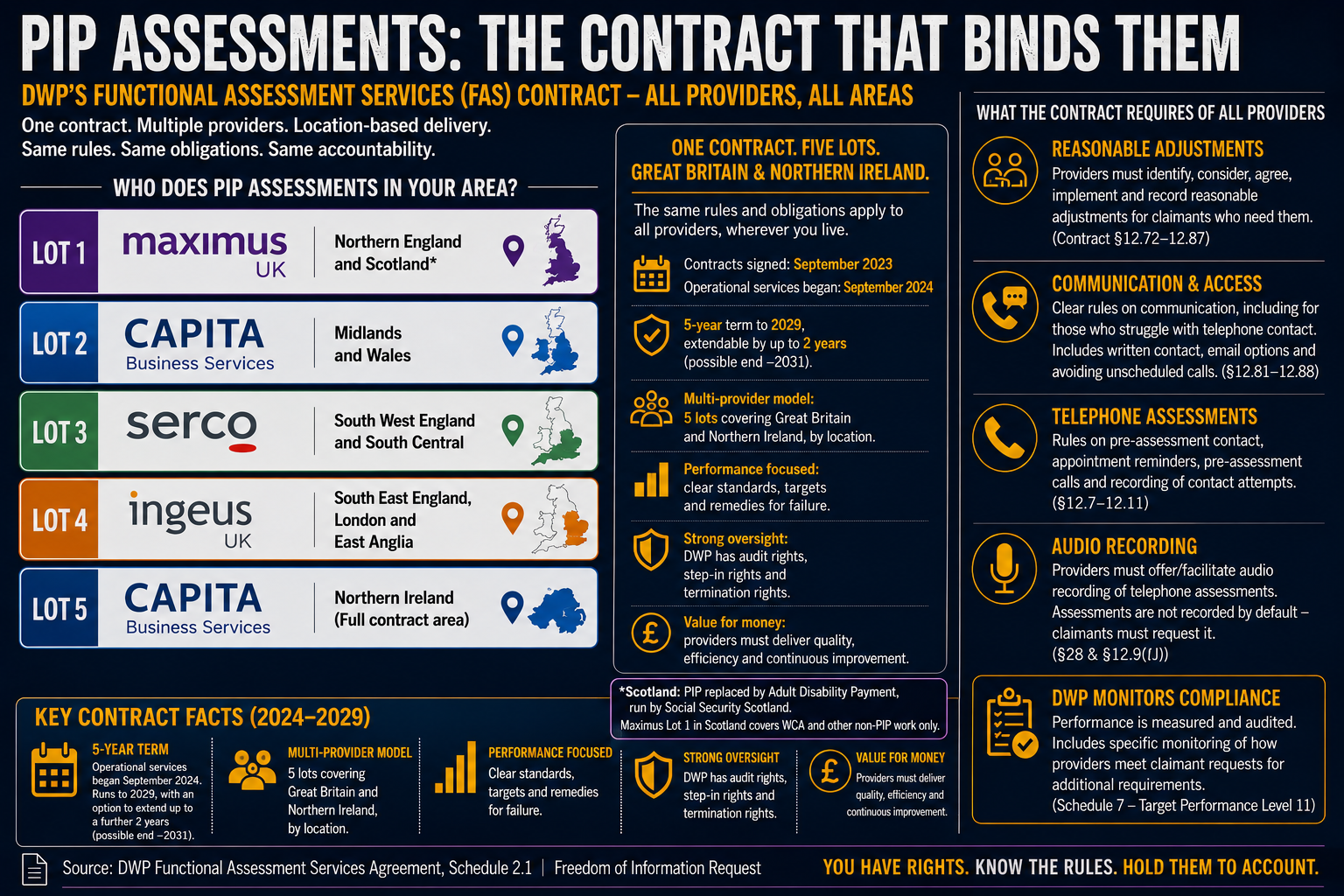
This is about that contract: what it requires, and how you can hold a provider to obligations it would rather you didn’t know about. It covers England, Wales and Scotland, where these assessments are run by private firms under the Functional Assessment Services contract. The current contracts run 2024 to 2029. Across Scotland and the north of England the provider is Maximus. In the Midlands and Wales it’s Capita, in the south east Ingeus, and in the south west Serco. They all work under the same contract, so most of this applies wherever you are.
The numbers nobody puts in front of you
It helps to start with how often a wrong refusal actually gets put right at the stage that’s meant to put it right.
Now compare that with what happens to the same decisions in front of a tribunal that doesn’t work for the DWP.
A decision the DWP swears is correct gets overturned two times out of three the moment someone independent looks at it. That’s not claimants getting lucky. It’s a first stage that doesn’t apply its own standard, and a system that makes you go a very long way before the rules count for anything. The contract’s one of the few things that lets you force the issue early, because you can point at a numbered clause and say: this is what you had to do, and this is what you did instead.
The contract’s public, and you can read it yourself
The Functional Assessment Services agreement isn’t a private arrangement between Maximus and the DWP. It’s published on the government’s contract services, and the DWP has confirmed in a Freedom of Information response that this is the document setting out the provider’s obligations on reasonable adjustments, communication with claimants, telephone assessments and recording. You don’t have to take anyone’s word for what the standard is. You can read the clause, quote it back, and attach it. The Maximus contract document is here on Contracts Finder, and the FOI response confirming it governs these obligations is here on WhatDoTheyKnow.
That’s really the heart of it. When a letter tells you an adjustment is a customer service matter, or that you can only use email once it’s been agreed, or that they can’t help with a recording, you can check it against a document the provider is bound by. Hardly anyone does, because hardly anyone’s told there’s anything to check. Here are the clauses that come up most.
What the contract makes them do
Reasonable adjustments, and the 48-hour rule
The contract calls the things you need in order to take part fairly your “additional requirements”, and it does not treat meeting them as optional.
The provider must meet any reasonable additional-requirement request made with at least 48 hours’ notice before the consultation.
How well they do this is scored against a contractual target the DWP tracks, called Target Performance Level 11. The Department keeps count of how often the provider gets it right.
The next clause is the one they least like being reminded of.
Where a requirement cannot reasonably be met, the provider “shall not undertake the Consultation”. It has to rearrange to a time it can meet the requirement, and give written notice.
If they can’t give you the adjustment, the contract does not let them push on with the assessment anyway. It tells them to rearrange. An assessment that goes ahead in the exact format you asked, in time, to avoid is a breach of this clause, not a misunderstanding.
Telephone barriers and how you get contacted
If the telephone itself is part of your disability, which is common with autism, anxiety and plenty of other conditions, the contract doesn’t leave it to chance.
Where your preferred method of contact is known, the provider must use it wherever reasonable.
The DWP passes your preferred contact method to the provider where it has it. If you’ve disclosed a telephone barrier, that disclosure is the known preference this clause is about.
The provider must communicate accessibly with disabled claimants and provide alternative formats, expressly “in line with the Equality Act 2010”.
The contract names the Equality Act itself. Accessible communication is written in as a requirement, not offered as a favour.
Recording your assessment
You can ask for your assessment to be recorded, and the contract sets out what’s supposed to happen next. A recording is the one thing that lets you hold the report up against what was actually said.
On request, the provider must record the assessment, give you a copy, and note on its own report and IT system that it was recorded. You can ask in advance, and you can ask to use your own equipment if you tell them first.
This doesn’t happen automatically. Asking for a recording before the assessment is the single most useful thing you can do. If the report later claims something you didn’t say, the recording proves it. Nothing arriving, or a blank disc, does not count as meeting this.
One figure puts the recording in its place. In the first half of 2024, around 1.4 per cent of PIP assessments were recorded.
Read this twice
They won’t record your assessment unless you ask. Recording is off by default.
Unless you request it in advance, there’s no official recording of your assessment. That means if the report says something you didn’t say, scores you on words you never used, or leaves out what you did say, you’ve nothing to check it against. It’s your account against the assessor’s write-up, and the write-up is what the decision maker reads.
Around four in five people who are refused go on to challenge it, and the gap between what was said and what was written is the single most common reason a report falls apart at reconsideration or tribunal. A recording is how you prove that gap. Without one, you’re starting that fight with one hand tied.
So it’s well worth requesting the recording, in writing, before your assessment, every time. Name paragraph 28, and keep the email. It costs you nothing, and it’s the difference between “I remember it differently” and “here’s the recording.” Don’t assume it happens automatically, because it doesn’t.
How to use it
Knowing the clauses is only half of it. The value’s in putting them on the record at the right moment, in writing, so there’s a paper trail nobody can later pretend away.
Before the assessment
- Keep everything in writing, and dated. If the telephone’s a barrier, say so in writing and ask for your adjustment more than 48 hours ahead. That timing is what triggers paragraph 12.72.
- Ask for the recording in advance, in writing. This is the big one. It’s off by default, so if you don’t ask, there’s no recording. Name paragraph 28, and keep the email.
- Say how you need to be contacted. Put it in writing so paragraph 12.84 is in play.
If they refuse or push on anyway
- Quote the clause back at them. Told an adjustment is discretionary? Point to 12.72 and 12.73. Assessment going ahead in the format you flagged? Ask in writing why it wasn’t rearranged, as 12.73 requires.
- Keep their replies. A letter that misstates the standard becomes your evidence the moment you can show what the standard really is.
- Going ahead under pressure isn’t agreement. If you attend because you’d no real alternative, say so at the time, in writing. Compliance under pressure isn’t consent.
After a refusal
- Get the recording if you haven’t. A blank or unusable copy is a failure against paragraph 28, worth raising as its own complaint.
- Complain in contractual terms, not just hurt ones. “You breached paragraph 12.73 of your contract with DWP” is harder to brush off than “I was treated unfairly”, even when both are true. Ask the provider directly how your case was scored for Target Performance Level 11.
- Keep going. One in five at reconsideration, two in three at tribunal. A knock-back at reconsideration isn’t the end. For most people who win, it’s the middle.
What the contract will not do
It’s a tool, not a magic wand, so it’s worth being straight about it. The clauses bind the provider to the DWP, so your direct lever is a complaint to the provider and, behind it, the DWP’s interest in whether its contractor is meeting standards it pays for. A provider might argue that wanting to avoid the phone entirely is a question of which assessment channel is used rather than an additional requirement for one appointment. You may meet that argument. But the communication duties in 12.84 to 12.87 don’t turn on it, and making a provider engage with its own contract, on the record, is worth something on its own. The contract sits alongside your other rights, the Equality Act duty, your data protection rights, your right of appeal. It strengthens them. It doesn’t replace them.
You were judged against a standard you were never shown. It’s public, it’s specific, and it’s yours to use. So read it, quote it, and hold them to it.
The clause card
A quick reference you can keep, screenshot, or take into an appointment.
FAS contract: your quick reference
The clauses Maximus and the other FAS providers are bound by. Public document, Schedule 2.1, on Contracts Finder. Quote the paragraph number when you write to them.
Remember: about 1 in 5 reconsiderations change the award; about 2 in 3 appeals are overturned at tribunal. A refusal is not the end. — The Reasonable Adjustment
Sources: DWP, Personal Independence Payment Official Statistics (reconsideration change rate); HM Courts & Tribunals Service, Tribunal Statistics Quarterly (appeal overturn rate); DWP published figures on PIP assessment recording. The Maximus FAS contract document is on Contracts Finder; the FOI response confirming it governs these obligations is on WhatDoTheyKnow. Clause numbers are given so you can find and check each one. This is general information, not advice on your case. For that, speak to a welfare rights adviser, Citizens Advice, or a solicitor.
Further reading from The Reasonable Adjustment
- FOI reveals disabled job applicants lost in recruitment data gap Public bodies logged almost 100,000 recruitment adjustment requests, but many couldn’t say how many they actually provided.
- What autistic applicants can ask for before a job interview A council’s FOI disclosure surfaces a practical storyboard adjustment autistic applicants can request in advance.
- The Cheshire West ruling shows how disabled people lose liberty quietly The Supreme Court has scrapped Cheshire West. What that means for autistic people, learning disabilities, and deprivation of liberty safeguards.
- How long do British councils keep SEND records? FOI responses show councils holding education and SEND records for decades, with refusals, missing guidance, and patchy governance.
- Ex-offender project didn’t trigger safeguard, says Newcastle Council In an internal review, the council says a grant-funded ex-offender project never triggered its “vulnerable client” monitoring under Clause 7.

Be First to Comment