Last updated on December 22, 2025
By Kieron JH · The Reasonable Adjustment
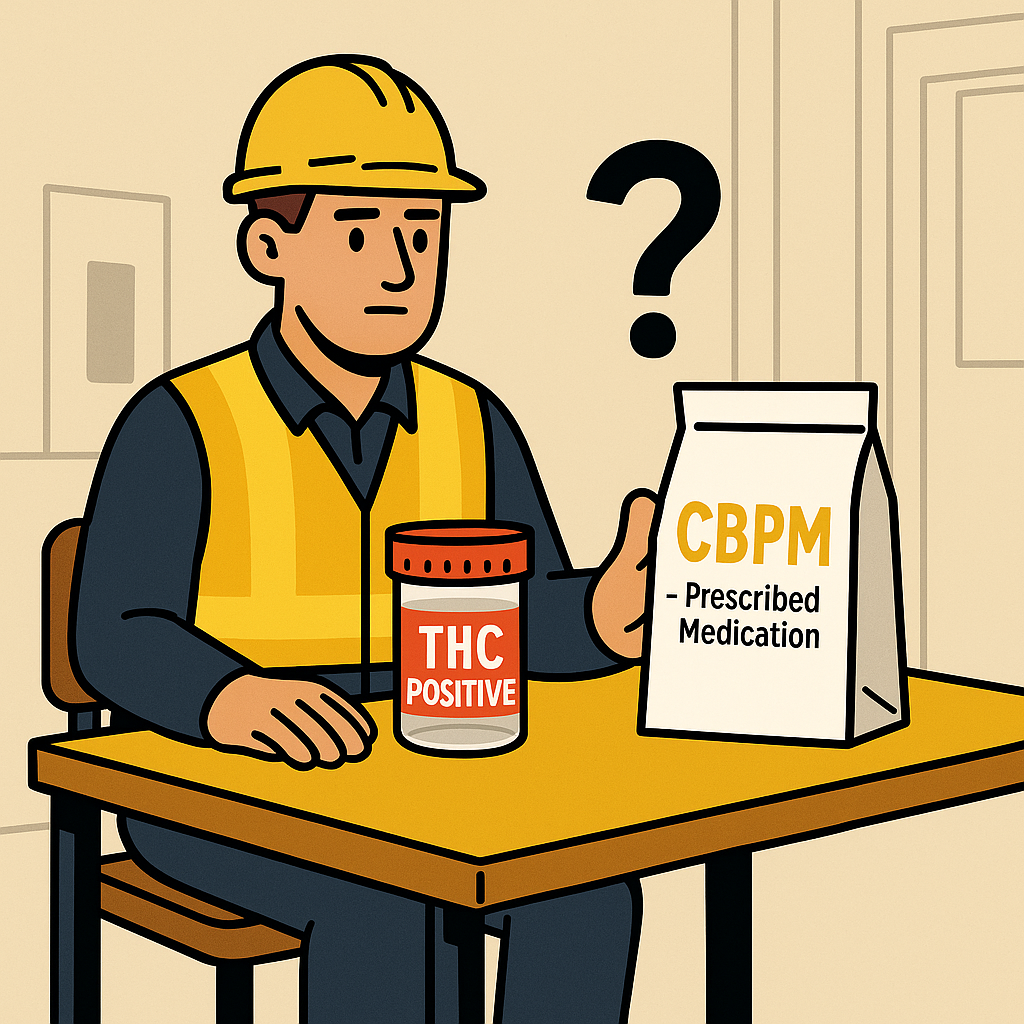
Short version: if you are prescribed cannabis based products for medicinal use (CBPM), a workplace drug test will almost always show THC. That does not automatically mean you are impaired, unsafe or in trouble. UK employers have legal duties around health and safety, disability and fair process. Those duties still apply when the drug on the lab report is cannabis.
This article is information, not legal advice. If your job or livelihood is at risk, speak to a solicitor or a specialist advice service as well as reading guides like this one.
At a glance
- CBPM is legal in the UK when prescribed by a specialist, and sits in Schedule 2 of the Misuse of Drugs Regulations 2001.
- Standard workplace drug tests are built to detect past cannabis use, not real time impairment.
- Many CBPM patients are disabled under the Equality Act 2010, so sudden punishment for a positive THC test can raise discrimination issues.
- Employers have to think about impairment and risk, not simply the presence of a metabolite in urine or saliva.
- Occupational health should focus on whether you are safe to do your job, not whether a lab machine has spotted THC at any level.
- You are allowed to ask for a fair process, reasonable adjustments and a proper explanation before anyone moves to discipline or dismissal.
1. What CBPM actually is, in law
Since November 2018, certain cannabis based products for medicinal use in humans have been placed in Schedule 2 of the Misuse of Drugs Regulations 2001. They remain controlled drugs, but can be prescribed legally by specialist doctors where the strict regulatory criteria for a CBPM are met.
The important points for employment are simple.
- A valid CBPM prescription means lawful possession and use.
- The product is a controlled drug, but also a prescribed medicine.
- Most CBPM patients have long term health conditions that will usually meet the definition of disability under the Equality Act 2010.
Employers do not get to pretend that CBPM is the same thing as someone smoking illicit cannabis in the car park. In legal terms, you are a patient on a tightly regulated medicine.
2. THC detection windows and why tests keep flagging you
Workplace tests for cannabis are really tests for THC and its metabolites. Those markers stay in the body far longer than alcohol or many other drugs. Typical approximate windows are:
- Urine: from around 3 days up to 30 days or more in regular users.
- Saliva: roughly 6 to 30 hours, sometimes a little longer with heavy use.
- Blood: often up to a week, depending on dose and pattern of use.
- Hair: up to 90 days, occasionally longer where hair samples are long.
The key point is brutal and often ignored: a positive THC test tells your employer that you used cannabis at some point in the last few days or weeks, not that you are impaired while standing in front of them.
That gap between presence and impairment is where many CBPM patients end up harmed by policies that were never written with prescribed cannabis in mind.
3. How workplace drug testing actually works
Most UK employers who test for drugs use a two step process.
- Screening test on site using a urine or saliva kit that shows a positive or negative line for a panel of drugs.
- Confirmatory laboratory test if the screen is positive, where a laboratory uses more accurate methods and reports a concentration.
These systems were designed with illicit use in mind. They are good at ticking a box that says “cannabis detected” and terrible at answering the real questions that matter in law:
- Is this person actually impaired at work today.
- Does their prescribed medicine make their specific job unsafe.
- Have we treated them consistently compared with colleagues on other sedating drugs like opioids or benzodiazepines.
That is why trade unions, professional bodies and safety specialists increasingly stress that drug testing should not be used as a blunt instrument. Testing is one tool, not the whole risk assessment.
4. The legal framework: more than one law in play
When a CBPM patient is drug tested at work, there are several overlapping areas of law.
4.1 Misuse of Drugs and CBPM
Cannabis itself is still a class B drug, and possession without a prescription remains a criminal offence. A CBPM that meets the regulatory definition and is prescribed by an authorised prescriber sits in Schedule 2 of the Misuse of Drugs Regulations 2001, which permits lawful use under professional control.
For employment, that means a positive THC result is not automatically evidence of illegal drug use. If it reflects prescribed CBPM taken as directed, the starting point is that you are acting lawfully.
4.2 Health and Safety at Work
Employers have a duty to protect the health and safety of employees and others affected by their business. That duty covers impairment from legal or illegal drugs, alcohol, fatigue and medical conditions.
In practice that means employers should:
- Identify safety critical roles where impairment could cause serious harm.
- Assess risk on the basis of current fitness, not simply the existence of a prescription.
- Use drug testing only where it adds meaningful information about risk compared with less intrusive methods.
4.3 Equality Act 2010 and disability
Most CBPM prescriptions are issued for long term conditions such as chronic pain, multiple sclerosis, epilepsy, inflammatory bowel disease, neurological or psychiatric conditions. Those will often meet the legal definition of disability: a substantial and long term adverse effect on normal day to day activities.
If you are disabled in this sense, your employer has legal duties to:
- Avoid direct and indirect disability discrimination.
- Avoid discrimination arising from disability, for example where something linked to your condition leads to worse treatment.
- Consider and implement reasonable adjustments so you can stay in or access work.
Penalising a disabled worker simply because a generic test shows THC from prescribed medication, without looking at impairment, role and alternatives, is a textbook example of where Equality Act problems can arise.
5. What employers can and cannot reasonably do
The detail will always depend on the job, the policy and the facts. However, there is a useful line between what is usually reasonable and what should ring alarm bells.
| Generally reasonable | Potentially unlawful or unreasonable |
|---|---|
| Having a clear, written drugs and alcohol policy that is shared with staff. | Relying on an old policy that treats all cannabis as illicit with no mention of CBPM. |
| Testing staff in safety critical roles, or after incidents, as part of a wider safety system. | Randomly testing only one worker because managers discovered that they use prescribed cannabis. |
| Seeking occupational health advice where a drug test is positive and there is a prescription involved. | Skipping occupational health and going straight to suspension or dismissal based on the lab report alone. |
| Discussing timing, dosage and duties with the worker and their prescriber, and adjusting shifts if needed. | Insisting the worker stops prescribed medication entirely as a condition of keeping their job. |
| Moving a worker temporarily away from a narrow safety critical task while an assessment takes place. | Ignoring available alternative duties and treating any THC finding as gross misconduct. |
| Considering CBPM alongside other sedating medication when assessing risk. | Treating CBPM as uniquely unacceptable while accepting similar risk from other prescription drugs. |
If an employer is using a positive THC test as a blunt weapon rather than the start of a fair process, that is a sign that their approach may not be compatible with modern guidance on workplace drug and alcohol management.
6. Occupational health: what a sensible assessment looks like
In a good system, a positive test for THC in a CBPM patient is followed by an occupational health assessment, not instant punishment. Occupational health is there to advise on fitness for work, not to police your private life.
A competent assessment should look at:
- Your underlying condition and how it affects you without medication.
- The specific CBPM product, route, dose and timing.
- Your job role, including any safety critical tasks.
- Whether there is evidence of actual impairment at work, such as slowed reactions, confusion or near misses.
- Any other medications that might interact with CBPM.
- Possible adjustments, such as moving certain tasks to earlier or later in the day.
What occupational health should not do is issue a blanket conclusion that “cannabis is detected, therefore the worker is unfit”, without context or individual assessment.
7. Reasonable adjustments for CBPM patients
If your condition falls within the Equality Act definition of disability, you can ask your employer to consider adjustments that reduce risk without forcing you to choose between work and treatment.
Examples of reasonable adjustments might include:
- Agreeing dosing times that minimise any sedating effect during working hours.
- Moving you away from the very highest risk tasks if there is a genuine safety concern that cannot be managed in another way.
- Allowing regular breaks to manage pain, spasticity or other symptoms that CBPM is prescribed for.
- Updating the drugs and alcohol policy so that CBPM is treated in line with other prescribed medicines.
- Replacing blanket urine testing with a more nuanced approach in non safety critical roles.
- Allowing a phased return to safety critical work after dose changes or titration.
An adjustment does not have to be perfect. It has to be logical, practical and not unreasonably difficult or expensive for the employer. What is never reasonable is treating a disabled worker as a problem to be removed because their medicine makes the paperwork awkward.
8. Building a simple evidence pack as a CBPM patient
If you are on CBPM and there is any chance of workplace testing, it is worth quietly building a small evidence pack so you are not scrambling if something happens.
Useful items include:
- A copy of your prescription, clinic summary or treatment plan that clearly shows the product, dose and prescriber.
- Any letter from your clinic that explains CBPM is legally prescribed and sets out general advice on safety.
- A copy of your employer’s drugs and alcohol policy, saved somewhere you control.
- Notes of any conversations where you told management or HR about your prescription and condition.
- Emails you have sent in advance, informing your employer that you are on CBPM and are happy to discuss any concerns.
- A brief symptom and dosing diary, especially if you work in a safety critical role.
You do not need to dump all of this on your manager on day one. The point is to have clear, consistent information ready if a test result becomes an issue.
9. If you are asked to take a drug test
Here is a calm, structured way to approach a test request if you are on CBPM.
- Stay calm and cooperate. Refusing a test outright can create separate disciplinary problems unless there is a clear reason.
- Flag your prescription early. Tell the tester or manager before the sample is taken that you are on prescribed CBPM and note their response.
- Do not argue at the collection point. The person taking the sample rarely has any discretion. Save your arguments for HR and occupational health.
- Ask for the policy and the laboratory process in writing. You are entitled to understand what they are testing and what they will do with the results.
- Request occupational health involvement if the test is positive and the employer proposes action.
- Ask for a written explanation of any disciplinary allegations that follow. “You tested positive” is not enough by itself.
- Keep your own notes of dates, conversations and who said what. Do not rely on the organisation to keep a fair record.
You are not trying to game the system. You are asserting the basic expectation that any response will be evidence based, disability aware and grounded in current law rather than stigma.
10. If things go wrong
If an employer rushes to suspend, discipline or dismiss you based purely on a THC result, it is usually a sign of deeper problems with their approach to disability and risk.
Steps you can consider include:
- Raising a formal written grievance that clearly sets out your disability, prescription, and where you believe the process has been unfair.
- Requesting copies of all test results, occupational health reports and relevant emails under your data rights.
- Asking for trade union support if you are a member.
- Seeking advice from an employment solicitor or law centre, particularly if you are facing dismissal.
- Keeping your GP or specialist informed, so they understand the work impact and can document it.
Sometimes a firm but informed push is enough to make an employer pause, take proper advice and course correct. Sometimes it is not. Either way, you do not have to carry the situation alone or accept the idea that being a patient automatically makes you a problem employee.
11. Why this matters beyond CBPM
CBPM exposes a wider problem that has been quietly present for years. Many UK workplaces are still using drug and alcohol systems built for a different era, where the focus was on catching “wrongdoers” rather than managing safety, health and rights in a grown up way.
Medical cannabis simply makes the contradiction obvious. You cannot claim to treat disabled staff fairly while treating a prescribed medicine as evidence of misconduct by default.
If you are a worker on CBPM, you are not asking for special treatment. You are asking for your employer to catch up with the law, current medical practice and basic fairness. That is the minimum standard, not a luxury.
References and further reading
- NHS England: Cannabis based products for medicinal use (CBPMs)
- Home Office: Controlled drugs list and CBPM scheduling
- Department for Transport: Medical cannabis and road safety
- TUC: Drug testing in the workplace
- HSE: Managing drug and alcohol misuse at work
- Institute of Occupational Health: Medicinal cannabis and safety critical work
CBPM Cost and Dosage Prototype, understand your THC intake
Trying to work out how much THC you’re actually using, what it costs, and whether a tolerance break might help? I built a simple tool that turns your prescription details into something you can actually reason about.
- Estimate THC per day and per month (based on your product and usage)
- Spot when “creeping tolerance” is doing the spending for you
- Plan tolerance breaks with real numbers, not vibes
- Budget your CBPM costs without spreadsheets and headaches
Be First to Comment