
A University of Arizona paper, published online in December 2024, tested four cannabis-derived terpenes in mice. The researchers used two laboratory models: a small paw incision to model post-operative pain, and a drug-induced state intended to reproduce some features of fibromyalgia. All four terpenes made the mice less sensitive to pressure, with geraniol producing the strongest overall effect. Unlike THC, these compounds are not associated with THC-like psychoactive effects. A University of Arizona release resurfaced on ScienceDaily this month, prompting a simple question: if geraniol stood out in these experiments, can a UK patient actually find it?
The answer is yes, technically, once. Out of 449 flower listings in TheGreenAvenger’s Medicann formulary tracker, exactly one names geraniol among its reported terpenes. Whether it is actually available to order is a separate, faster-moving question, covered below.
The study
John Streicher’s lab at the University of Arizona College of Medicine tested geraniol, linalool, beta-caryophyllene and alpha-humulene. The paper describes “mouse models of post-operative pain and fibromyalgia”, which does not mean the mice literally had either condition.
For the post-operative model, the researchers made a small incision in a mouse’s paw. For the fibromyalgia model, they used reserpine, a drug treatment used in research to create heightened pain sensitivity resembling some features of fibromyalgia. After those models were established, each mouse received one terpene. The researchers then used calibrated filaments to test how much pressure the mice tolerated over the next three hours.
All four terpenes raised that pressure threshold. In plain English, the treated mice became less sensitive to pressure. Geraniol produced the largest overall change. The other terpenes also showed effects, but the exact order varied between the two models, so a neat one-to-four ranking would overstate what the paper shows.
The team also tested a possible biological pathway. When mice were given istradefylline, which blocks the adenosine A2a receptor, the terpene effect disappeared. That suggests this receptor was involved in the observed effect in these mice. It does not establish that the same mechanism, dose or result will apply in people.
This is preclinical research, not a human trial. It did not test people with fibromyalgia, compare geraniol with THC, or test any UK prescription product. This piece is about whether the market gives patients enough information to identify a compound that has drawn research interest, not about what anyone should take.
What’s actually on the market
TheGreenAvenger’s Medicann formulary is a patient-facing tracker built from MedBud product information. It records details including brand, cultivator, price, THC, CBD and, where supplied, terpene information. Of the 449 flower listings in the dataset used here, 338 report at least some terpene content. The remaining 111 are marked “Not Listed”.
That limitation is important. A terpene missing from a product listing is not proof that it was chemically absent from the flower. It may not have been tested for, may not have been included in the product information, or may simply not appear in the dataset. The figures below show what was reported on listings, not the true chemical prevalence of each terpene across the UK market.
Across those 449 listings:
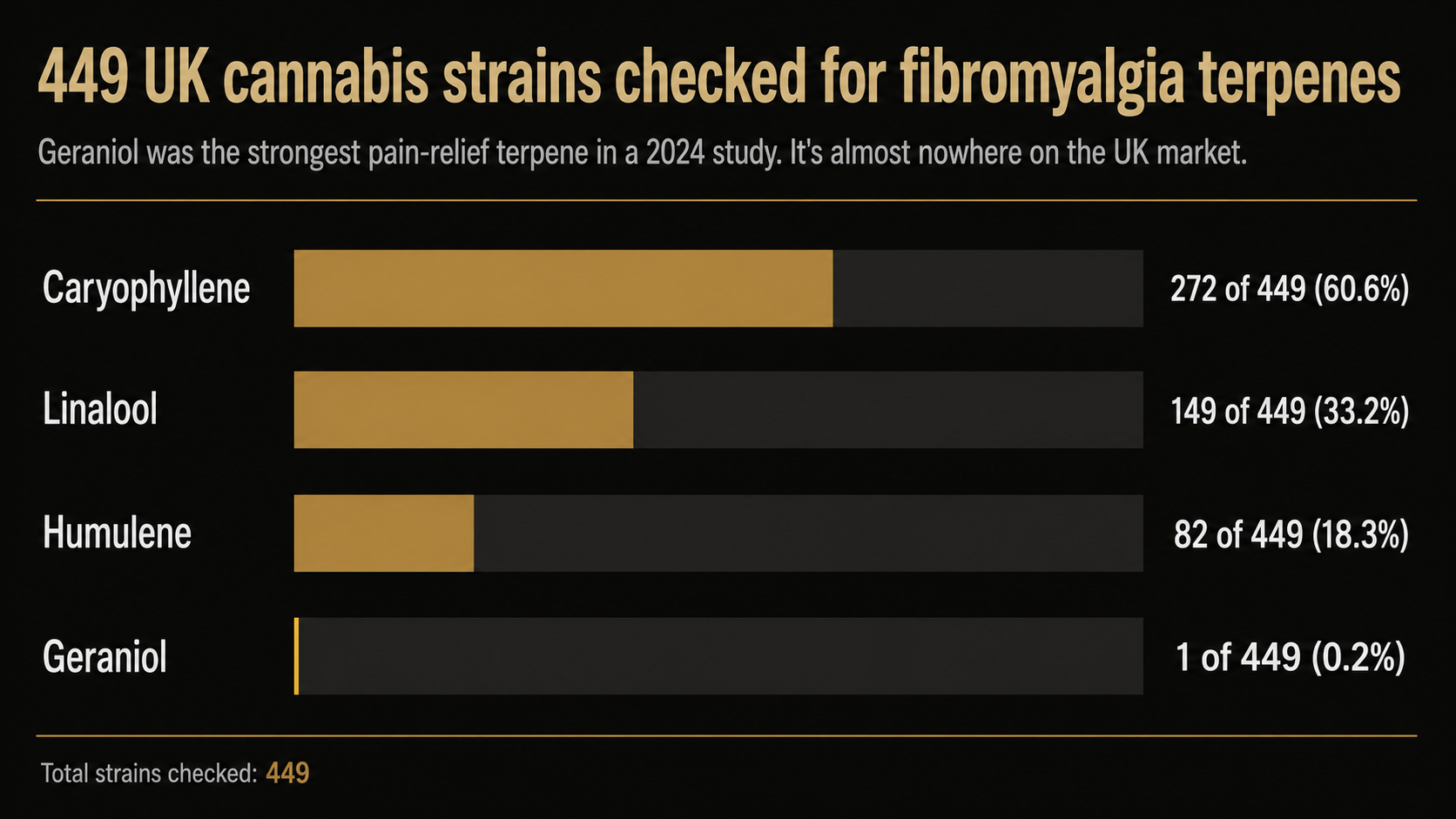
- Caryophyllene: 272 products (60.6%)
- Linalool: 149 products (33.2%)
- Humulene: 82 products (18.3%)
- Geraniol: 1 product (0.2%)
That one geraniol-listed product is Chapel of Love, grown by Herdade Das Barrocas in Portugal and listed at 29% THC. On this dataset, it is the only flower carrying all four terpenes studied by the Arizona team. At the time of writing it was listed as out of stock on TheGreenAvenger’s tracker. Stock changes constantly, so check the MedBud link directly for the current position.
Twenty-four other products carry three of the four, caryophyllene, humulene and linalool, without geraniol. The full list:
Source: TheGreenAvenger Medicann Formulary product data, accessed 28 June 2026. A tick means the terpene was named on the product listing. It does not show the concentration, and a dash does not prove the terpene was chemically absent. 111 of the 449 flower listings had no terpene information at all. Click a strain name to view its current listing, including current stock, on MedBud.
Not on the menu, even when it’s in the building
There is a separate, narrower issue. My own account with Medicann, a UK medical cannabis clinic, lets patients filter available products by terpene. The list of filter options is fixed.
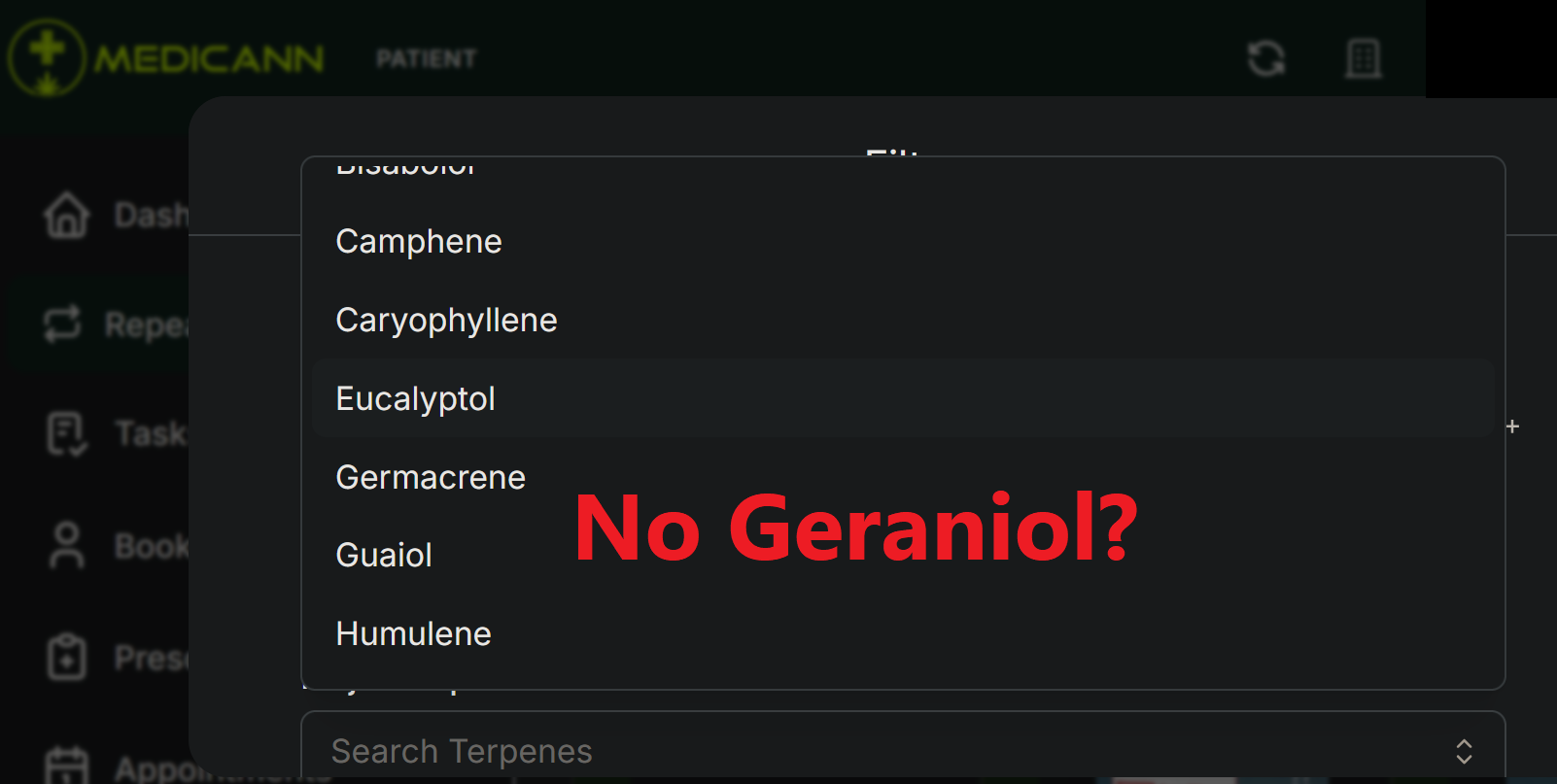
This should not be read as evidence that geraniol is absent from the UK market. The tracker shows one listing that names it. What the screenshot shows is more limited: on at least one clinic platform, a patient browsing the available range cannot filter for geraniol because it is not offered as a search option.
The screenshot cannot tell us why that option is missing. It may reflect the clinic’s chosen list of tags, the way its product data is supplied, or the current range. But the practical effect is clear: a patient cannot use that filter to look for geraniol. Alongside the incomplete listing data above, it shows how difficult it is to turn a research finding into a straightforward product search.
A non-intoxicating option, not a replacement for THC
The “without the high” angle is understandable, but it is easy to overread. A compound without THC-like psychoactive effects could be useful for patients who prefer to avoid impairment. That does not make it a universal upgrade on THC-containing medicine.
This study did not compare geraniol with THC, cannabis flower or any current prescription product. It cannot tell us whether geraniol works as well as THC in people, whether the two compounds work better together, what dose would matter, or which patients would prefer one approach over another. It identifies a research lead, not a replacement for existing treatment.
What this doesn’t show
This is not evidence that geraniol is absent from UK cannabis. It shows that only one of 449 flower listings in this dataset names it. Because 111 listings report no terpene information at all, the 0.2% figure means “reported on 0.2% of listings”, not “chemically present in 0.2% of UK flower”.
It is also not a reason to choose a product on the strength of a mouse study. The Arizona work is preclinical. The product data does not give a concentration for any of the four terpenes, so a listing that names caryophyllene, linalool, humulene or geraniol could represent a trace amount or a much larger one. This dataset cannot distinguish between them.
The immediate problem is not simply that geraniol is hard to find. It is that patients and prescribers are not given a consistent, comparable picture of terpene content. They cannot reliably see whether a compound was tested for, how much of it is present, or whether a relevant product is actually available. That makes responsible, evidence-led product comparison far harder than it should be.
Further reading
- Canna-Calculator: FREE CBPM Cost Calculator
- NPCC-Approved Medical Cannabis Guidance
- Travelling Abroad With a Medical Cannabis Prescription
- Prescribed medical cannabis at events, gigs and festivals in the UK
Sources
- Seekins, C.A., Welborn, A.M., Schwarz, A.M., Streicher, J.M. (2025). Select terpenes from Cannabis sativa are antinociceptive in mouse models of post-operative pain and fibromyalgia via adenosine A2a receptors. Pharmacological Reports, 77, 172–181. Published online 12 December 2024. doi.org/10.1007/s43440-024-00687-1
- University of Arizona Health Sciences. “Cannabis terpenes offer potential new way to treat fibromyalgia pain”, 11 March 2025. healthsciences.arizona.edu
- ScienceDaily. “Scientists found a cannabis compound that relieves pain without the high”, 20 June 2026. sciencedaily.com
- TheGreenAvenger Medicann Formulary, full product dataset, accessed 28 June 2026. thegreenavenger.uk
- Medicann patient portal, terpene filter list, screenshotted 28 June 2026.
Methodology note: terpene figures are drawn from TheGreenAvenger’s full Medicann formulary product data as of 28 June 2026, covering 449 flower listings. The figures show reported presence on a listing, not laboratory-confirmed prevalence or concentration. 111 listings were marked “Not Listed” for terpene content. Total terpene content and the relative proportion of each compound are not captured by this dataset. Stock status is a single snapshot and will change.

Be First to Comment