Constant throat mucus can feel disgusting and confusing. Thick phlegm that sits in your throat, nonstop throat clearing, that “sticky” feeling that never properly shifts.
If you vape, it’s easy to assume the cause is vaping. A lot of people do. But there’s a simple clue that often points somewhere else.
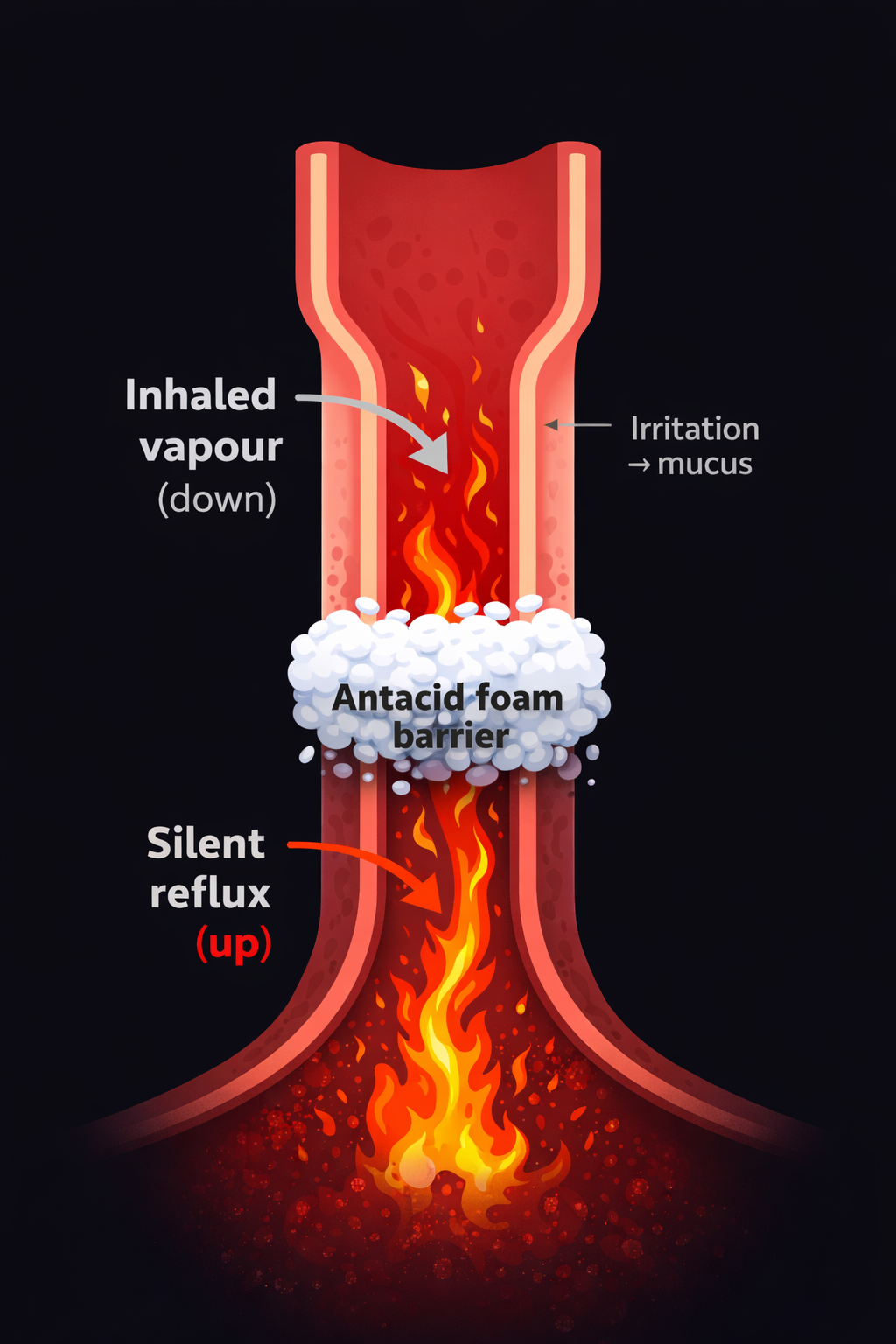
If Gaviscon or Rennies noticeably reduces your throat mucus, it may be silent reflux (LPR), not lung phlegm.
What people mean when they say “vape phlegm”
Most people aren’t describing chest congestion. They’re describing throat symptoms:
- mucus that feels stuck behind the tongue or at the back of the throat
- throat clearing every few minutes
- a lump sensation when swallowing (globus)
- hoarseness, voice strain, “morning voice”
- a dry cough that hangs around
- a sore or irritated throat without obvious illness
Those symptoms can be caused by irritation, and vaping can irritate the throat. The problem is that silent reflux can produce the same symptoms, and it often gets missed because it doesn’t always feel like heartburn.
Silent reflux (LPR) explained in plain English
LPR stands for laryngopharyngeal reflux. In normal reflux, acid causes a burning sensation in the chest. In LPR, reflux irritates higher up, the throat and voice box.
Your throat tissue isn’t built to handle stomach contents. So when reflux reaches that area, the body tries to protect it. One of the main “protection” responses is mucus production. That’s why LPR can look like a phlegm problem, when it’s actually a reflux irritation problem.
The “antacid clue”, why Gaviscon or Rennies can be a giveaway
Antacids don’t clear mucus out of your lungs. They act in the stomach and upper digestive tract, they neutralise acid, and in the case of Gaviscon, can help reduce reflux reaching the throat.
So if your throat mucus improves after antacids, you’ve learned something practical. The symptom is responding to reflux treatment.
Blunt version: lung congestion doesn’t usually care about indigestion medication. Throat reflux often does.
How to tell the difference between LPR and “vaping irritation”
This is not a diagnosis, but patterns matter.
Clues that point toward LPR:
- worse after meals
- worse when lying down, especially at night or first thing in the morning
- worse after caffeine, fatty food, chocolate, mint, alcohol, or big meals
- comes and goes depending on eating timing and speed
- improves with antacids
Clues that point toward airway irritation:
- symptoms flare immediately after vaping
- dryness and irritation more than thick mucus
- less relationship to meals and lying down
It can be both, but if antacids shift the symptoms, don’t ignore that signal.
Common triggers that push reflux up into the throat
- eating quickly
- large meals
- late-night eating
- caffeine
- fatty foods
- chocolate
- mint
- lying down soon after eating
Fast eating is a big one, it increases the chance of reflux and makes symptoms feel random because the cause is behavioural, not “your body suddenly broke”.
What you can do next
If this sounds familiar, treat it like a lead and tighten your observations for a week.
- Track when it’s worst, after meals, after caffeine, at night, or on waking.
- Avoid eating right before bed.
- Slow meals down and reduce portion size.
- If antacids help, note how quickly and how consistently.
If symptoms are persistent, or you’re relying on antacids regularly, speak to a clinician. Chronic throat reflux can keep tissue inflamed, and it’s worth managing properly.
When to get checked sooner
Don’t sit on this if you’ve got any of these:
- difficulty swallowing
- unexplained weight loss
- coughing up blood
- severe chest pain
- persistent hoarseness that doesn’t improve
General information only, not medical advice.
Related on The Reasonable Adjustment
- Email image signatures: accessibility, GDPR, and why they become a redaction nightmare
- ReasonableRedactor: free local PDF redaction at scale (no Acrobat, no uploads)
- Free tools that quietly save you thousands over time
- “Therapist” isn’t a protected title in the UK, and the public pays for the confusion


Hi, l am a vapour and a heavy drinker. I get phlegm all the time. I suffer from heartburn and indigestion often , normally at night. It’s like a lump that sits between my stomach and rib cage. I have found sometimes that 3 Rennie a night sorts me out. I have got prescribed a 24 hour gastro pill. Do you think I am doing the right thing? I can’t stop vaping or drinking at the moment. Any advice can help
Thanks for sharing your experience. I can’t give medical advice here, but I can relate to some of what you’re describing.
From my own experience dealing with reflux-type symptoms, taking steps to manage the acid itself is generally the right direction. That said, it’s always worth discussing symptoms like persistent heartburn, chest discomfort, or nighttime reflux with a qualified medical professional, especially if they’re ongoing.
One thing I learned along the way is that different over-the-counter products work in different ways. Standard antacids like Rennie mainly neutralise stomach acid, which can give quick relief for a few hours.
Products that contain alginate (such as Gaviscon) work a bit differently. They form a kind of protective “raft” that floats on top of the stomach contents and helps stop acid reaching the oesophagus, which is why some people find them helpful for reflux, particularly at night.
There’s also research showing alginate-based treatments can be more effective than antacids alone for relieving reflux symptoms in some cases.
But everyone’s situation is different, especially when things like alcohol use, vaping, diet, and prescribed medication are involved. If symptoms are persistent or worsening, it’s definitely worth having a proper conversation with a GP or gastro specialist so they can look at the full picture.
Wishing you the best with it!