Reasonable adjustments are often explained in very broad terms. Applicants are told that support is available, or that an employer is committed to inclusion, but they’re not always given a clear example of what they can actually ask for.
That can make the process harder than it needs to be. If you’re autistic, you may know that interviews are difficult, but still struggle to turn that into a specific request. You may also worry that asking for too much information in advance will be seen as awkward, demanding, or unusual.
A recent Freedom of Information response from Durham County Council gives a useful example of what an autism-friendly recruitment adjustment can look like in practice.
The full WhatDoTheyKnow thread is available here: Reasonable adjustments in recruitment processes, Durham County Council. Durham’s response and attachments can also be viewed directly via the council’s response on WhatDoTheyKnow.
The disclosed documents are also available as a ZIP bundle here: Durham County Council reasonable adjustments recruitment FOI bundle.
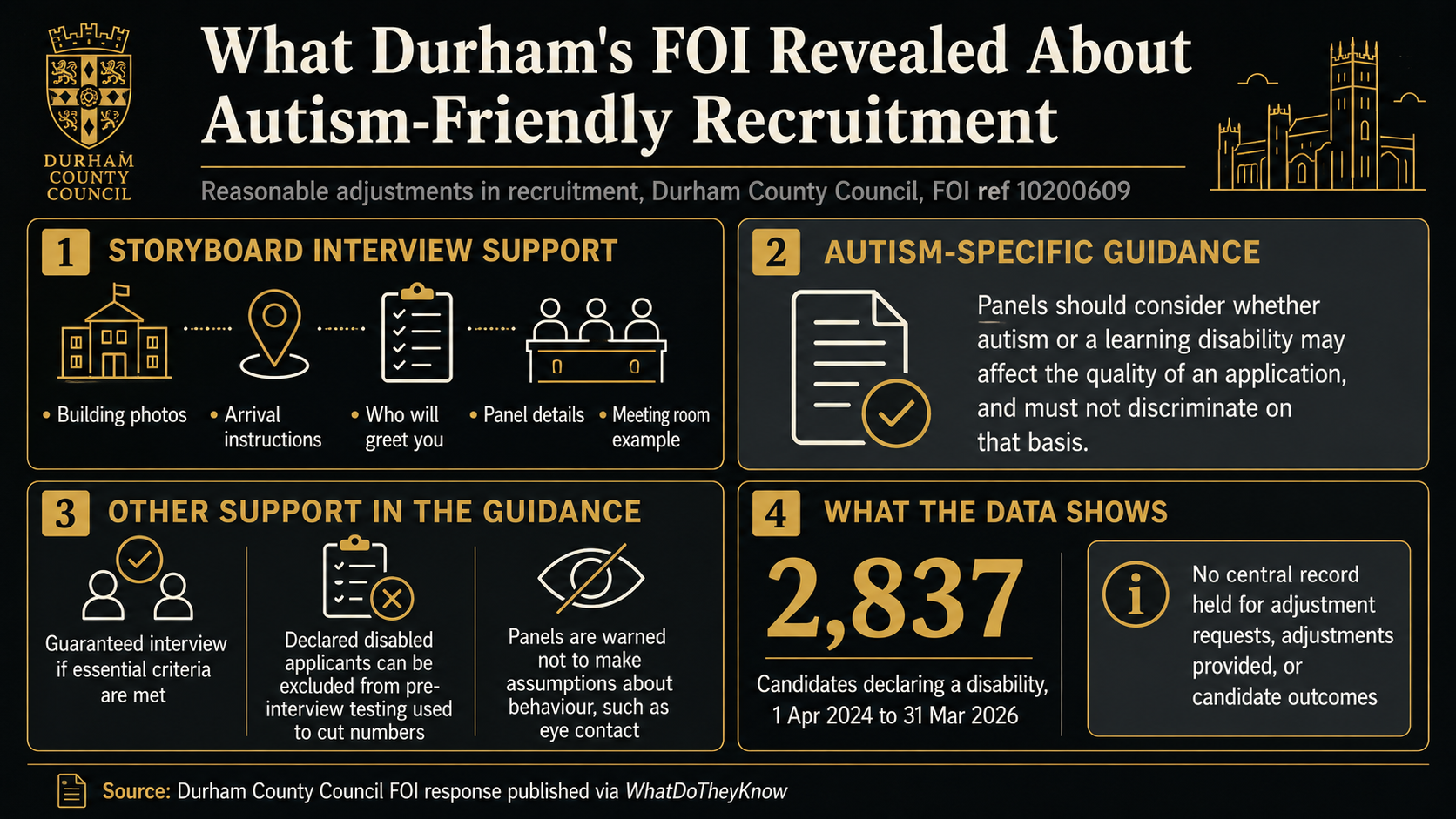
The council disclosed reasonable adjustment guidance used in recruitment. One part of that guidance says that where an applicant has declared a learning disability or a condition related to Autism Spectrum Disorder, a “storyboard” approach may be useful before interview.
The guidance says this can include practical, step-by-step information such as car parking details, what to expect, pictures of the building, how to access the building, who will greet the candidate, where to go on arrival, who will be on the panel, and an example of the meeting room.
This is a useful example because it deals with a real barrier.
For many autistic applicants, the interview itself is only part of the difficulty. The wider process can also create pressure: finding the building, dealing with reception, waiting in an unfamiliar space, meeting a panel of strangers, working out what tone is expected, and trying to manage uncertainty about what will happen next.
A storyboard doesn’t give the candidate the answers. It doesn’t lower the standard for the job. It simply gives the person clearer information in advance, so they have a better chance of taking part in the process fairly.
That is the practical purpose of a reasonable adjustment. The applicant still has to meet the requirements of the role, answer the questions, and show they can do the work. The adjustment reduces avoidable disadvantage created by the recruitment process itself.
What this could look like in practice
An autistic applicant could ask for a version of this adjustment before an interview. The request doesn’t need to be dramatic or overly medicalised. It can be simple and specific.
For example:
I am autistic and would like to request reasonable adjustments for the interview. It would help me to receive a step-by-step outline of what will happen on the day, including where to go when I arrive, who will be on the panel, what the interview format will be, and whether there will be any tests or exercises. If possible, I would also find it helpful to receive information about the building, the room, and the arrival process.
That sort of request is practical. It explains the adjustment being asked for, links it to the interview process, and avoids asking the employer to make assumptions about autism.
Some applicants may not need all of those details. Others may need extra information, depending on the role, the format, or their own needs. The point isn’t that every autistic person needs a storyboard. The point is that advance structure, visual information, and clear instructions can be reasonable things to ask for.
Why this disclosure is useful
This FOI response doesn’t create legal precedent in the way a court judgment would. It would be wrong to describe it that way.
However, it does provide a useful benchmark. Durham County Council is a large public authority. Its own recruitment guidance recognises that storyboard-style preparation may help autistic applicants take part in interviews.
That means an employer would struggle to dismiss this kind of request as strange or unrealistic without explaining why. If a candidate asks for the names of the panel, directions to the room, photographs of the building, or a clear outline of the interview process, those are not unusual demands. They are ordinary pieces of information being used to reduce disability-related disadvantage.
There may be cases where an employer can’t provide every detail. The panel might change at short notice. The room might not be confirmed. A particular security process may apply. But in many recruitment exercises, most of this information will either already exist or be easy to provide.
If an employer refuses, the useful question is why. Not in a confrontational way at first, but in a practical way. What part of the request is unreasonable? What alternative can they offer? Can they provide some of the information even if they can’t provide all of it?
Other useful points in Durham’s guidance
The storyboard example is the most practical part of the disclosure, but it isn’t the only useful part.
Durham’s guidance says that if an applicant has declared a disability related to Autism Spectrum Disorder or a learning disability, the Lead Officer and panel members must consider whether this may have a bearing on the quality of the application and must not discriminate on that basis.
That is important. Some autistic people may be strong candidates but find application forms difficult, especially where the form relies heavily on vague competency examples, self-promotion, or compressed written answers. An employer should be careful not to confuse difficulty with the recruitment format for lack of ability to do the job.
The guidance also says that disabled applicants who meet the essential criteria should be guaranteed an interview under the council’s policy, even where desirable criteria have been applied to other candidates.
It also says that a disabled candidate who has declared their disability at application stage should be excluded from pre-interview testing used to reduce numbers before interview. This is useful because some tests can screen people out before they have any proper opportunity to explain their experience or ask for adjustments.
Durham’s manager guidance also tells interview panels not to make assumptions about candidate behaviour, including lack of eye contact, because this may relate to cultural background or disability.
For autistic applicants, that is a very practical point. Interviews often reward eye contact, quick social responses, confident small talk, and a particular style of presentation. Those things may influence how a candidate is perceived, even when they have little to do with whether the person can do the job.
The limits of good guidance
Durham deserves credit for having this kind of guidance. The storyboard example is practical, low-cost, and easy for other employers to learn from.
There is still a weakness in the FOI response. Durham said it recorded 2,837 candidates declaring a disability between 1 April 2024 and 31 March 2026, but it does not hold central figures for how many candidates requested reasonable adjustments, how many were provided with adjustments, or the progression and success rates of candidates who requested adjustments.
The council said this is because recruitment is devolved and requests for reasonable adjustments are made directly to the Lead Officer, with no central record of those requests.
That leaves a gap between policy and evidence. The guidance may be good, but the council does not appear to centrally track how often these adjustments are requested or provided.
This links to a wider issue I’ve covered before: public bodies often have policies that look sensible in isolation, but weaker evidence about whether those policies are working in practice. I looked at that broader recruitment issue in my earlier FOI piece on reasonable adjustments and recruitment data gaps.
It also sits alongside a similar records problem in education and SEND. In my article on SEND record retention and council governance, I looked at how councils can hold long-term records and policies while still leaving important questions about oversight, consistency and disposal controls unanswered.
That doesn’t make Durham’s guidance worthless. It simply shows the next step. If a public body has a useful reasonable adjustment process, it should also be able to understand how that process is working in practice.
A useful model for autistic applicants
The main value of this disclosure is that it gives autistic applicants something concrete to point to.
If you’re autistic and preparing for an interview, you can reasonably consider asking for clear information in advance. That might include where to go, who will be there, what the room or format will be like, whether there will be tests, how long the interview is expected to last, and what will happen when you arrive.
You’re not asking for an easier interview. You’re asking for enough structure to participate fairly.
Durham County Council’s guidance shows that this kind of adjustment is already recognised in public-sector recruitment practice. More employers should be willing to provide it, and more autistic applicants should know that they can ask.

Be First to Comment