Last updated on May 3, 2026
Medical cannabis at work is still poorly understood in the UK. Many workers know cannabis can now be prescribed, but they’re less clear on what that means for employment, workplace drug testing, safeguarding duties, driving, occupational health, and disclosure to an employer.
The confusion gets worse because workplace myths spread quickly. Some people hear “cannabis” and assume every case is automatically misconduct. Others assume a prescription gives complete protection. Both views are too crude. The practical position depends on the prescription, the job, the risk of impairment, the employer’s policies, and any disability-related duties.
This article explains the main issues in plain English. It’s not legal advice, and it’s not telling anyone to attend work impaired. The aim is to explain the difference between self-medicating, being lawfully prescribed cannabis-based medication, and being fit for work.
Why this issue causes so much confusion
Cannabis-based products for medicinal use, often called CBPMs, have been available on prescription in the UK since 2018. Despite that, many workplaces still use policies written as though all cannabis use means illegal drug use.
That creates a problem for prescribed patients. A worker may be using cannabis-based medication under specialist clinical supervision, but still face suspicion if their employer sees the word “cannabis” and stops thinking.
The workplace question should usually be more precise. Is the worker lawfully prescribed the medication? Are they impaired during work? Does their role involve driving, machinery, children, vulnerable adults, clinical decisions, safeguarding, restraint, emergency response, or other safety-sensitive duties? Has occupational health been involved? Has the employer considered reasonable adjustments where a disability or long-term condition is involved?
Those questions are more useful than a manager saying, “we don’t allow that here”, as though a workplace policy can erase prescription law, disability law, and basic employment fairness by sheer lanyard authority.
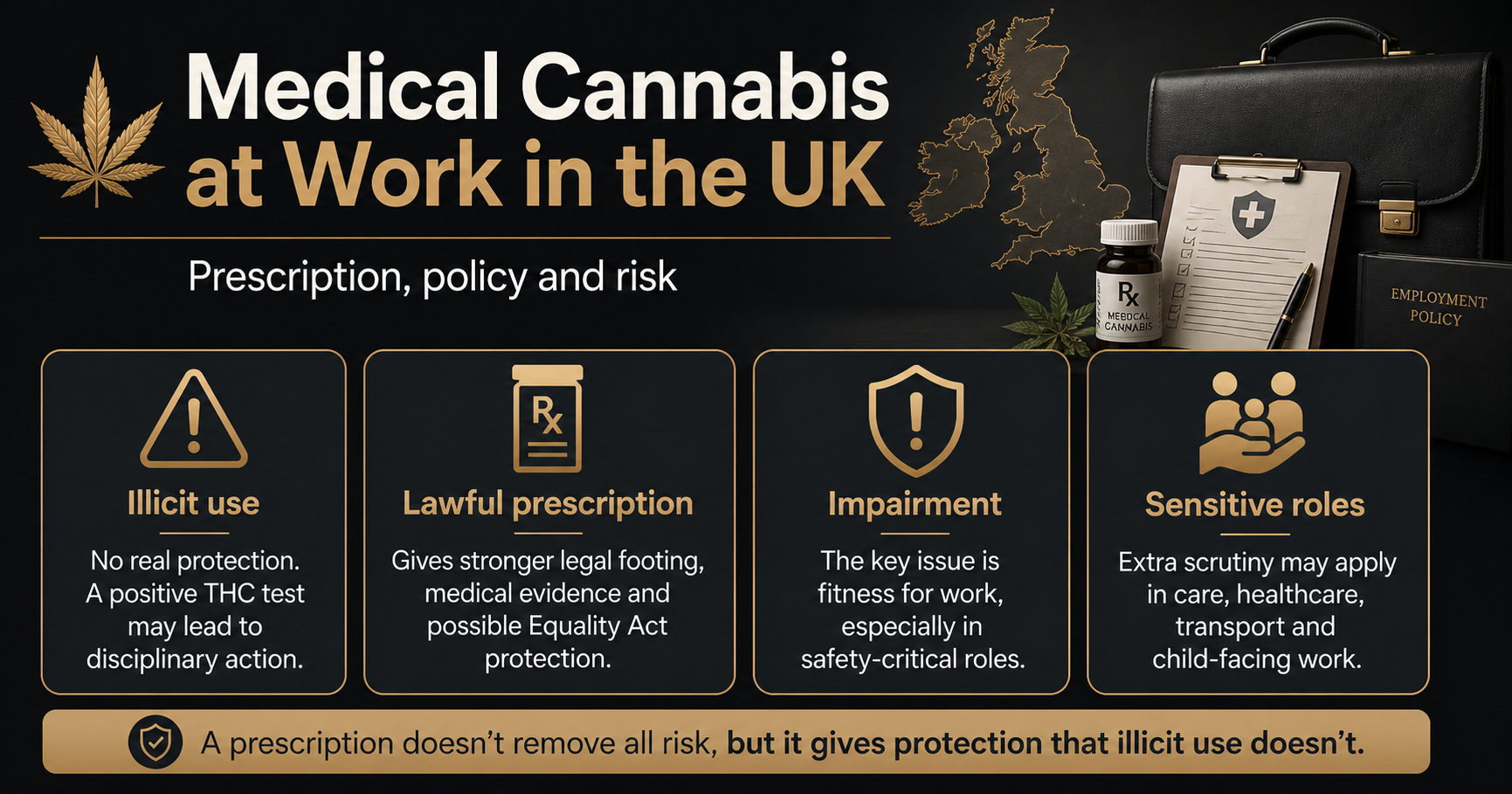
Self-medicating while employed gives you very little protection
Many people self-medicate with cannabis because they’re dealing with pain, anxiety, sleep problems, trauma, bowel conditions, neurodivergence-related distress, or other long-term health issues. In human terms, that’s understandable. In employment terms, it leaves them exposed.
If you’re using cannabis without a prescription, you’re using an illicit substance. However genuine your health reasons are, that gives you no real workplace protection if your employer finds out, drug tests you, or decides the use breaches its policy.
That is the blunt difference. Self-medicating may explain why someone uses cannabis, but it doesn’t make the possession lawful, it doesn’t turn the cannabis into prescribed medication, and it doesn’t give the employer the same duties it would have when dealing with a lawful prescription linked to a disability or long-term condition.
If you test positive for THC at work without a prescription, your employer is far more likely to treat it as illicit drug use. That can lead to suspension, disciplinary action, dismissal, referral to a regulator, or safeguarding concerns, depending on your role.
The risk is higher in jobs involving children, vulnerable adults, driving, transport, construction, machinery, healthcare, social care, security, policing, prisons, probation, schools, or regulated professional standards. In those settings, employers will usually have stricter policies, and some of that strictness will be legitimate.
The difficult part is that a positive THC result doesn’t always prove someone was impaired at work. THC can remain detectable after the main period of impairment has passed. But without a prescription, a worker has far less protection and far less room to argue that the use was lawful medication rather than misconduct.
A prescription changes the footing
A lawful medical cannabis prescription changes the footing significantly. It gives the worker evidence that they’re using prescribed medication under clinical supervision. It also means they’re not unlawfully possessing the medication, provided it’s prescribed to them and held lawfully.
That doesn’t make the worker untouchable. An employer can still manage safety. It can still require someone to be fit for work. It can still ask sensible questions about duties, timing, dosage, impairment, storage, driving, and risk. In some roles, extra controls may be justified.
But a prescription does give protection that illicit use doesn’t. It gives the worker a lawful basis for possession. It gives them medical evidence. If the underlying condition amounts to a disability, it may bring Equality Act duties into play. It also makes it harder for an employer to justify treating the worker as though they’ve simply been caught misusing drugs.
That is why the prescription matters. It moves the issue away from “you’ve used cannabis” and towards prescribed medication, occupational health, fitness for work, risk assessment, disability, and reasonable adjustments.
Impairment is the central workplace issue
No worker should attend work impaired in a way that creates a safety risk. That applies across the board. It doesn’t only apply to cannabis.
A person can be impaired by prescribed cannabis, strong painkillers, benzodiazepines, pregabalin, sedating antihistamines, alcohol, lack of sleep, illness, stress, or a mix of factors. Employers should focus on actual fitness for work, rather than relying on stigma attached to one type of medication.
This is especially important with drug testing. A THC-positive test may show cannabis exposure, but it doesn’t always answer whether the person was impaired during working hours. A competent policy should understand that difference. A lazy policy will pretend the test result answers everything.
Working with children, care leavers and vulnerable people
Roles involving children, looked-after children, care leavers, vulnerable adults, victims, alleged perpetrators, or people with complex safeguarding needs require careful handling. Employers and providers are entitled to take safeguarding seriously.
That still doesn’t justify blanket nonsense. A lawful prescription should trigger a proper assessment, not an instant assumption that the person is unsafe. The same logic already applies to other prescribed medications that can affect alertness, judgement, driving, or coordination.
A sensible assessment would look at the worker’s role, the medication, the dose, the timing of use, the possibility of impairment, the need for driving or lone working, whether restraint or emergency intervention is part of the job, and whether medication needs to be stored securely.
Where the worker has a disability or long-term condition, the employer should also consider whether adjustments are needed. That could involve occupational health input, altered duties, changed shift patterns, clear storage arrangements, or agreed rules around disclosure and fitness for work.
Safeguarding requires proper judgement. It shouldn’t become a convenient excuse for treating every prescribed CBPM patient as though they’ve turned up to supervise children with a bucket bong and a packet of Space Raiders.
What workers should keep documented
If you’re prescribed medical cannabis and you work, it’s sensible to keep clear records. You may never need them, but if a workplace issue arises, vague explanations are weaker than documents.
- Proof of prescription.
- A clinic letter or medication record.
- Current dosage instructions.
- Any written advice about driving, machinery, sedation, or impairment.
- Evidence of the underlying condition, where it’s relevant to reasonable adjustments.
- Any correspondence with occupational health, HR, or management about your medication.
Workers should also be careful about timing. If medication affects alertness, coordination, judgement, or reaction time, that needs to be taken seriously. A prescription helps with legal and employment status, but it doesn’t excuse unsafe working.
Disclosure to an employer
Disclosure is a difficult area. Some workers may be required to disclose medication under their contract, drug and alcohol policy, driving policy, safeguarding policy, or professional standards. Others may not have a clear obligation unless the medication affects their work.
If disclosure is needed, it’s usually better to keep it factual. Explain that the medication is lawfully prescribed, provide evidence where appropriate, and ask for occupational health involvement if the employer lacks the expertise to assess it properly.
The discussion should stay focused on fitness for work, safety, reasonable adjustments and the actual role. It shouldn’t become a moral debate about cannabis. Managers who want to debate cannabis policy should do that in their own time, preferably after reading something longer than a Facebook comment.
What employers should be doing
Employers need policies that can deal with prescribed controlled drugs properly. That includes cannabis-based medication, but the principle is wider than cannabis.
A competent policy should explain how the employer deals with prescribed medication, impairment, drug testing, disclosure, occupational health referrals, safeguarding duties, driving, safety-critical tasks, storage, confidentiality and reasonable adjustments.
It should also make clear distinctions between illicit use, lawful prescription use, possession of medication prescribed to the worker, a positive drug test, and actual impairment at work. Those categories can overlap, but they aren’t identical.
For employers in regulated settings, including children’s services, care, healthcare, transport and construction, this should already be basic governance. If the policy can’t handle prescribed cannabis without collapsing into panic, the policy is probably out of date.
Drug testing at work
Workplace drug testing can create serious problems for prescribed patients. Some policies focus heavily on whether a substance is detected, while saying much less about whether the worker was impaired, whether the substance was prescribed, and whether the employer has considered disability-related duties.
That can lead to unfair outcomes. A prescribed patient may test positive because they’re taking their medication as directed. If the employer treats that result as automatic misconduct, it may be ignoring relevant context.
That said, prescribed patients shouldn’t be casual about testing. If your workplace has a drug testing policy, especially in a safety-sensitive role, you need to understand what it says. If it doesn’t deal properly with prescribed controlled drugs, that gap should be raised before it becomes a disciplinary problem.
Driving and medical cannabis
Driving is one of the most sensitive areas. A prescription doesn’t give anyone permission to drive while impaired. Workers who drive for work need to be especially careful, because employment policy, road traffic law, insurance, DVLA medical rules and workplace safety duties can all become relevant.
The Reasonable Adjustment has covered this area in more detail through FOI work and case coverage. See:
Anyone prescribed CBPMs who drives for work should treat this as a serious practical issue. Keep documents, read your employer’s driving policy, follow clinical advice, and don’t drive impaired.
Venues, public access and inconsistent policy
Medical cannabis policy problems are not limited to workplaces. Venues, public bodies and private operators often struggle with the same basic issue: they see cannabis, then fail to distinguish lawful medication from illicit possession or recreational use.
The Albert Hall Manchester medical cannabis policy article is an example of how unclear or poorly applied policies can affect prescribed patients in public settings:
The same kind of thinking appears in employment. If an organisation has no proper process for prescribed cannabis, staff may default to fear, stigma or guesswork. That’s bad for patients and bad for governance.
Privacy and sensitive medical data
Medical cannabis also raises privacy issues. A worker’s prescription, diagnosis, symptoms and treatment history may involve sensitive personal data. Employers shouldn’t handle that information casually.
If a worker discloses prescribed cannabis use, the employer should limit access to people who genuinely need to know. The information shouldn’t become office gossip, safeguarding theatre, or a general management curiosity.
The wider issue of CBPM privacy is covered here:
Workers should be careful about what they disclose, who they disclose it to, and whether the employer has explained how the information will be used, stored and shared.
Practical points for prescribed patients
If you’re prescribed medical cannabis and you work, the safest approach is to be organised before there’s a problem.
- Keep prescription evidence accessible.
- Understand your employer’s drug and alcohol policy.
- Check whether your role has specific rules on medication, driving, safeguarding, machinery, or safety-critical duties.
- Don’t attend work impaired.
- Consider occupational health if your employer needs to assess fitness for work.
- Keep communication factual and written where possible.
- Ask for reasonable adjustments if your underlying condition affects work.
- Challenge vague assumptions, especially where the employer treats prescription use as automatic misconduct.
For people new to medical cannabis, practical use also brings basic questions about products, devices and administration. The beginner guide to dry herb vaporisers may help here:
Final point
Self-medicating with cannabis while employed carries real risk, especially in regulated or safety-sensitive work. If it’s illicit, you’ve got very little protection. You may have an explanation, but you don’t have the same legal footing as someone using prescribed medication.
A lawful prescription changes that. It gives you a clearer legal position, medical evidence, and a stronger basis for asking the employer to deal with the issue properly. It may also bring disability and reasonable adjustment duties into play, depending on your condition and circumstances.
Employers still have room to manage safety, impairment and safeguarding. That’s fair. What isn’t fair is treating prescribed medication as automatic misconduct because the medication happens to be cannabis-based.
The serious approach is to assess the actual role, the actual medication, the actual risk and the actual evidence. Anything else is policy theatre with a payroll number.
Kieron JH

Be First to Comment