Author: Kieron JH, Founder, The Reasonable Adjustment
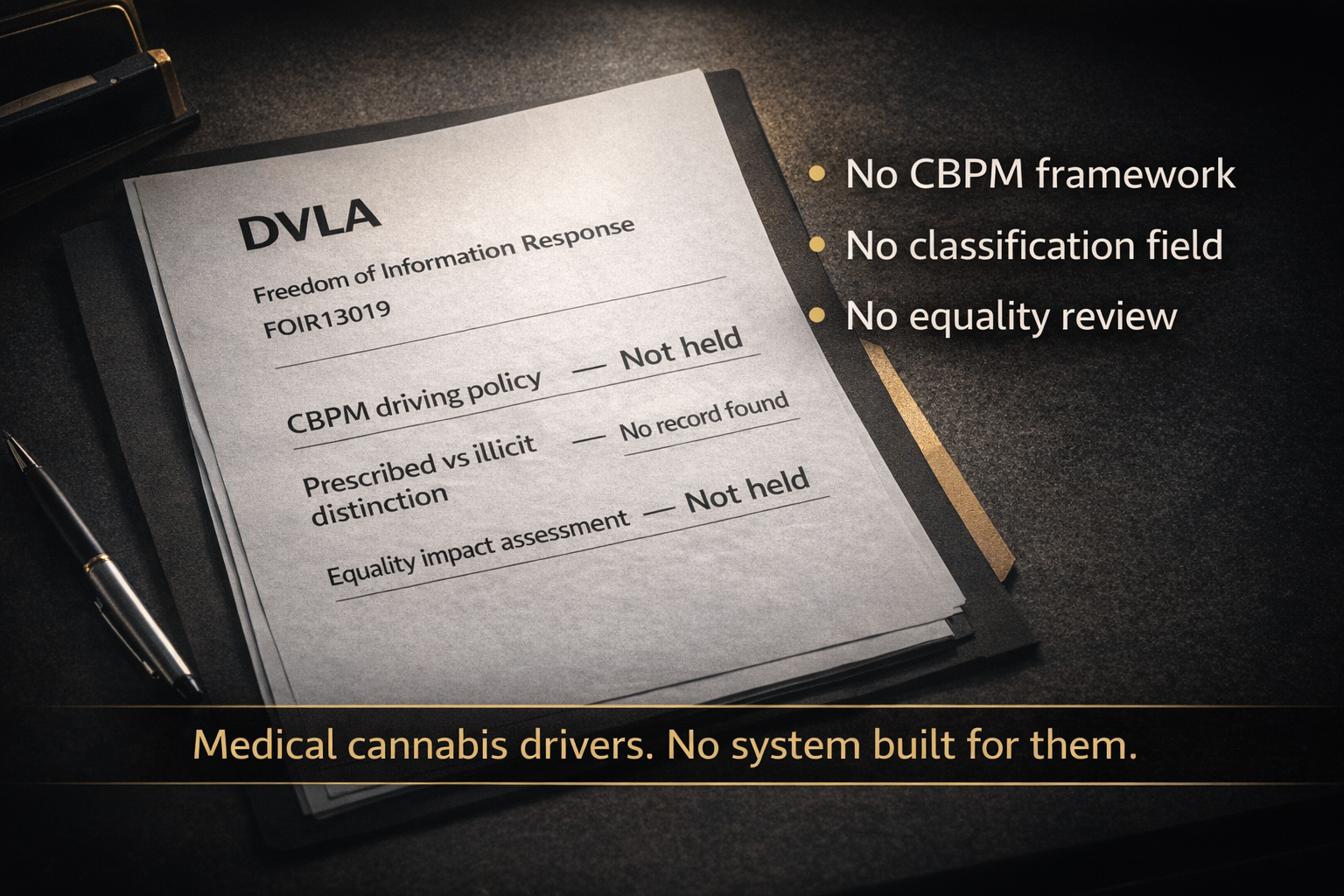
FOI reference: DVLA FOIR13019
You can read the full FOI WhatDoTheyKnow thread here: Medical fitness to drive decisions – prescribed cannabis and CBPM (FOIR13019). Their complete response can also be found here in pdf format.
What I Asked DVLA About CBPM and Driving
In 2018 the UK legalised cannabis based products for medicinal use (CBPM). Clinics opened, patients moved from street supply to regulated prescriptions, and thousands now rely on CBPM for long term conditions and symptom control.
At The Reasonable Adjustment we have already covered what happens when this meets DVLA and the courts in the Sal Aziz medical cannabis driving case, how clinics handle patient data in our CBPM privacy policy audit, and how police forces like GMP have treated prescribed cannabis in practice in our GMP seizure FOI write-up.
This time the question was simple: has DVLA updated its medical fitness to drive framework to recognise prescribed cannabis, or is it still treating everyone under one blunt “drug misuse or dependence” label?
Under FOI I asked DVLA for:
- Any guidance or policies that deal specifically with CBPM or prescribed cannabis and driving.
- Any way their medical licensing systems distinguish prescribed cannabis from illicit cannabis.
- Any Equality or Disability Impact Assessments that cover CBPM patients.
- Complaint and appeal numbers where drug or alcohol misuse and dependence were a factor.
In SEO terms, this is about DVLA medical cannabis driving and medical fitness to drive, and whether CBPM patients are being treated lawfully and consistently when their driving licence is at stake.
What DVLA Admitted in FOIR13019
1. No CBPM specific guidance at all
DVLA confirmed it holds no medical guidance and no policy documents that specifically refer to CBPM or prescribed cannabis. Nothing for doctors. Nothing for caseworkers. Nothing that recognises lawful cannabis treatment as a distinct situation in medical fitness to drive decision making.
2. They look at your condition, not your prescription
DVLA says it is not required to investigate the effects of medication on safe driving, including medicinal cannabis. It focuses on the underlying medical condition, not the drug you take for it.
That means:
- If your condition is on the notifiable list, you must tell DVLA about the condition.
- The fact that you are taking CBPM for it is treated as background detail, not a policy issue in its own right.
This sits awkwardly alongside the way police and CPS handle drug driving limits, where THC levels are central, and the kind of decisions we saw in the Sal Aziz driving case.
3. Prescribed cannabis is not notifiable by itself
DVLA states that taking prescribed medication, including prescribed cannabis, is not a relevant medical condition on its own. You only need to tell DVLA if the condition that led to the prescription is notifiable.
On paper that sounds neutral. In practice it hides a bigger problem. The law created a group of patients on a psychoactive controlled drug without any explicit licensing framework built around that reality or any CBPM-specific risk assessment.
4. No distinction at the misuse and dependence stage
When DVLA looks at drug misuse or dependence, it does not distinguish between prescribed and illicit cannabis. The same threshold is used for everyone. There is no internal code that marks someone as a CBPM patient under medical supervision rather than an illicit cannabis user.
Once the word misuse appears, lawful CBPM and street cannabis essentially fall into the same bucket inside the system. That is a problem for patients who have done exactly what the state asked them to do and moved from illicit supply into clinical care, often at significant personal cost.
5. No equality or disability impact work on CBPM
DVLA also confirmed that it has carried out no Equality Impact Assessments or Disability Impact Assessments that cover CBPM or prescribed cannabis. There is no formal analysis of how disabled people who rely on CBPM are affected by the way the licensing regime works.
For a cohort that is largely made up of people with chronic pain, neurological conditions and other long term disabilities, the absence of any recorded equality analysis on medical cannabis and driving licences speaks for itself.
6. Hundreds of complaints and appeals, but no visibility by drug
DVLA did provide high level numbers where drug or alcohol misuse and dependence were a factor in medical cases:
- Complaints per year: over a thousand in 2021 and 2022, then just under that in later years.
- Appeals per year: several hundred every year across the same period.
They refused to break those numbers down by specific drug type on cost grounds and admitted they do not code CBPM separately in the first place. So the data simply cannot tell you how many CBPM patients have been caught up in these decisions or how often DVLA is suspending or revoking licences from prescribed cannabis patients.
Why This Matters If You Are on Prescribed Cannabis
If you are a CBPM patient, DVLA’s own response tells you the following.
- The medical licensing framework has not been updated for CBPM at all.
- Your prescription is not recognised as a distinct factor in its own right.
- If anyone decides your pattern of use amounts to misuse or dependence, you are treated the same as an illicit user.
The whole point of CBPM is regular, long term use of THC or related cannabinoids under supervision. The line between legitimate long term treatment and what DVLA calls dependence is not just a medical line. It is a legal and cultural line too. At the moment the system has not done the equality work to handle that tension fairly.
You can see the human impact of that gap in cases like Sal Aziz versus DVLA, where prescribed cannabis, drug driving limits, and licence decisions collided in real life rather than theory.
Equality by Design, or Discrimination by Neglect
None of this requires a conspiracy. It is what structural discrimination often looks like in practice.
- No one redesigns the form, so the new cohort stays invisible in the data.
- No one writes the guidance, so caseworkers lean on old habits and broad labels.
- No one runs an equality assessment, so nobody has to own the impact on disabled people.
The result is simple. CBPM patients who did the right thing and moved into regulated care can find themselves treated exactly like the people whose behaviour they were trying to leave behind, with no way to show up in DVLA statistics as a distinct group.
In parallel we are still seeing poor practice around medical cannabis in policing, such as GMP’s handling of seized prescriptions, and poor digital governance by clinics highlighted in our CBPM privacy policy audit. DVLA is just one part of that wider systemic picture.
What You Can Do Right Now
While DVLA continues to ignore CBPM as a policy problem, patients still have to live with its decisions. A few practical points if you drive on prescribed cannabis:
- Check whether your underlying condition is on DVLA’s notifiable list and keep copies of what you reported.
- Keep proof that your CBPM is lawfully prescribed, especially if you drive regularly or may be stopped and tested.
- Keep clinic letters that describe your functional stability, not just your diagnosis and medication list.
- If a decision letter labels you as misusing drugs, ask for the clinical basis and ask whether any distinction was made between supervised CBPM and illicit use.
What Comes Next
This FOI response is not the end. It is a clear snapshot of a system that has not caught up with its own legislation on cannabis based products for medicinal use and driving licences.
At The Reasonable Adjustment we will be using this disclosure to push for:
- Transparent coding of CBPM in DVLA medical systems.
- Equality and disability impact assessments that actually cover CBPM patients.
- Clear, public guidance for clinicians and patients about how CBPM interacts with licence decisions and drug driving enforcement.
If you are a CBPM patient who has had licence issues, or a clinician whose patients have been affected by this policy gap, you can contact The Reasonable Adjustment confidentially at [email protected].


Be First to Comment