Last updated on July 3, 2026
Related, and newer
Another Knockout Audit clip, another viral pile-on. Footage of an arrest on Broad Street, Birmingham, on 21 June 2026 surfaced in early July and has since been watched tens of millions of times across X, TikTok and YouTube, drawing comment from Reform UK MP Robert Jenrick and the controversial Tommy Robinson.
The source video is Knockout Audit’s YouTube upload, “Attacked 2v1 In Wigan”. Readers should watch the footage for themselves, because the public-interest argument here rests on what the video shows: objections to filming, claims about consent, threats, escalation and the wider behaviour around Britain’s night-time economy.
A late-night Wigan video by Knockout Audit has become more than another viral clip of men making fools of themselves outside a venue. It shows, in plain view, how alcohol, ego, public filming myths and street-level aggression can turn ordinary public space into a problem for everyone nearby.
At the centre of the footage is Greg McGuinness, the man behind Knockout Audit, filming Wigan’s night-time economy. He isn’t just a bloke wandering around with a camera. BoxRec lists Greg McGuinness as a professional boxer with a 6-0 record, fighting under the alias “The Bolton Brawler”. BoxRec: Greg McGuinness
Also visible in the wider incident are MC Viper of Blackout Crew and Sam Shackleton. This should not be lazily framed as “Blackout Crew” collectively, because the clearly identified public figure is MC Viper rather than the group as a whole. The accurate point is sharper anyway: MC Viper is publicly associated with Blackout Crew, and his appearance in the footage brings a public-interest angle because he is not an anonymous passer-by drifting through the background.
Evidence note: The images used in this article are included to support identification, public association and context. They are drawn from public-facing material connected to the Knockout Audit footage, public Instagram activity and published local court reporting.
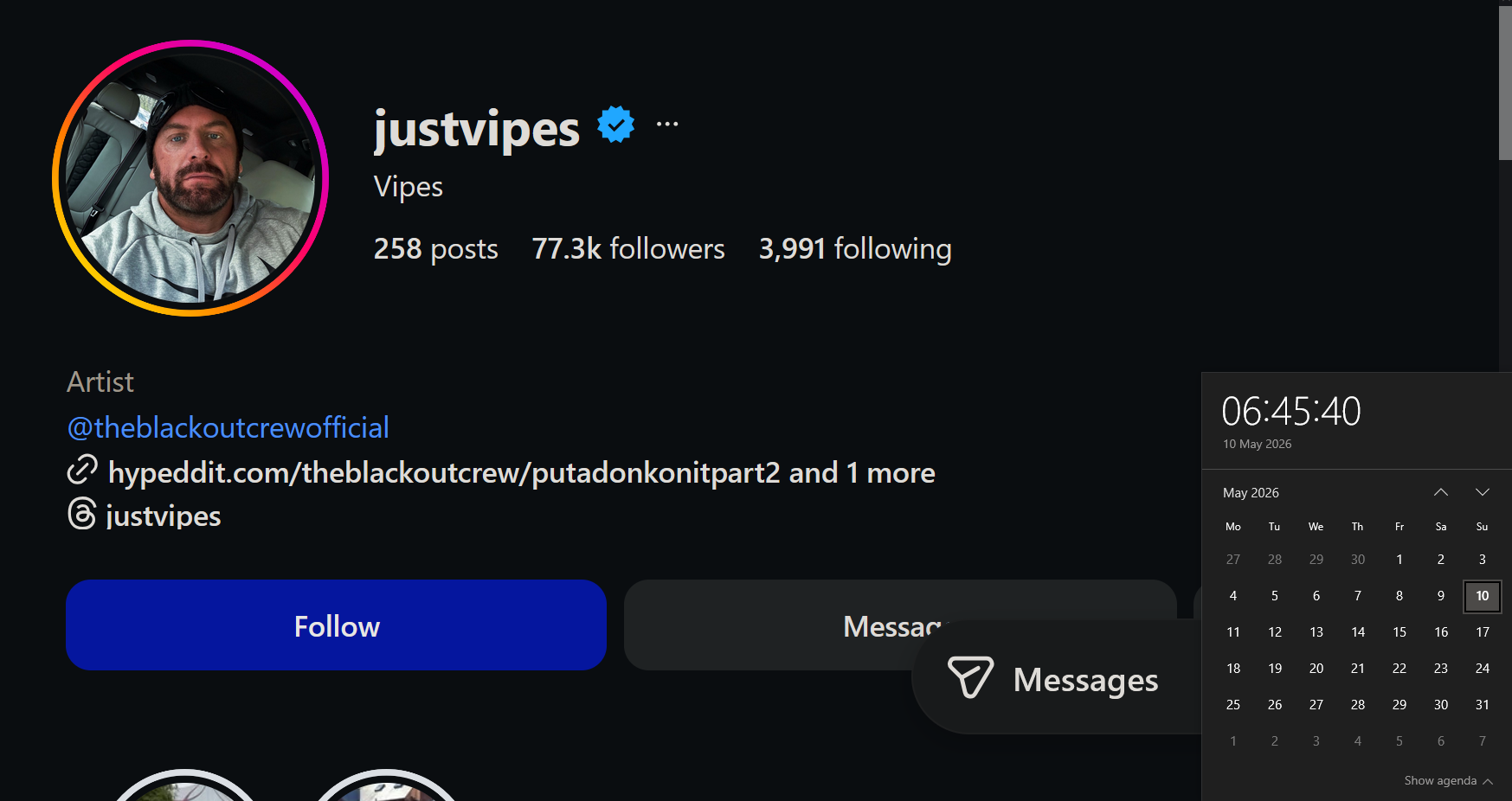
One exchange sums up the tone of the confrontation. MC Viper says words to the effect of: “You know what your problem is? You haven’t been knocked out.” Said to an unbeaten professional boxer, it is a strange bit of pavement wisdom. More importantly, it captures the mindset running through the incident: the idea that being filmed, challenged, or simply not obeyed should somehow be answered with threats or violence.
What happened in the Wigan footage
McGuinness begins the video by recording Wigan’s night-time economy. He speaks to people, films the atmosphere outside venues, interacts with door staff and captures the usual late-night mixture of noise, bravado, drink and people being more confident than the situation requires.
The argument develops around the camera. Several people object to being filmed, claim he cannot use the footage without permission, and tell him to turn it off. In the transcript, people can be heard saying he “can’t use that” without permission and “can’t video somebody” unless he has permission.
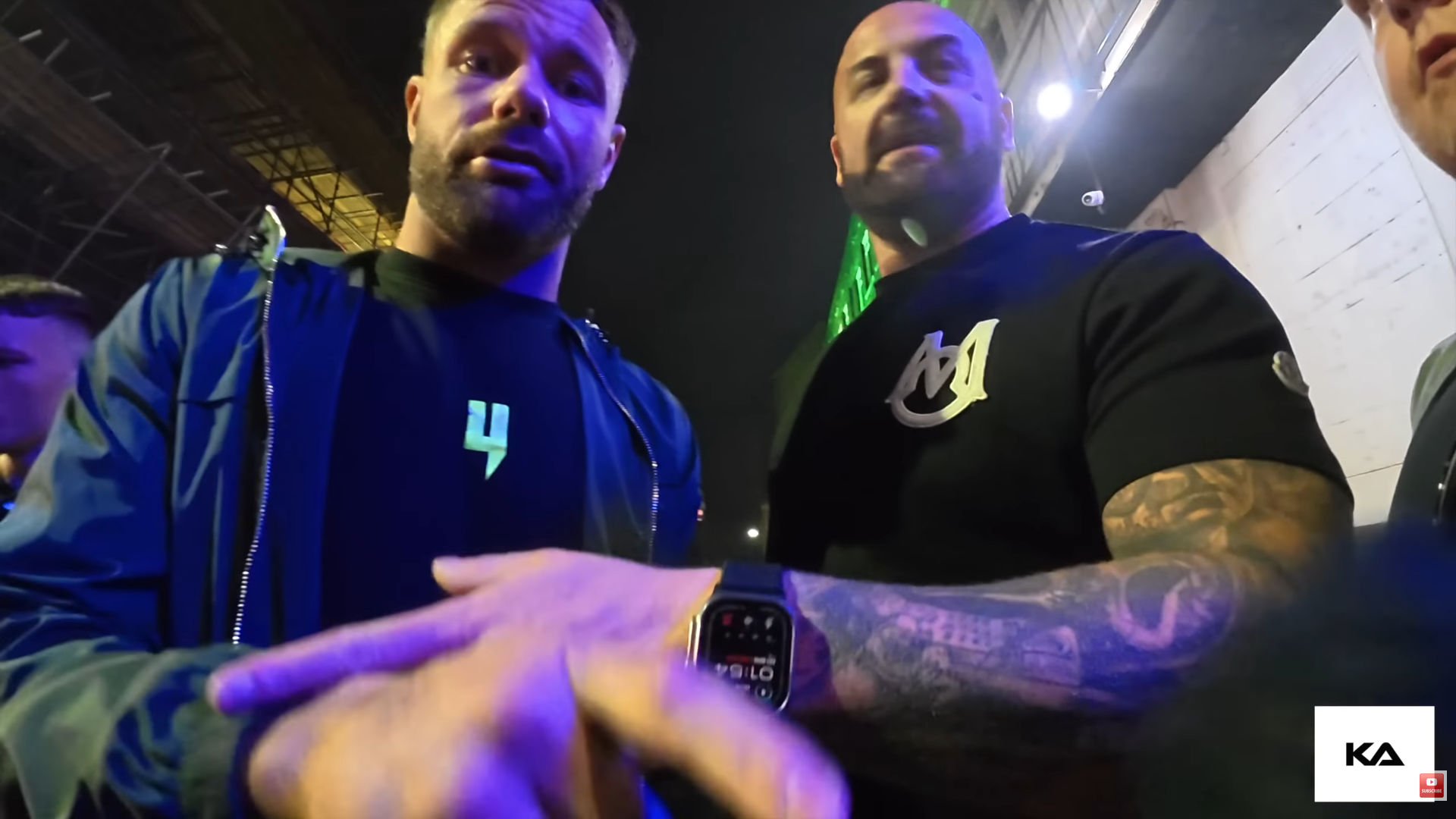
From there, the mood becomes more threatening. The transcript records threats including “I swear I will just drop you now” and “come near me, I’ll hurt you”. People are recorded in public constantly. CCTV, dashcams, doorbell cameras, venue security systems and mobile phones capture ordinary life every day without anyone staging a pavement tribunal about consent. What changes in videos like this is that the camera is obvious, the behaviour is unflattering, and the person being filmed cannot quietly rewrite the story later. That loss of control may be uncomfortable, but it does not create a right to threaten, intimidate or attack the person filming.
Blaming the camera is too easy. The recording did not invent the behaviour, it preserved it. Too many people watch footage like this and obsess over the filming, while treating the conduct being filmed as if it were just background noise.
MC Viper and the problem with public attention
MC Viper occupies a public-facing position through Blackout Crew, a group linked to performance, nightlife, crowd energy and recognition. That does not mean he should be harassed or followed. It does not strip him of basic dignity. But it does make sudden outrage at being filmed in a public nightlife setting much harder to take seriously.
Public attention cannot only be acceptable when it flatters. It cannot help build a name, sell tickets, feed nostalgia and support a public image, then become intolerable the moment it records something ugly.
Nothing in the Wigan footage needs inflating. A public-facing nightlife figure appears in a confrontation where a camera becomes the excuse for hostility and escalation. That is enough to justify scrutiny without pretending the entire Blackout Crew is responsible for one man’s conduct.
Sam Shackleton’s history is relevant because the same themes keep appearing
Sam Shackleton’s involvement deserves scrutiny because his name appears in several Lancashire Telegraph court reports involving violence, alcohol, criminal damage and assault. In 2015, the paper reported that Samuel Shackleton admitted unlawful wounding after Cameron Watson was punched to the ground in Rawtenstall town centre on Christmas Eve, leaving him with a broken jaw. Lancashire Telegraph: 2015 unlawful wounding report
A later report, published in 2021, said Samuel Shackleton pleaded guilty to criminal damage to a car and possession of cocaine after an incident involving his estranged partner. The court heard that he jumped on the bonnet of her car, damaged the windscreen, and followed her as she drove away, only abandoning the pursuit when she reached Burnley police station. The prosecution said the victim could see he was drunk. Lancashire Telegraph: 2021 criminal damage and cocaine possession report
By 2023, the same newspaper was reporting that Samuel Shackleton had pleaded guilty to two charges of assault after an incident involving a young man and the young man’s father. The report said Shackleton punched the younger man to the head, then punched his father three times when he intervened. The court was told Shackleton accepted he was drunk. Lancashire Telegraph: 2023 assault report
None of those reports decide every fact in the Wigan video. They should not be used as a shortcut around the footage itself. They are relevant because the same themes keep appearing: violence, alcohol, intimidation, public disorder and other people being left to deal with the aftermath. Rehabilitation is possible, but public context does not vanish simply because it becomes inconvenient.
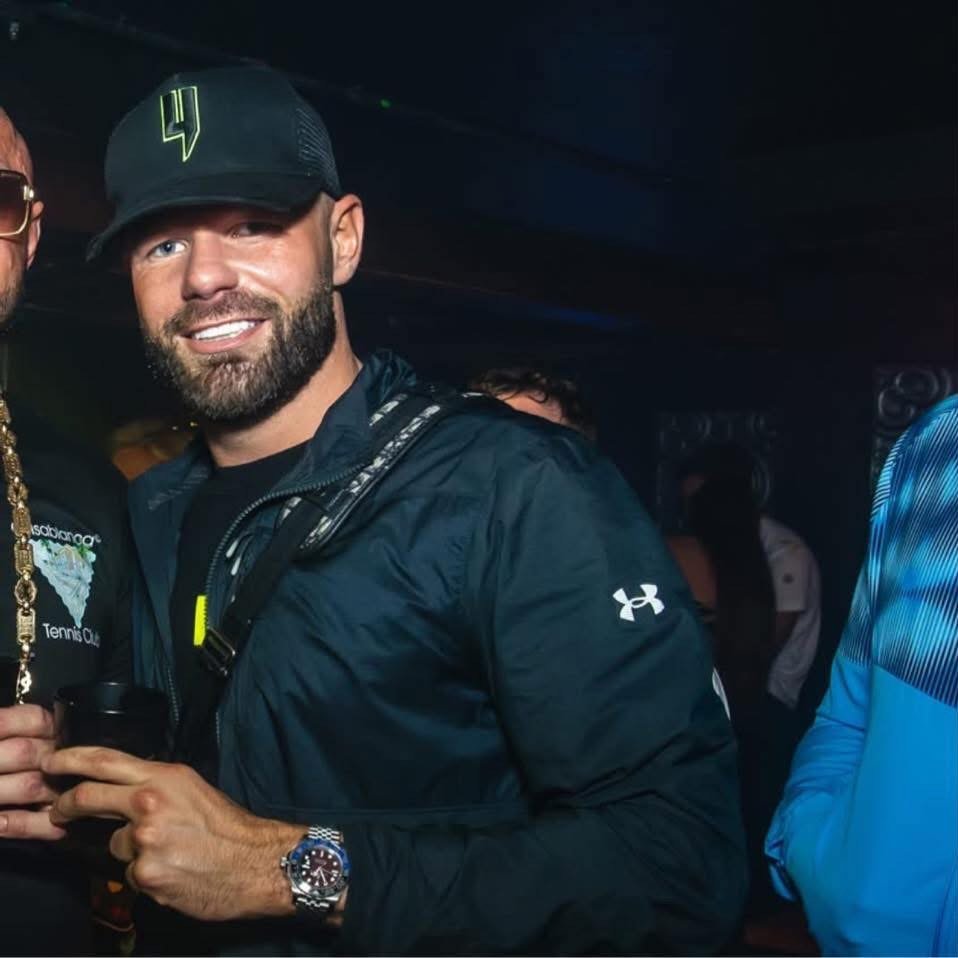
The Instagram material adds public context
Public Instagram material reviewed for this article appears to show MC Viper’s account connected with the account using the name “Sam Shack”. A post by MC Viper, tagged in Wigan, shows both accounts together and includes visible interaction in the comments. Beneath the post, the official Blackout Crew account also appears with the comment “LADS”.
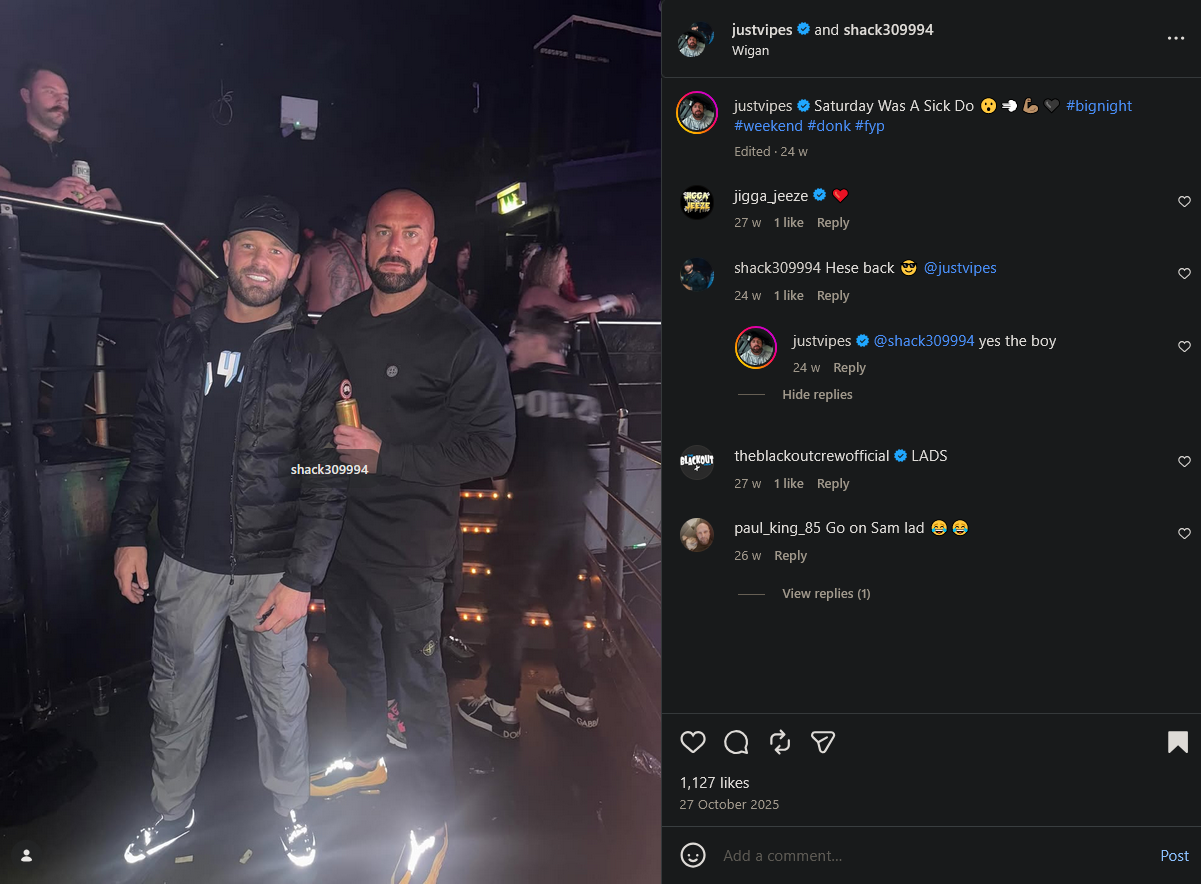
That material does not make Blackout Crew collectively responsible for the Wigan confrontation. It also does not prove that whoever ran the official account knew about Sam Shackleton’s published court history. Claiming that would go beyond the evidence.
Still, the association is fair to examine. A public-facing music brand appears to have warmly acknowledged a social scene involving MC Viper and a man whose name appears in multiple court reports involving violence, alcohol, criminal damage, cocaine possession and assault. Blackout Crew are not responsible for Shackleton’s reported past because an account commented under a post, but public branding carries public judgement. Once an official account steps into a visible association, people are entitled to ask what that association says.
The public filming myth keeps making situations worse
Much of the confrontation rests on a familiar misunderstanding: the belief that someone can stop public filming simply by saying they do not consent. In most ordinary public filming situations, that is wrong. The Metropolitan Police states that members of the public and media do not need a permit to film or photograph in public places, and that police have no general power to stop them filming incidents or police personnel. Met Police: Photography advice
There are, of course, limits. Filming can become harassment, stalking, voyeurism, intimidation or exploitation. Private property can raise different issues. So can repeated targeting or sexualised filming of vulnerable or intoxicated people.
Recent coverage of night-time economy content creators has blurred this distinction. There is a real problem with men targeting intoxicated or scantily dressed women for sexualised clips, humiliation content and engagement farming. That conduct deserves serious criticism. But documenting street disorder, venue behaviour or a public confrontation is not the same thing.
The problem with predatory nightlife filming is not merely that consent is absent. The problem is the targeting, sexualisation, humiliation and exploitation. When everything gets reduced to “filming without consent”, people walk away with the wrong lesson and start believing any public camera can be switched off by personal objection.
Once that myth reaches the street, it creates work for everyone else. People approach auditors, journalists and street documentarians demanding cameras be turned off. They threaten police involvement. They start arguments. Some then become the very public-order problem they claim to be objecting to.
People hate the camera because it remembers
There is a reason drunk people often react badly to being filmed. They know alcohol changes how they behave. They may become louder, nastier, more reckless or more aggressive than they would be sober. The version of themselves captured at 3am may not be the version they want employers, partners, families or the wider public to see.
Not everyone filmed on a night out is doing something wrong. But the camera creates a record, and that is often enough to unsettle people. It removes the comfort of forgetting. It turns a temporary loss of control into something that can be watched, paused and judged later.
When someone responds to a camera with threats, intimidation or violence, the camera is not the central problem. It is the first honest witness.
Knockout Audit records what official language softens
Knockout Audit’s footage has public value because it shows the night-time economy without the council varnish. Official documents tend to use phrases such as “anti-social behaviour”, “public nuisance”, “licensing concerns”, “partnership working” and “community safety”. Those phrases have their place, but they can make disorder sound bloodless and administrative.
On camera, the human version is harder to ignore: drunk people squaring up, men performing aggression for mates, people misunderstanding the law, door staff managing egos, bystanders getting dragged into nonsense, and public space turning hostile because someone cannot handle being recorded.
This is evidence of a social problem. Messy, informal and uncomfortable, yes, but still evidence. It records how alcohol can change public space and how quickly ordinary town-centre streets can become unpleasant for everyone nearby.
Alcohol gets a softness cannabis never receives
The Wigan footage sits inside a wider hypocrisy in British drug policy. Alcohol is sold, advertised, taxed, celebrated and built into the national routine. It is part of football, weddings, clubs, pubs, work events, holidays, birthdays, funerals and weekends. Britain does not merely tolerate alcohol, it organises huge parts of social life around it.
The aftermath is paid for elsewhere. Police deal with threats and fights. Ambulance crews deal with injuries, collapses and panic. A&E deals with the damage. Door staff deal with the egos. Local authorities deal with licensing, complaints, nuisance and street cleaning.
Cannabis receives nothing like the same cultural softness. Most ordinary users remain criminalised. Medical cannabis patients still face suspicion, access problems and confusion from venues, employers and public bodies. Cannabis is not harmless, but the current hierarchy is dishonest.
The legal drug causes visible disorder in town centres every weekend. The illegal drug is still treated as the greater public threat. That is not evidence-led policy. It is a cultural blind spot dressed up as law, with the bill passed quietly to police, ambulance crews, A&E staff, door supervisors and the public who have to share those streets.
The night-time economy passes the bill around
The night-time economy makes money from intoxication, then expects everyone else to absorb the behavioural debt. Someone drinks too much, gets loud, threatens a stranger, starts swinging, loses their phone, needs an ambulance, gets arrested, or wakes up with a story about how it was not really their fault.
That bill moves through police time, NHS capacity, door staff abuse, public fear, CCTV reviews, licensing meetings, court lists, probation workloads, injured victims and communities told this is simply the price of having a vibrant town centre.
It is a poor bargain, especially when the same society still treats cannabis as the obvious public-order villain.
MC Viper and Sam Shackleton should not become a throwaway joke
Some viewers will treat the Wigan video as comedy. MC Viper gets dragged by public opinion. Sam Shackleton gets named in the comments. Someone gets dropped. The internet laughs and moves on.
There is plenty in the footage that looks ridiculous, but the public-interest issue is not funny. A public-facing music figure and Sam Shackleton appear in a video where a confrontation over filming turns into threats and physical disorder. Shackleton’s name is already attached to published court reports involving violence, alcohol, criminal damage, cocaine possession and assault. That is not a minor footnote.
Nostalgia should not soften scrutiny. Being part of a scene does not make intimidation more acceptable. Having a name does not turn accountability into persecution.
What the Wigan video really exposes
Britain has a confused relationship with alcohol, cameras and responsibility. People focus on the filming because it is easier than focusing on the behaviour. They ask why McGuinness was recording instead of asking why grown men reacted like that to being recorded. They ask whether people consented instead of asking why so many people think personal embarrassment gives them authority over public space.
Public filming can be annoying, uncomfortable and ethically questionable depending on how it is done. None of that justifies violence. Embarrassment does not create legal authority, and being drunk does not excuse becoming someone else’s problem.
Conclusion
The Wigan Knockout Audit video deserves attention because it records several problems at once: public filming treated as unlawful when it usually is not, entitlement around cameras, aggression dressed up as wounded pride, and a night-time economy that creates work for everyone except the people profiting from it.
It also shows why Britain’s drug policy conversation is so warped. Alcohol causes visible public harm every weekend and still gets cultural tenderness. Cannabis users, including people using it quietly and privately, are still treated as a greater threat to public order.
That position is no longer serious. Britain does not have a coherent approach to drug harm. It has a cultural blind spot for alcohol, and Wigan has given us another ugly example in high definition.
Further reading
The Wigan video is not an isolated culture-war scrap. It sits in the same wider pattern: Britain excuses some forms of public harm while obsessively policing others. These related pieces look at alcohol, cannabis policy, public morality and institutional double standards from different angles.
Very well said. That video was outrageous. Having seen the published records on this Sam Shackleton, people like this shouldn’t be walking around freely. He needs to be put away until he changes his behaviour. He’s an aggressive, primitive violent, drug addicted drunk and there are too many like him that aren’t being dealt with