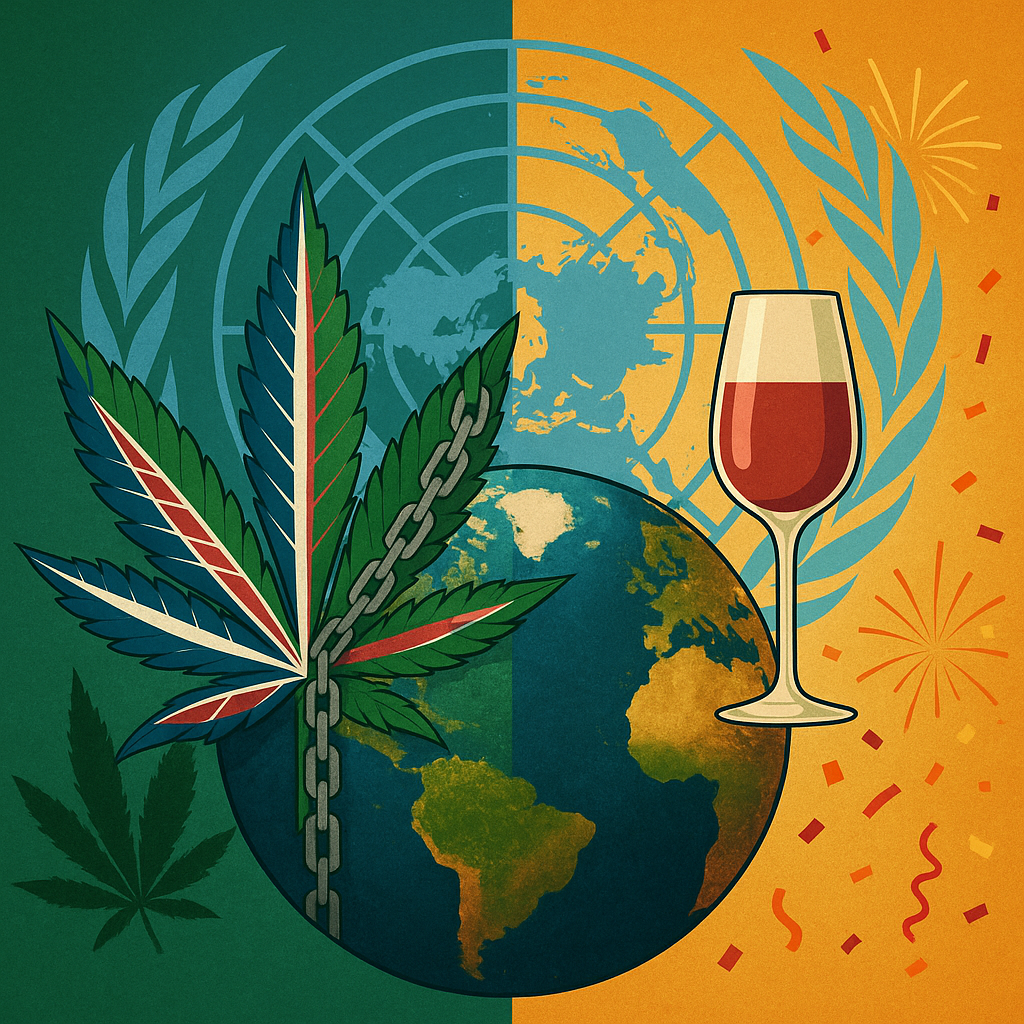
Why do so many countries outlaw cannabis while selling alcohol like bottled water? It’s not about health. It’s not about logic. It’s about who wrote the rules, and who got conveniently left out.
The Global Drug Law Con
Today’s cannabis laws don’t come from a universal scientific consensus. They come from a series of international treaties drafted in the mid-20th century, pushed hard by the United States, enforced through UN conventions, and adopted by countries without much room for dissent.
Meanwhile, alcohol was given a free pass. Despite being more addictive, more damaging, and more socially destructive, it was never included in those treaties. Alcohol was already embedded in Western culture and politics, and the nations writing the rules weren’t about to criminalise their own exports.
Britain and the Colonial Cannabis Loop
Long before cannabis was criminalised, the British Empire was both cultivating and regulating it across its colonies. In the 1800s, Britain taxed and traded cannabis products like bhang and ganja in India. It wasn’t outlawed, it was monetised.
The 1894 Indian Hemp Drugs Commission, set up by the British, concluded that moderate cannabis use was relatively harmless. But that evidence was discarded when prohibition became politically useful. Britain also influenced early cannabis bans in Egypt, using prohibition to exert colonial control. [source]
Britain’s Own Cannabis Chaos
Back home, the UK has had a confused and inconsistent relationship with cannabis. In 2004, cannabis was downgraded from Class B to Class C under the Misuse of Drugs Act. This meant softer penalties for possession, and police were encouraged to issue warnings instead of arrests. But just four years later, the government reversed course. In 2009, cannabis was moved back to Class B, despite the Advisory Council on the Misuse of Drugs advising against it.
Even medical use was blocked for decades. It took until November 2018 for the UK to legalise medical cannabis on prescription, and even now access is severely limited. Most patients are forced to go private, and NHS prescriptions remain rare. The plant is legal in theory, but not in practice. Meanwhile, alcohol remains widely available and socially accepted.
The contradictions continue. Britain helped write global cannabis prohibition, then ignored its own evidence, then selectively relaxed and tightened laws based on political optics. Cannabis is still classified alongside ketamine and amphetamines, while alcohol remains a regulated but legal consumer product.
A Timeline of Hypocrisy
1925 – Cannabis enters the chat
The Geneva Opium Convention adds cannabis to the list of controlled substances, after pressure from British-influenced Egypt. Britain signs on. [source]
Alcohol status: untouched
Alcohol is ignored entirely by the same convention. Western interests are protected, not penalised.
1937 – US bans cannabis federally
The Marihuana Tax Act criminalises cannabis at the federal level in the United States. Britain begins aligning with similar rhetoric and control methods. [source]
1961 – Global prohibition begins
The UN signs the Single Convention on Narcotic Drugs. Cannabis is placed in the most restricted categories. Britain signs and adopts, criminalising the plant entirely.
Alcohol status: still ignored
Alcohol is excluded once again. No treaty ever touches it.
1971–1988 – More control, less sense
Further UN treaties demand criminalisation of possession and harsher penalties worldwide. Countries fall in line. Cannabis becomes globally illegal, enforced by arrest and stigma.
2000s – Medical pushback begins
Evidence grows for medical benefits. Public opinion starts shifting. Some governments consider reform, but many are still bound by treaty obligations.
2013 – Uruguay legalises
Uruguay becomes the first country to fully legalise cannabis. The UN protests, but imposes no penalties.
2018 – Canada follows
The first G7 country to fully legalise. International cracks begin to show.
2020 – UN slightly backpedals
Cannabis is removed from the harshest schedule but remains tightly controlled. Symbolic, not structural. [source]
2022–2025 – Slow reform
Germany, Thailand, and others begin reform. But many remain stuck under outdated UN frameworks. Britain maintains a medical-only stance with tight restrictions.
The Bottom Line
Alcohol is addictive, deadly, and destructive. But it was profitable and culturally accepted, so it was never criminalised. Cannabis was used by marginalised communities, colonised populations, and political outsiders. So it was banned globally and punished with full force.
This is not about health. It is about power. The treaties still shape national laws, and their legacy is a patchwork of injustice that spans continents.
Britain didn’t just sign the script. It helped write it. And until we unpick that history, we will keep repeating it.
Be First to Comment