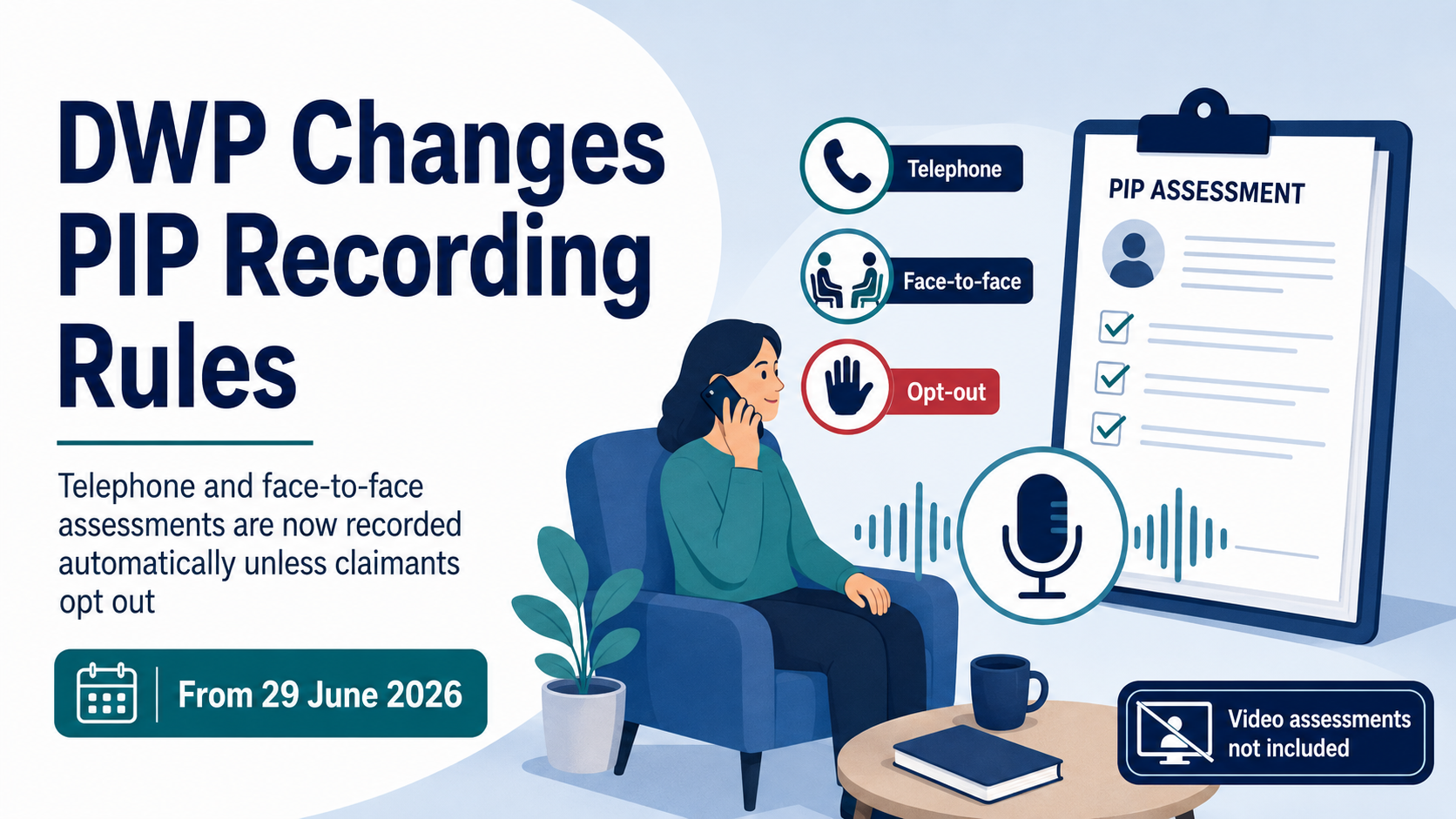
Telephone and face-to-face PIP assessments are now audio recorded automatically unless the claimant opts out, following a major change by the Department for Work and Pensions.
The new policy took effect on 29 June 2026.
Three days earlier, The Reasonable Adjustment had published an examination of the Functional Assessment Services contract used by companies carrying out PIP and work capability assessments.
That article warned claimants:
“They won’t record your assessment unless you ask. Recording is off by default.”
That was accurate when the article was published on 26 June. On 29 June, the DWP reversed the default.
The timing does not prove that our article caused the change. Automatic recording had been discussed by government for several years and appeared in the March 2025 Pathways to Work Green Paper. It is still a notable sequence.
We examined the contract, identified the recording arrangements as one of its most important practical weaknesses and warned that claimants could be left unable to prove what they had actually said. Three days later, the DWP moved from an opt-in system to automatic recording.
What has changed?
All telephone and face-to-face health assessments should now be recorded automatically unless the claimant chooses not to be recorded.
The policy covers assessments for:
- Personal Independence Payment;
- Universal Credit Work Capability Assessments;
- Employment and Support Allowance Work Capability Assessments; and
- Industrial Injuries Disablement Benefit.
It applies whether a face-to-face assessment takes place at an assessment centre or in the claimant’s home.
Claimants no longer have to arrange a recording in advance. The assessment provider should record the appointment as standard.
The DWP says the previous opt-in system was used by fewer than 3% of claimants, despite recording being mentioned in appointment letters and on provider websites.
An option buried in paperwork is not the same as an option people can realistically use. Many claimants do not realise how useful a recording may be until they receive a report that misquotes them, removes context or bears little resemblance to the assessment they remember.
The new system creates the evidence before the claimant knows they will need it.
Automatic recording does not mean automatic access
The assessment should now be recorded automatically, but the recording will not automatically be sent to the claimant.
You must ask for a copy during the assessment or contact the number on your appointment letter afterwards.
When the recording is ready, the DWP says you will receive a text message containing a secure download link. You will need your National Insurance number to access it.
The download rules are needlessly tight:
- the link remains active for seven days after it is sent;
- you can download the file more than once, but only during the 24 hours following the first download; and
- after that 24-hour period, the download option expires.
If the link expires or does not work, you will need to request another one.
Download the recording promptly and save a backup somewhere secure. Keeping it only on the device used to download it is asking for trouble.
People who cannot use the download system can make a DWP Right of Access request or write to the Department. Our plain-English guide to subject access requests explains the basic process for obtaining personal information held about you.
Video assessments are not included
The automatic recording policy does not currently cover video assessments.
The DWP says video assessments cannot be recorded because of technical limitations, although it is working on a system capable of recording their audio in future.
Anyone booked for a video assessment who considers a recording important should contact the provider before the appointment and ask what alternatives are available.
That could include requesting a telephone or face-to-face assessment so the automatic recording policy applies. Where a particular assessment format creates a disability-related barrier, the request should be made clearly and in writing. Our guide on asking for reasonable adjustments includes practical wording and templates.
A claimant should not have to choose between the assessment format they can most easily access and having an official record of what happened.
The recording is not automatically considered by the decision maker
There is an important limitation in the updated guidance.
The DWP says decision makers will not use recordings when making the initial benefit decision. The written assessment report will continue to form part of the evidence considered.
The recording is therefore a safeguard, not a replacement for the report.
Its main value appears when there is a dispute about what happened during the appointment. It can be used to compare the assessor’s report with the words that were actually spoken, support a complaint or provide evidence during a mandatory reconsideration or appeal.
This distinction is easily missed. An assessment being recorded does not mean someone at the DWP will listen to it before deciding your claim. You may still need to obtain the recording, identify the relevant sections and raise any discrepancies yourself.
What should claimants do now?
The advice in our original contract article was to request a recording before the assessment. The operational default has now changed.
The updated practical advice is:
- Do not opt out unless you have a specific reason to do so.
- At the beginning of the appointment, confirm that recording has started.
- Ask for a copy before the assessment ends.
- Download the file as soon as the link arrives.
- Save at least one secure backup.
- Compare it with the written assessment report if the decision or report appears wrong.
If the provider failed to record an eligible telephone or face-to-face assessment, ask for a written explanation and make a complaint. Keep the appointment letter, messages, emails and details of any telephone calls.
Our guide on complaining without being fobbed off explains how to set out the problem, identify the outcome you want and keep the complaint focused on evidence.
Claimants can still opt out
Anyone who does not want their assessment recorded can contact the Health Assessment Advisory Service before the appointment or tell the health professional during it.
The DWP says opting out will not affect how the assessment is carried out, disadvantage the claimant or delay the claim.
An opt-out only applies to the particular appointment. It does not automatically carry over to future assessments.
Unless there is a specific reason not to be recorded, opting out removes a useful piece of evidence for little obvious benefit.
The DWP normally keeps recordings for two years
The updated guidance says assessment recordings will normally be retained for 24 months before being securely deleted.
They may be kept for longer where there is an ongoing dispute.
The DWP also says recordings may only be used in connection with the benefit claim and must not be published or reproduced. Claimants should therefore treat the file as evidence for their own case rather than material for public circulation.
The change was promised before our article
There is no sensible basis for claiming the DWP designed and implemented a national recording policy in three days because of one article.
The previous government’s 2023 Health and Disability White Paper recorded calls for assessments to be recorded on an opt-out basis. It also said the DWP was developing systems with the capability to record assessments.
The current government’s March 2025 Pathways to Work Green Paper then said the Department was looking at making recording standard practice.
What the three-day sequence does show is that the weakness identified in our contract article was real.
The DWP’s own figure shows that fewer than 3% of claimants used the previous recording system. A safeguard that depends on disabled people discovering it, understanding its significance and requesting it before an assessment is a safeguard most people will never receive.
Making recordings automatic is a sensible improvement. It should have happened sooner.
The rest of the contract still matters
The recording section of our earlier article described the system in force when it was published. The rest of the Functional Assessment Services contract investigation remains relevant.
Assessment providers are still subject to contractual requirements concerning reasonable adjustments, accessible communication, preferred contact methods and what must happen when an adjustment cannot be provided.
Automatic recording will not fix every problem with PIP assessments. It will not stop poor questions, rushed appointments, missing context or inaccurate conclusions.
It does mean there should now be an objective record when those problems occur.
The old advice was to ask for a recording. The new advice is to make sure it happened, obtain the file and keep it.
Official sources
- DWP: Health assessments to be recorded as standard
- DWP guidance: Audio recordings at health assessments
- Pathways to Work Green Paper
- 2023 Health and Disability White Paper
This article provides general information about the assessment process. It is not legal or welfare rights advice about an individual claim.

Be First to Comment