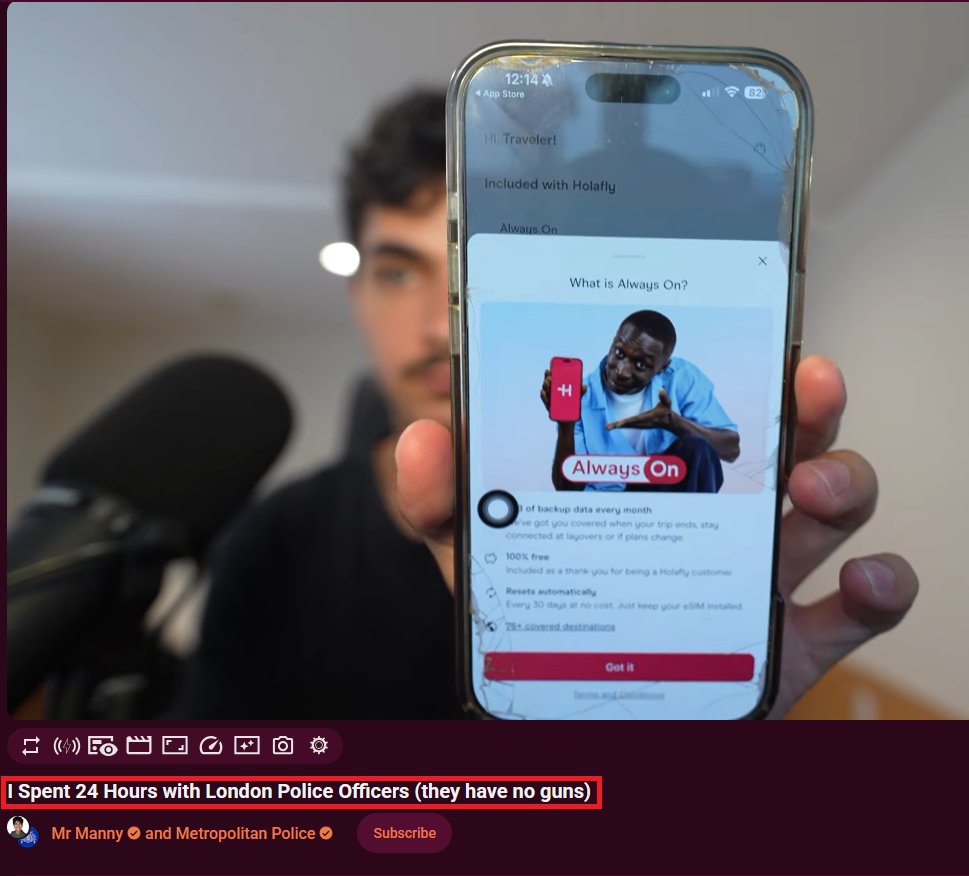
Mr Manny’s video is titled I Spent 24 Hours with London Police Officers (they have no guns) YouTube attributes it to “Mr Manny and Metropolitan Police”, with both names carrying verification marks.
That makes the title much harder to dismiss as ordinary creator clickbait. The Metropolitan Police appears as a named collaborator on a video telling an international audience that London officers “have no guns”.
The claim is categorically untrue. The Met has thousands of officers authorised to carry firearms, operates armed response vehicles and maintains specialist firearms teams. Its own figures recorded 2,238 deployable Authorised Firearms Officers in November 2024.
The footage contradicts the title too. It begins with officers recovering suspected firearms and later includes a firearms deployment. It also shows an ordinary officer discharging incapacitant spray, notably a prohibited weapon included within the Firearms Act’s definition of a firearm, into a young man while several officers restrain him.
Most Met officers don’t routinely carry pistols. That’s a genuine difference between British and American policing. Mr Manny and the Met have turned that qualified fact into a description of a police force that doesn’t exist.
The Met has more than 2,000 armed officers
The accurate explanation is straightforward. Most frontline officers in London don’t routinely carry conventional firearms. When guns may be required, specially trained officers are deployed.
The Met’s information about Authorised Firearms Officers says support is primarily provided by MO19 Specialist Firearms Command. Armed officers also work in Aviation Policing, Parliamentary and Diplomatic Protection, and Royalty and Specialist Protection.
A January 2025 Freedom of Information disclosure recorded 2,238 deployable Authorised Firearms Officers as of November 2024. The force says they attend thousands of incidents each year.
Mr Manny may have meant that the response officers accompanying him didn’t carry pistols. The title says London police officers “have no guns”, while the footage shows ordinary officers supporting a specialist firearms response.
There was an interesting comparison available here. Mr Manny could’ve examined how Britain’s largely unarmed frontline works alongside armed response vehicles and specialist units. Instead, the absence of a pistol from some officers’ belts becomes a false claim about the whole force.
“Unarmed” doesn’t mean without weapons
During the e-bike incident, an officer discharges incapacitant spray while several officers struggle with a young rider. A woman nearby says the officers are armed.
An inspector corrects her. He explains that when police use the word “armed”, they mean officers carrying conventional firearms.
That’s normal police terminology. An Authorised Firearms Officer carrying a pistol or carbine is described as armed. A response officer carrying a baton and incapacitant spray is still classed as unarmed.
The woman was speaking in ordinary English. The officers had weapons, and she’d just watched one of them being discharged into somebody’s face.
British law treats incapacitant spray as serious weaponry. Section 5(1)(b) of the Firearms Act 1968 covers weapons designed or adapted to discharge a noxious liquid, gas or other substance. Section 57 includes prohibited weapons within the Act’s definition of a firearm.
Mr Manny calls it pepper spray. British officers commonly carry PAVA or CS spray. A member of the public carrying an equivalent product could be prosecuted for possessing a prohibited weapon.
A spray canister and a pistol are physically different weapons, and an officer carrying PAVA doesn’t become an Authorised Firearms Officer. The legal position still makes the title particularly dishonest. The video claims the officers “have no guns”, then shows one of them using a weapon controlled under firearms legislation without properly examining whether it was necessary.
Look at how many officers were there
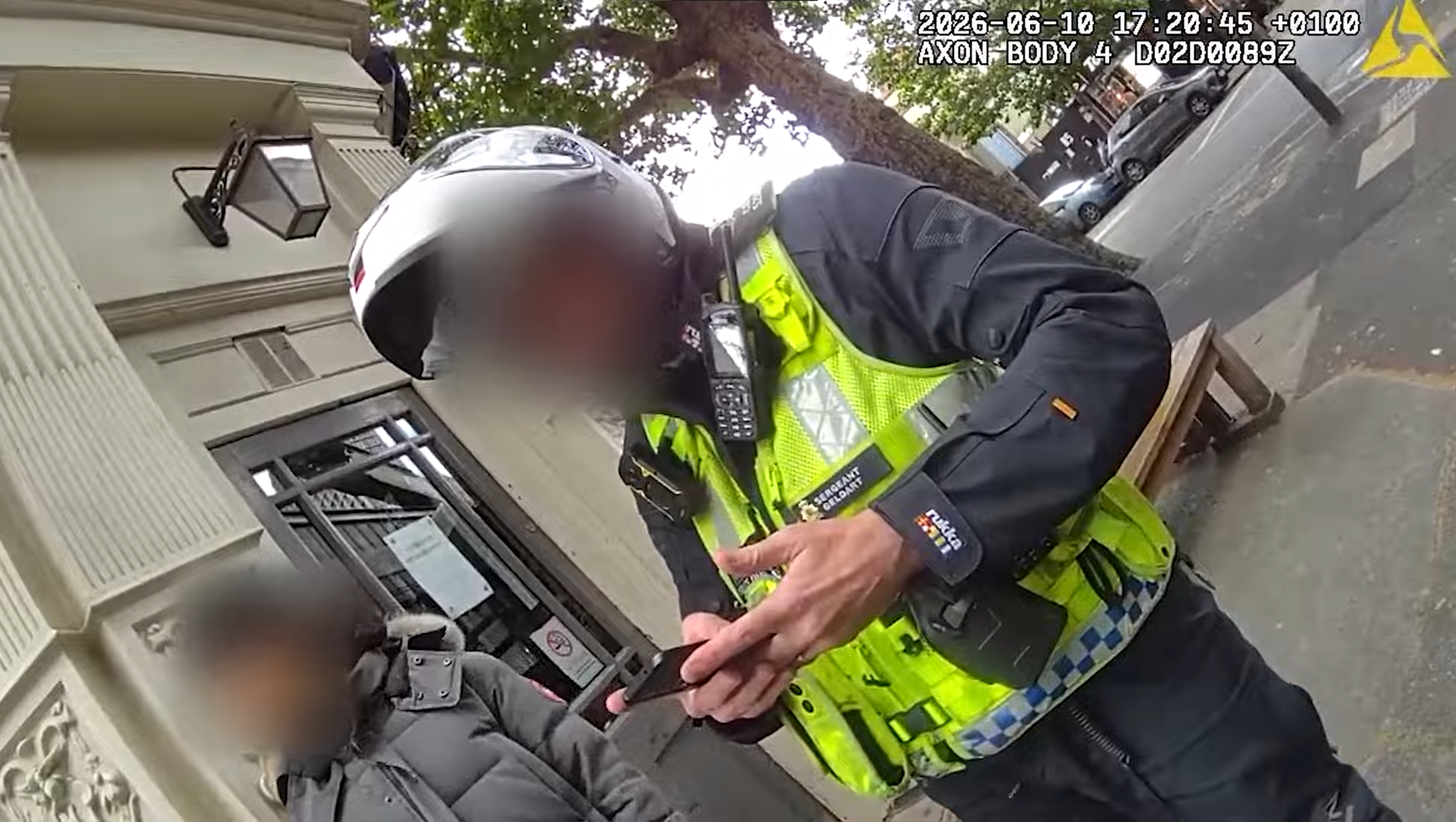
The body-worn footage identifies one of the officers as a sergeant. He’s wearing full operational gear, including protective equipment and a police motorcycle helmet, and he’s considerably larger than the young man he’s dealing with.
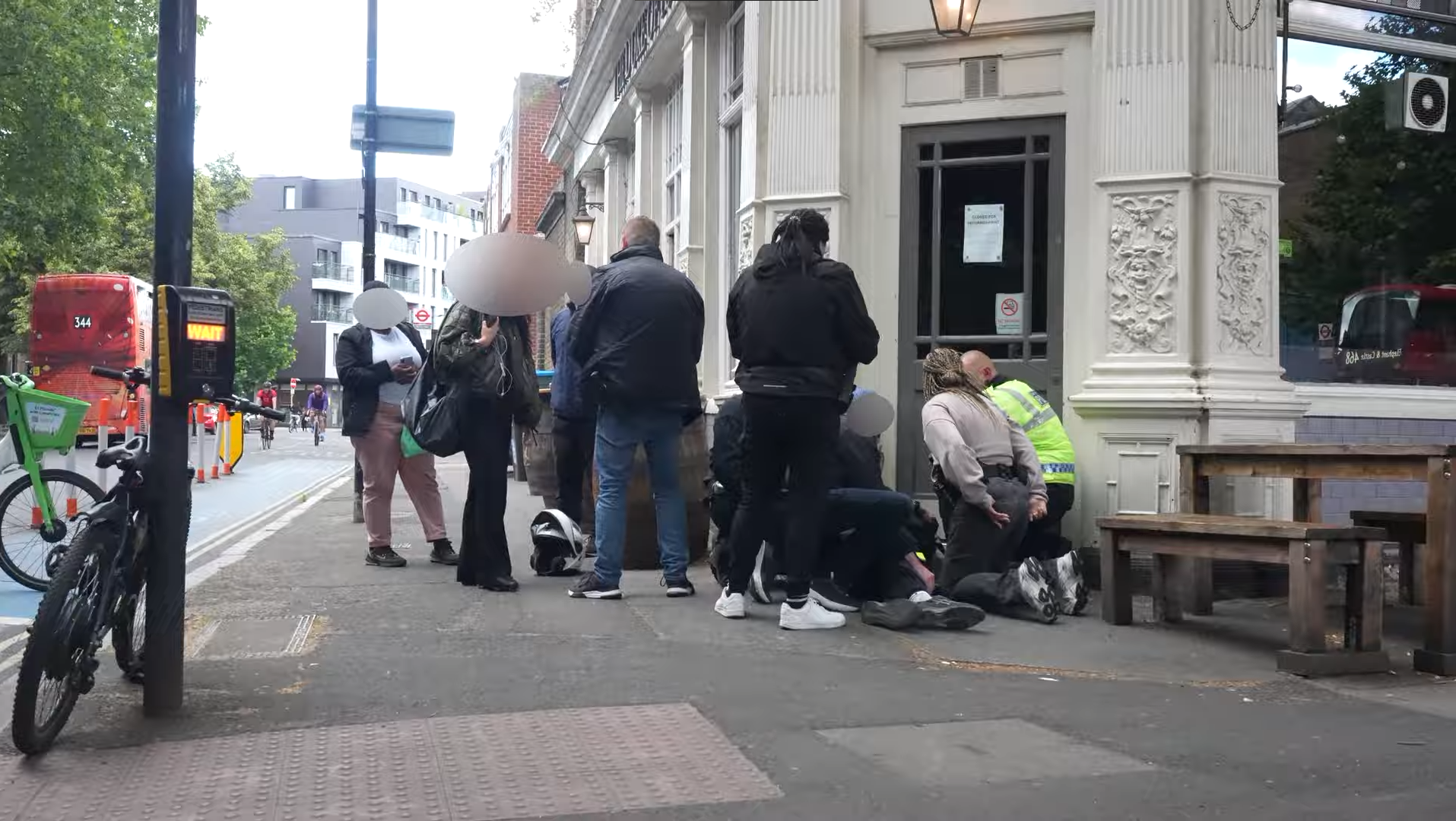
The wider footage shows the rider on the pavement with officers immediately around him and more people standing close by. One uniformed officer appears to have so little need to intervene that they’re kneeling nearby with their hands resting behind them, and another colleague watching the arrest with seemingly very little contribution.
Mr Manny reduces the incident to the rider trying to flee, assaulting an officer and therefore being sprayed:
“This moment, he tried to flee and then assaulted one of the officers. So, they deployed pepper spray.”
The word “assault” does most of the work. The footage doesn’t show the alleged assault clearly enough to assess it, and Mr Manny never explains what the rider is said to have done.
Assault covers conduct presenting very different levels of danger. Punching an officer, pushing one away and making contact while trying to pull free don’t create the same threat. Using one label for all of them doesn’t answer how much force was needed.
The officers outnumbered the rider, outsized him and had far more training in controlling a physical confrontation. They were wearing protective equipment and had an experienced sergeant directly involved. Additional officers were close enough to help.
Those advantages are part of the force available. Police numbers, physical strength, equipment and restraint training should reduce the need to escalate. Here, the officers had already gone hands-on and had enough people to prevent the rider leaving.
They didn’t need to go further than that.
The spray added another level of force
The officer discharged incapacitant spray into a struggle already involving several trained colleagues. PAVA is designed to cause pain, close the eyes and temporarily impair someone’s ability to function.
The Independent Office for Police Conduct lists common reactions as including temporary blindness, weakened legs and an instinctive movement of the hands towards the face. Those effects can also add panic and confusion to a close physical struggle.
The College of Policing says police force must be reasonable and proportionate in the circumstances. That assessment doesn’t end because an officer alleges an assault. The remaining threat, the other options available and the minimum force required all remain relevant.
On the footage Mr Manny published, the officers weren’t isolated, outnumbered or waiting for support. They had already surrounded the rider and begun restraining him.
The inspector later explains that the spray worked. It made the rider’s eyes burn, stopped him resisting and allowed officers to secure him. Its effect is obvious from the young man on the ground complaining that he can’t see.
Effectiveness doesn’t establish necessity. Greater force will often make someone easier to control. The officers still had to justify why their numbers, strength and training weren’t enough.
Mr Manny doesn’t ask. He doesn’t establish what the alleged assault involved, whether the officer gave a warning or what immediate danger remained when the spray was discharged. He praises the inspector for calmly explaining that the weapon successfully incapacitated the rider.
Calmly defending force doesn’t make the force proportionate.
The images are available for everyone to examine. The rider is on the pavement. A sergeant in full operational gear is directly involved. Officers surround them, with at least one appearing to have no immediate role in the restraint.
I ask anyone reading this: do YOU think this was reasonable and proportionate?
The Met’s name appears on sponsored content
The video repeatedly promotes the access Mr Manny received. A member of the Met’s social-media team appears in it and helps him navigate the filming. He accompanies officers during operations, response calls and a firearms deployment.
The upload also contains a sponsored Holafly promotion. During the advert, YouTube continues to display the title and attributes the video to “Mr Manny and Metropolitan Police”.
The public page therefore places the Met’s name beneath commercial content as well as the misleading “they have no guns” claim. It’s reasonable to ask what the force agreed to when it entered this collaboration.
Did the Met approve the final edit and title? Did it know the video would contain a paid promotion? Could it request changes? What staff time, transport and operational access did it provide? Did anybody object to the force’s name appearing beneath a false description of its firearms capability and alongside a commercial advert?
The page doesn’t establish who wrote the title or how much control the Met had. If the force reviewed the final upload, it accepted this presentation. If it didn’t, it allowed its name to be attached to public-facing, monetised content without checking what viewers would be told.
The access also shaped the reporting. Police suspicions become Mr Manny’s narration. An alleged assault becomes a fact. The success of an incapacitant weapon becomes its justification. A witness challenging the force used becomes someone an inspector commendably calms down.
Mr Manny asks officers plenty of questions about their work. When the footage raises a difficult question about their conduct, his curiosity disappears.
This borders on misinformation
British policing is less routinely armed than policing in the United States. Most Met officers don’t carry pistols during ordinary duties, while specialist armed officers respond when conventional firearms may be required.
The Met still has more than 2,000 deployable Authorised Firearms Officers, armed response vehicles and several armed commands. Its ordinary officers carry other weapons, including incapacitant sprays controlled under firearms legislation.
Mr Manny’s own footage shows both sides of that system. It includes suspected firearms, a specialist firearms response and an ordinary officer spraying a young man who was already surrounded by larger, trained officers.
The title ignores all of it. “They have no guns” turns a qualified fact about most frontline officers into a false claim about the Metropolitan Police, then presents that claim under the force’s own name.
That borders on misinformation carrying an official badge.
Sources
- Mr Manny and Metropolitan Police, I Spent 24 Hours with London Police Officers (they have no guns), YouTube.
- Metropolitan Police, Authorised firearms officer.
- Metropolitan Police, Authorised Firearm Officers in the MPS, January 2025.
- Firearms Act 1968, section 5 and section 57.
- College of Policing, Use of force, firearms and less lethal weapons.
- Independent Office for Police Conduct, Met officer convicted of assault for PAVA spraying man.
Further reading
- CPS Drops Charges After Birmingham Arrest Footage Weakens Case
- MC Viper, Sam Shackleton and the Wigan Knockout Audit Video
- Broad Street Arrest: West Midlands Police Cleared Their Own Officer
- The award-winning probation officer who concealed a child’s killing for 44 years
- Why Did the Henry Nowak Case Reach the Public in Pieces?


Be First to Comment