British drinking culture hypocrisy is easy to spot when you compare what gets normalised to what gets moralised.
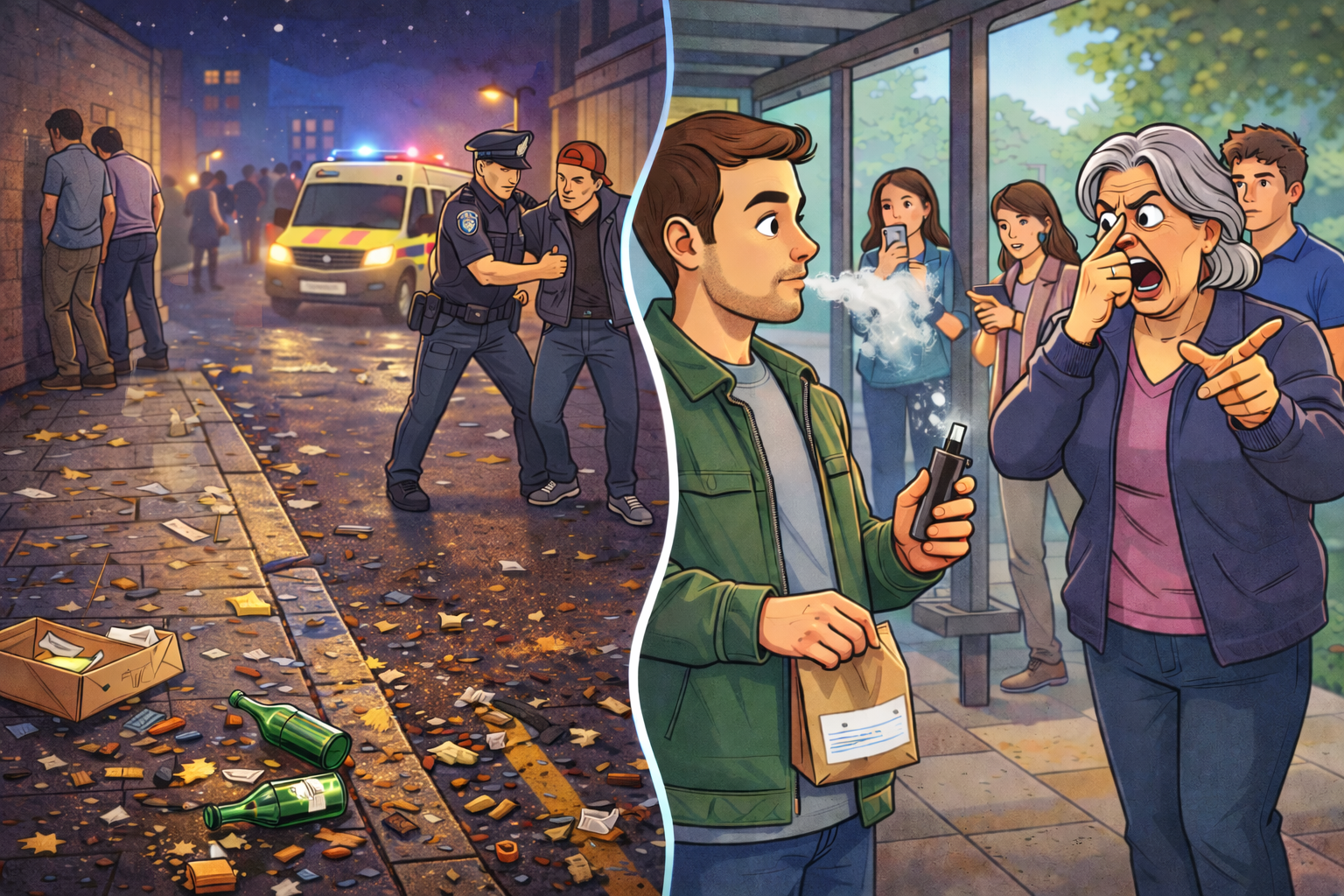
Walk through a British city centre on a warm weekend and you’ll get the full sensory brochure for drinking culture. Stale lager, sweat, smashed glass, and the overwhelming stench of piss that appears when enough people treat public streets like a toilet. Newcastle in summer is a particularly honest example.
Most people accept this as background noise. It’s “just how nights out are”.
Now compare that tolerance to the reaction cannabis often gets. A faint smell can trigger a lecture about respect and decency, like it’s a personal failing rather than a basic shared-space issue.
This isn’t a debate about whether smells can be annoying. It’s about why one set of behaviours is culturally protected, even when it creates real harm, while another is treated as a moral problem even when it’s quiet, lawful, and medical.
British drinking culture hypocrisy, in one simple contrast
If this was genuinely about “strong smells” or “public nuisance”, the response would be consistent. The same people who clutch pearls over cannabis would be furious about public urination, broken bottles on paths, and alcohol-fuelled disorder that forces emergency services to absorb the fallout every weekend.
Instead, the reaction is selective. That’s the giveaway. The judgement comes first, then people reverse-engineer a justification.
Cannabis is controlled, and prescription exists
The lazy line is “weed is illegal”. It’s also incomplete.
In the UK, cannabis is a controlled drug, and there is a legal route for cannabis-based products for medicinal use to be prescribed in tightly controlled circumstances. That matters, because a chunk of the public is still arguing with a version of reality that stopped updating years ago.
If you want a blunt reset on the law and why “illegal, full stop” is wrong, read: A Recorder said “cannabis is illegal, full stop”. That is wrong.
If you’re a patient, or you are trying to avoid getting stitched up by crude workplace policies, these are worth bookmarking:
- CBPM and workplace drug testing: your rights in the UK
- Medical cannabis and employment in the UK: know your rights
- Medical cannabis in the UK: how to access treatment, costs, and clinics
We also built a free tool to help patients put real numbers on their prescription costs: CBPM cost and tolerance break calculator, powered by the TRSA tools archive at trsa.org.uk.
Alcohol is not “just a bit rowdy”, it is a workload
Drinking culture isn’t just a vibe, it’s a recurring demand on healthcare and emergency response.
- England hospital admissions (2023 to 2024): OHID reports 1,018,986 alcohol-related hospital admissions under the broad definition, plus 339,916 alcohol-specific admissions. (OHID alcohol profile, Feb 2025 update)
- Emergency departments: UK emergency care research notes that alcohol-related attendances peak on Friday and Saturday evenings, and up to 70% of attendances can be alcohol-related at weekend peak times. (Emergency Medicine Journal, plus related summaries and evidence)
- Ambulance call-outs (Scotland, 2019): A published study estimated 16.2% of call-outs were alcohol-related, rising sharply at weekend nights. (Manca et al, 2021)
That’s the difference people dodge. Alcohol regularly ends up as someone else’s job, someone else’s risk, someone else’s clean-up, someone else’s shift from hell.
Public piss and broken glass are treated as normal
There’s no better snapshot of the double standard than what gets tolerated in public.
Public urination is treated like a predictable side effect of “a good night”. Broken glass on streets and paths is treated like an unfortunate aesthetic choice. People go drinking on walks, smash bottles, leave shards behind, and the hazard stays there for dogs and everyone else.
Those are real harms. They are not symbolic. They cut paws and send people to A&E.
Yet cannabis often gets treated as the bigger moral offence, even when the reality is a quiet patient, a lawful prescription, and a smell that can be handled the same way you’d handle cooking, bleach, paint, or anything else in a shared space.
Consistency would look boring, and that’s the point
If cannabis smell bothers you, deal with it like a normal shared-space issue. Use words, set boundaries, open a window, move on.
If you’re defending drinking culture, stop pretending the costs are imaginary. Public disorder, broken glass, and emergency service workload are not personality traits.
Public piss and broken glass get a shrug. Cannabis gets the lecture. That is British drinking culture hypocrisy in its purest form.
Further reading on The Reasonable Adjustment
- Medical cannabis is legal. So why are UK patients still treated like criminals?
- Cannabis and your rights
- UK cannabis policy, evidence, costs, and why Class B fails
Sources
- OHID: Alcohol profile short statistical commentary (Feb 2025)
- Manca et al (2021): Estimating the burden of alcohol on ambulance call-outs (Scotland)
- ONS dataset: Nature of crime (violence)
- NHS HRA research summary on weekend-night alcohol-related ED attendances
By Kieron JH
Founder, The Reasonable Adjustment
Be First to Comment