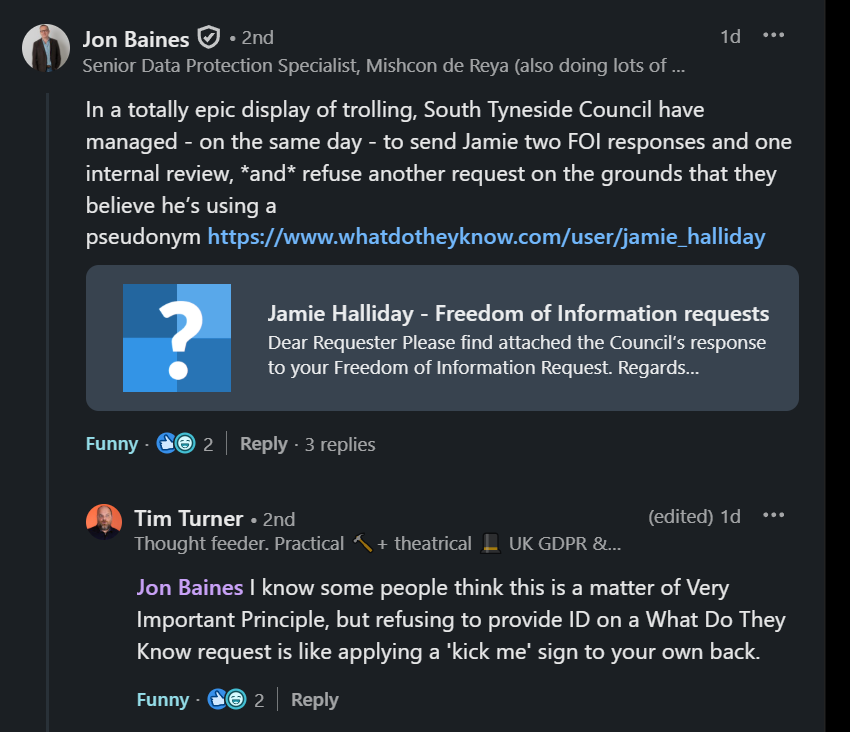
FOI Daily recently published a LinkedIn post about the Ministry of Justice (MoJ) and “real name” FOI requests, using my requests as Jamie Halliday as the example: MoJ FOI “real name” policy, ICO interpretation, and risks of authorities demanding ID documents via public FOI platforms. The tone is jokey and dismissive, presenting the whole thing as a self inflicted mess by an awkward requester.
If you want the detailed background on the MoJ passport and utility bill demands themselves, that is set out in my earlier article: MoJ FOI ID requirement: passport, utility bill, or no answer.
FOI Daily is 2040 Training, and 2040 Training is Tim Turner
FOI Daily is a content stream for 2040 Training, a commercial FOI and data protection training business. On 2040’s own site, the contact page sets it out bluntly: “My name is Tim Turner. I am what you get if you use 2040 Training. There is no one else. It is just me.” FOI Daily’s LinkedIn profile lists 2040training.co.uk as its website and the company description matches 2040’s training offer. FOI Daily is therefore not a neutral community page. It is one of the marketing fronts for a one person consultancy.
When FOI Daily chooses to turn a live dispute about ID checks into content, it is a business decision, not just casual chat. That matters when the story it tells happens to be missing some fairly important facts.
What the MoJ actually demanded
Under the name Jamie Halliday on WhatDoTheyKnow, I submitted several FOI requests to the MoJ. In response, the MoJ sent a template letter saying that they were “unable to confirm the validity” of my requests under section 8 FOIA unless I supplied:
- one piece of photo ID such as a passport or driving licence, and
- a second document showing my name and current address, such as a utility bill, council tax bill or bank statement.
They claimed this was necessary because of “a volume of requests from people who may be using pseudonyms”, and said they would not treat my FOI requests as valid until that bundle of ID had been provided. In effect, FOI rights were being made conditional on sending passport level documents to a central government department.
I refused. The risks of copying passports and bank statements around multiple inboxes are obvious, particularly for people who already have reasons to be cautious about how their identity is handled.
What WhatDoTheyKnow support said
Because the requests went through WhatDoTheyKnow, I contacted their support team. Their response is the key piece that FOI Daily skimmed over.
First, they confirmed that it is literally impossible for a user to upload scans of passports or other attachments directly to WhatDoTheyKnow. The platform does not accept user uploaded files of that kind. The only way a passport scan could ever appear in the public archive would be if an authority chose to send it back in a reply. So the imagined scenario where people start “uploading” passports to WDTK is fiction. The real risk is public bodies pushing requesters to email ID outside the platform. This is all spelled out, with direct quotes from support, in the MoJ article linked above.
Second, WhatDoTheyKnow support said that the amount of documentation the MoJ was demanding could reasonably be seen as excessive, and that a proportionality and data protection complaint was likely to be the most sensible route. That is exactly what I did, including a detailed FOI request to the ICO about the MoJ’s “real name” policy and the risks of demanding ID through FOI correspondence channels.
What the law actually says about real names
Section 8 FOIA requires a request to state the name of the applicant and an address for correspondence. The ICO’s guidance “What makes a valid request” and “Consideration of the applicant’s identity or motives” both repeat the same point: authorities should not normally try to verify identity, and ID checks are the exception, not the rule. The test is whether the name identifies a real person for the purpose of correspondence, not whether the person has emailed over their passport.
I use “Jamie Halliday” consistently as a name I am known by. The WhatDoTheyKnow profile makes it obvious that requests are made in connection with my work at The Reasonable Adjustment. There is a stable identity behind the name, a public profile, and a functioning email address. That is what the law requires. Sending a photocopy of a passport does not suddenly make the questions more legitimate.
How other authorities treated “Jamie Halliday”
South Tyneside Council had no difficulty accepting Halliday as a valid identity while it suited them. They have responded in full to several requests under that name, including:
- PCN volumes and income by area and contravention code (South Tyneside) , requesting detailed parking ticket volumes and associated income broken down by area and contravention.
- Police vehicle collision – Dean Road and Grange Road West, South Shields , requesting information about a specific police vehicle collision at that junction.
- Grit bins and winter maintenance (South Tyneside) , asking about provision and maintenance of grit bins and related winter road treatment.
They also engaged with more sensitive subject matter under the same name. For example, they initially responded to:
- Taxi and private hire driver licensing, criminal convictions, discretion and ethnicity , before attempting to use the “pseudonym” argument at internal review stage, with the Head of Legal Services suddenly deciding the name was a problem.
- Retention periods and disposal controls for pupil records, SEND, exclusions and EOTAS , where concerns about identity only surfaced once the questions cut close to SEND data governance.
So the pattern is clear. When the topic is parking tickets or a police collision, “Jamie Halliday” is a perfectly acceptable identity. When the topic is taxi licensing for ex offenders and ethnicity, or how long SEND records are held, “pseudonym” suddenly becomes a convenient shield. FOI Daily’s neat narrative does not touch that.
Tim Turner’s “kick me” comment
Under Jon Baines’ LinkedIn post, Tim Turner wrote that refusing to provide ID on a WhatDoTheyKnow request is like putting a “kick me” sign on your own back. He is trading on his status as a trainer and consultant when he says that. People reading it are meant to conclude that anyone who refuses a passport demand is naive and is bringing trouble on themselves.
The reality is the opposite. Treating passport scans and bank statements as routine FOI collateral is reckless. If a requester has already provided a consistent name and a working address through a platform that cannot even accept identity documents, then insisting on passport level ID is a choice to increase risk, not reduce it. Refusing that choice is not self sabotage. It is basic digital self respect.
Due diligence on a training brand
Once a business starts using live FOI disputes as content, it should expect some scrutiny of its own house. 2040 Training’s public sitemaps list hundreds of publicly indexable URLs going back to 2011. There is a long running archive of FOI and data protection commentary, course pages and sales copy. The site is fully open to any normal browser, including visits from standard VPN exit points. None of that is unusual, but it does underline the point that this is not a private individual making a throwaway comment. It is a commercial training provider positioning itself as the adult in the room.
If a company uses that position to tell ordinary requesters that declining to email passports is a “kick me” move, it deserves to be challenged. The surface it presents to the world and the advice it gives to that world do not sit neatly together.
What FOI Daily left out
FOI Daily’s story leaves readers with the impression that this was all about pride in a fake name and a pointless FOI to the ICO that was always doomed. Here are the parts that were left on the cutting room floor:
- The MoJ is using a template letter that tries to bolt a passport gate onto FOI requests submitted via WhatDoTheyKnow.
- WhatDoTheyKnow support consider the level of documentation demanded to be excessive, and they say so in plain terms.
- The platform does not allow users to upload identity documents at all, so the risk of ID leaking into a public archive comes almost entirely from authorities, not from requesters.
- The FOI to the ICO is a structured set of questions about policy, proportionality and risk, not a diary entry about my feelings.
These are not small omissions. They change the nature of the dispute from “awkward requester refuses to play” to a serious argument about how far public bodies can push ID checks before they undermine the right of access altogether.
Why this matters
If passport and utility bill checks become normal for FOI requests, a lot of people will simply stop asking questions. Ex offenders, disabled people, survivors of abuse, anyone who has learned the hard way not to hand copies of their ID to whoever asks, these are exactly the people who often need FOI the most. They are also the people most likely to back off when a department demands a full identity pack up front.
FOI Daily chose to stand on the other side of that line and laugh. That is their choice. Mine is to spell out what is actually at stake and let people decide whose idea of “getting data protection right” they trust.
Kieron JH
Founder, The Reasonable Adjustment


Be First to Comment