When Nexus introduced a new Metro byelaw banning vaping from July 2025, it created an obvious question for anyone prescribed cannabis based medicines.
If a passenger is lawfully prescribed medical cannabis and uses a vape as their delivery method, what are Metro staff actually told to do?
This piece looks at what came back through two routes used at roughly the same time, a Freedom of Information request and a direct email to Nexus customer relations. It walks through the training slides, the equality paperwork, and Nexus’ written clarification on how the byelaw applies to prescribed medical cannabis. The focus is on the gaps that matter if you are disabled, medicated, and travelling on public transport in the North East.
Source documents
The analysis below is based on information Nexus disclosed under FOI, and on parallel correspondence with its customer relations team:
- Customer Service and Revenue Protection training slides (PDF)
- Equality Statement for amendment of byelaws (PDF)
- Clarification request on Metro vaping byelaw and prescribed medical cannabis (PDF)
- Nexus customer relations response on vaping byelaw and prescribed cannabis (PDF)
What was asked
On the FOI side, the request to Nexus asked for recorded information about staff instructions and training, specifically:
- Any guidance or instructions that mention prescribed medical cannabis, cannabis based medicinal products, or controlled drugs that are lawfully prescribed to passengers.
- Any training given to staff on how to handle medical cannabis patients, including when to call the police and how to avoid discriminatory enforcement.
- Any training or equality paperwork linked to the vaping byelaw that considers disabled passengers or people prescribed controlled medication.
- Any recorded guidance on enforcement thresholds, such as whether smell, complaints, or possession alone are treated as enough to act.
In parallel, a direct email to Nexus’ Customer Relations Team on 24 January 2026 asked for plain language, on the record confirmation of what their staff can and cannot do to passengers who are lawfully prescribed medical cannabis, and what limits apply to enforcement of the vaping byelaw.
What Nexus actually holds
In response to the FOI, Nexus confirmed that it holds no specific written guidance for staff that mentions prescribed medical cannabis or cannabis based medicinal products.
Instead, they disclosed two things:
- An extract of Revenue Protection training slides used for Customer Service Assistants.
- An Equality Statement relating to the amendment of the byelaws to prohibit vaping.
That is all that exists at policy or training level. Everything about medical cannabis has to be inferred from generic references to vaping and banned drugs.
The Yellow Card system and vaping
The first disclosed slide is titled “Yellow Cards”. It lists examples of behaviour where staff are told to issue a warning rather than go straight for prosecution. On that list:
- Children aged 10 to 17 with no ticket.
- Elderly passengers travelling without full documentation.
- Disabled passengers, for example blind or partially sighted people or those with learning difficulties.
- Vaping.
Vaping sits in the same list as vulnerable passengers who have got something wrong with tickets or documentation. It’s framed as behaviour that attracts a recorded warning, not an instant criminal matter.
According to the training officer, staff are told on the day that:
- From 1 July 2025, vaping is covered by a specific Metro byelaw.
- Staff must first tell the person that vaping is not permitted on Metro and that it’s a prosecutable offence.
- They must then issue a Yellow Card and select “Vaping” from a dropdown list.
- An offender receives one warning only.
- If they refuse to stop vaping when warned, staff go straight to an MG11 report for prosecution.
The enforcement ladder is simple:
Vaping observed → one warning and Yellow Card → refusal to stop → MG11 and byelaw prosecution.
Nothing in that training distinguishes:
- Recreational vaping versus prescribed medication.
- Nicotine liquids versus cannabis based products.
- Legal prescription versus illegal possession.
To the system, it’s just “vaping”.
“No smoking or vaping” and “taking banned drugs”
The second slide lists examples of when staff should issue a Byelaw prosecution instead of a Yellow Card. These include:
- No smoking or vaping.
- Intoxication.
- Possession of open intoxicating liquor.
- Unacceptable behaviour.
- Taking banned drugs on Metro.
- Bringing e scooters onto stations or trains.
- Trespass, feet on seats, altered tickets, and related issues.
Again, nothing in the wording separates illegal drug use from lawful medication.
For frontline staff with limited time, the training effectively boils down to two broad ideas:
- Vaping is a byelaw matter, warn once, then prosecute if the person carries on.
- Drugs belong in a “banned drugs on Metro” category.
Now picture a passenger whose prescribed cannabis based product is taken using a vape, and whose clothing or bag smells of cannabis even if they’re not using it on the train. The paperwork gives staff no help in recognising that a patient with lawful medication exists as a distinct category.
Equality assessment, mental health mentioned, cannabis ignored
Nexus also disclosed a short Equality Statement for the vaping byelaw.
Key points:
- The only protected characteristic explicitly flagged as needing attention is Disability. Other characteristics are left blank.
- The statement acknowledges that some people with mental health difficulties may vape to alleviate stress or similar issues.
- It then plays down impact by arguing that:
- Vaping is already not permitted under the Metro conditions of carriage.
- Many stations are open, so people can vape “outside areas where signage is in place”.
- Trains run frequently and journeys are short, so time without vaping will be short.
- Nexus says it’s “sympathetic” to customers with mental health difficulties and will assess breaches case by case, taking account of input from health professionals or care workers if that input is provided.
What’s missing is just as important:
- No mention of prescribed cannabis based products as medication.
- No recognition that some disabled passengers are prescribed controlled drugs that come with smell, paraphernalia, or delivery methods that are socially policed.
- No acknowledgement that being challenged about “banned drugs” in public, or reported to police, is itself a serious equality issue.
The equality paperwork assumes the problem is people wanting to vape for comfort or habit, not people managing a medically recognised condition with a prescribed controlled drug that carries stigma.
Direct clarification from Nexus on prescribed cannabis
Because none of the FOI material said anything explicit about prescribed cannabis, the parallel customer relations email on 24 January 2026 spelled out a series of specific questions about the vaping byelaw and medical cannabis.
In their response on 12 February 2026, Nexus’ Customer Relations Team replied point by point and confirmed several important limits on staff powers and thresholds:
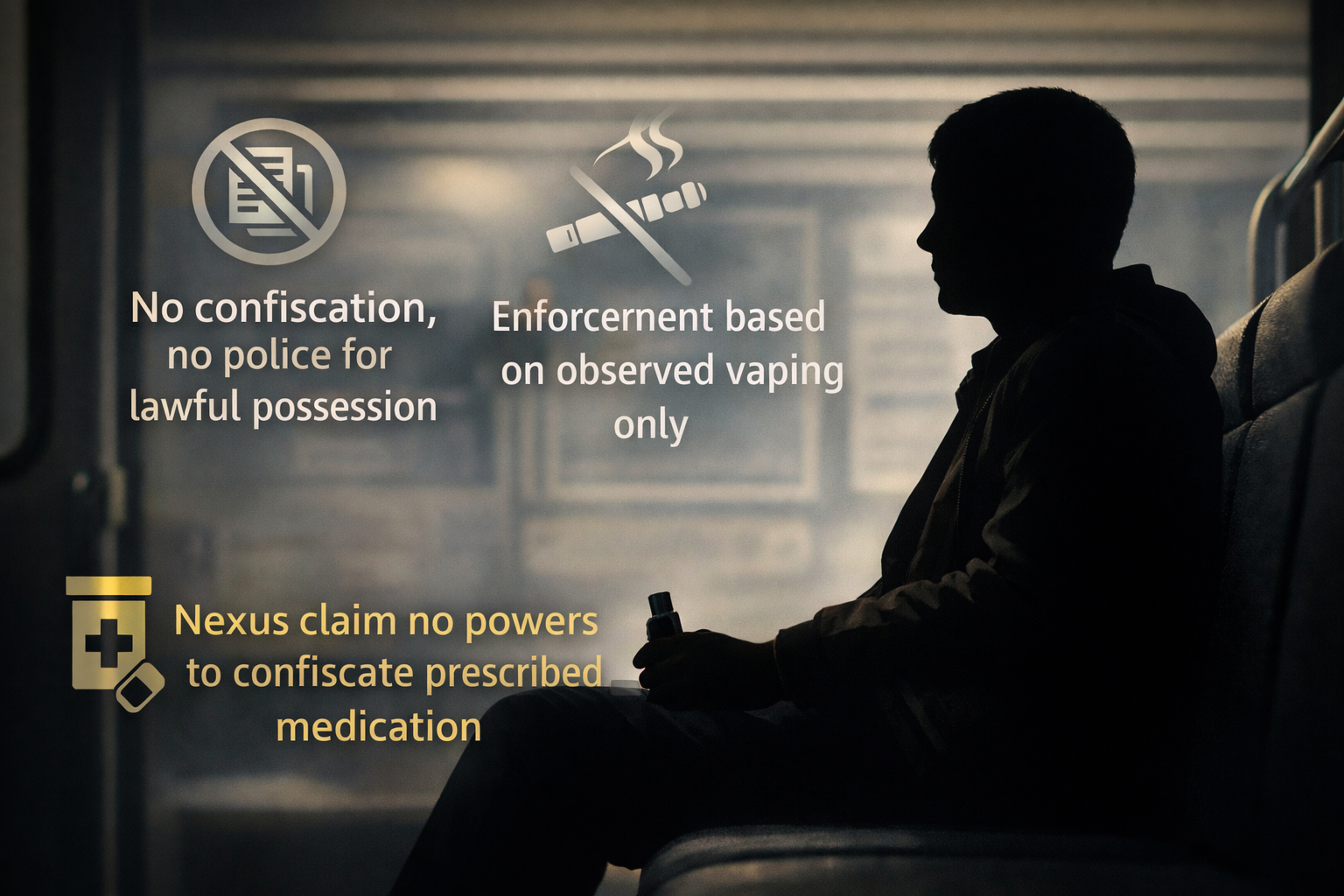
- No confiscation of prescribed cannabis or devices. Customer Service Advisors will not remove or confiscate medical cannabis or associated devices. They also state that advisors “will not remove any personal belongings from passengers, this includes prescribed medication”.
- No police solely for lawful possession. Nexus confirms that staff have no authority to treat lawful possession of prescribed medical cannabis as a criminal matter. Police may be called if a passenger is breaching the byelaw by using a vaping device on Metro infrastructure, not simply because a passenger lawfully possesses medication.
- Enforcement is limited to observed vaping. Nexus explicitly confirms that “enforcement action under the byelaw is limited strictly to observed vaping” and that possession of a device, the presence of prescribed medication, or perceived smell alone does not constitute an offence under the byelaw.
- No powers to remove or detain passengers. Customer Service Assistants “are not medically trained and have no legal power or authority to remove or detain passengers”. If they believe a byelaw is being breached they may request assistance from the Metro Police Unit.
On training, Nexus is blunt:
- Metro customer service staff are not trained in the Misuse of Drugs Regulations 2001.
- They do receive an introduction and training on the Equality Act 2010, including how to support passengers who are protected under the Act, with a mandatory assessment and regular refresher training.
- All new Customer Service staff do three weeks of in person training covering revenue protection procedures, scenario based learning, hazard identification, recognition of suspicious items, customer service standards and conflict management.
None of this creates dedicated medical cannabis guidance, but it does give passengers clear written boundaries to point to if staff or contractors overstep.
Thresholds for action, what is and is not an offence
The FOI response originally said Nexus held no internal recorded guidance on enforcement thresholds under the vaping byelaw. The customer relations response fills part of that gap.
On paper, the position is now:
- Vaping with a device on Metro trains or stations is a byelaw breach.
- Staff should give one warning, then prosecute if the person refuses to stop.
- Confiscation of prescribed cannabis or devices is not permitted.
- Possession of a device, the presence of prescribed medication, or smell alone does not constitute an offence under the vaping byelaw.
There’s still nothing formal on:
- How staff should approach situations where prescribed cannabis is involved and other passengers complain.
- How staff should record incidents involving prescribed controlled medication, short of observed vaping.
- How to avoid sliding from “enforcing a vaping byelaw” into “treating a disabled patient as a drug offender”.
The line on paper is clear, enforcement has to be based on observed vaping, not smell or possession. The risk is that front line practice doesn’t always follow that line when stigma, complaints, or pressure to “do something” enter the picture.
Why this matters for disabled and medicated passengers
If you have a lawful prescription for a cannabis based product, the FOI and the customer relations correspondence together tell you a few practical things about travelling on the Metro:
- Metro staff are not trained on medical cannabis at all. They’re trained on vaping and “banned drugs”. If you’re challenged, you’re starting from a place where your medication is not part of the mental model.
- The system is built around behaviour, not context. Staff are told to respond to observed vaping and refusal to comply, not to consider whether a device or smell relates to prescribed medication.
- Equality training exists, but it’s generic. Staff get Equality Act training and accessibility policy content, but the written materials on the vaping byelaw don’t join that up with prescribed controlled drugs or medical cannabis.
- There is at least a written ceiling on overreach. Nexus has now confirmed in writing that staff can’t confiscate prescribed cannabis or devices, can’t treat lawful possession as criminal, and can’t rely on smell or possession alone for enforcement. That gives you something concrete to quote if you need to push back.
Some staff will use common sense and listen when you show a prescription or explain your medication. Others will lean on “banned drugs” stereotypes. The system they work in still hasn’t been designed with prescribed cannabis patients in mind.
What should have been in place
Nexus could easily have included, in the same training materials:
- A one page note on prescribed controlled drugs, including cannabis based products, explaining that lawful possession is not a banned drug offence.
- A simple instruction such as, “If a passenger says they are on prescribed medical cannabis, focus on vaping behaviour, not possession, and don’t treat lawful medication as a byelaw or criminal matter in itself.”
- A clear reminder of Equality Act duties, including the need to avoid harassment or victimisation of disabled people because of their medication.
- A line in the equality statement recognising that some disabled passengers will have medication that smells or looks like recreational drugs, and that this requires more care, not less.
Instead, medical cannabis remains invisible in the core paperwork. The only recognition sits in a customer relations email, not in the documents that actually train and guide staff day to day.
Where this leaves passengers
From a transparency point of view, the FOI and the customer relations correspondence were useful. They confirmed:
- What Metro staff are actually told to do under the vaping byelaw.
- How equality was considered at policy level.
- That there was a complete policy vacuum around prescribed cannabis based medicines, and that Nexus now accepts clear limits on staff powers in writing.
From a rights perspective, there’s still work to do.
If you’re a medical cannabis patient using the Metro, it’s worth:
- Carrying proof of prescription and stating clearly that the product is lawfully prescribed medication if challenged.
- Making a note immediately after any incident of what was said and done, who was present, and whether anyone mentioned banned drugs or threatened police involvement.
- Using Nexus complaints processes where staff behaviour crosses the line from enforcement into harassment, and citing the Equality Act and Nexus’ own written assurances where needed.
For anyone designing transport policy, the lesson is simple. If you’re going to police vaping in a world where cannabis based medicines are lawful and prescribed, you can’t pretend that patients don’t exist. You have to build them into the rules, the training, and the equality paperwork from the start, not bolt them on after the first complaint lands.

Be First to Comment