Defamation in the UK: The Absolute Defence of Truth and What Actually Protects You
If you write critically about organisations or individuals, you will eventually encounter the word “defamation” — usually as a threat. Here is how the law actually works, and why truth is your most powerful shield.
Whether you are an accountability journalist, a blogger, someone documenting institutional wrongdoing, or simply a person who has been treated badly and wants to speak publicly about it — at some point you will be told your words are defamatory. Usually with a strongly-worded letter attached.
Understanding how UK defamation law actually works, rather than how powerful organisations want you to think it works, is one of the most practically useful tools you can carry. This article draws on an excellent explainer by Alan Robertshaw of Art of Law — a genuinely outstanding resource for litigants in person and anyone wanting to understand the law without needing a law degree. His video on UK defamation law is well worth your time.
What Is Defamation, Actually?
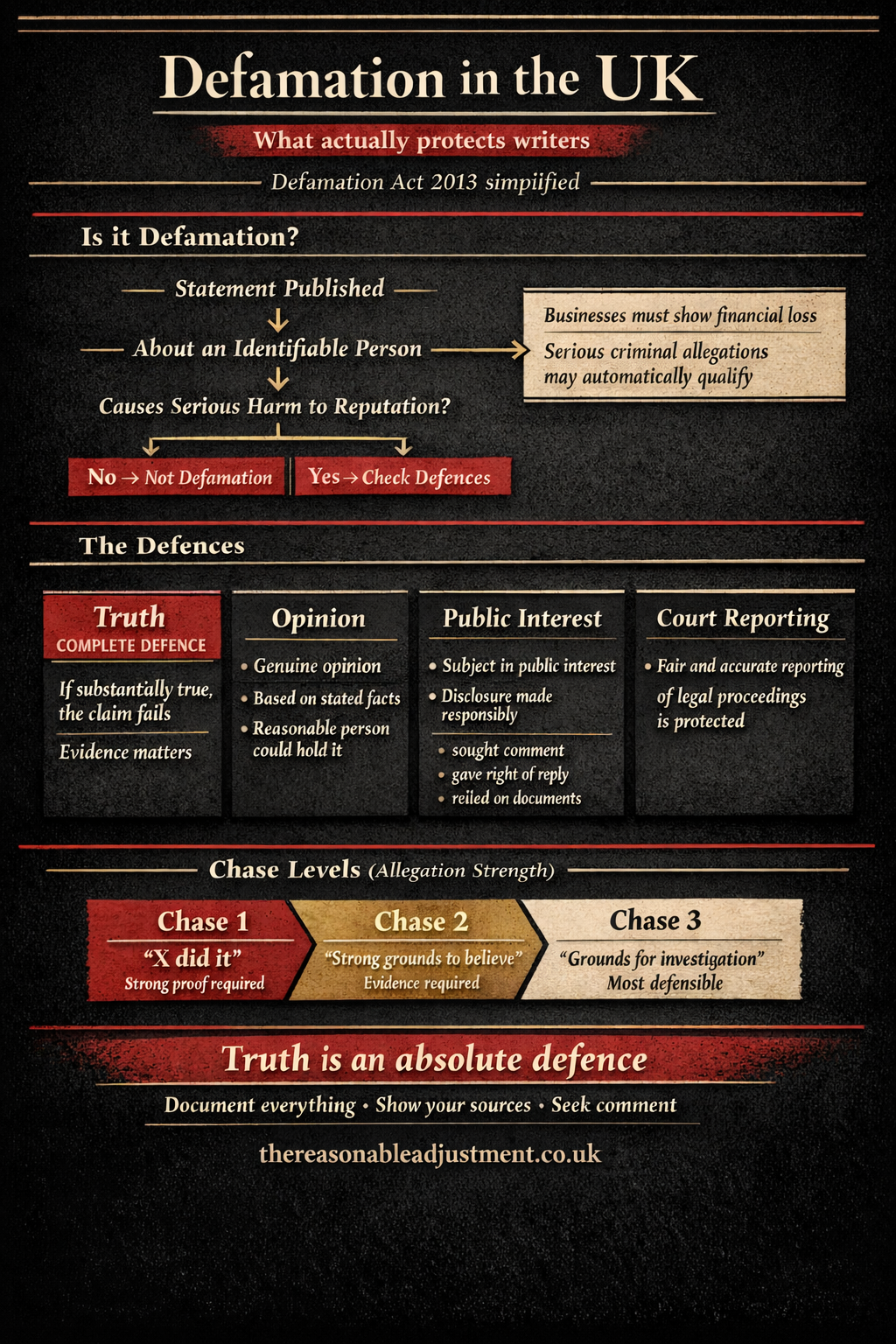
Defamation is a false statement of fact that damages someone’s reputation. Under the Defamation Act 2013, a claimant cannot simply claim hurt feelings or suggest that “people might think less of me.” They must demonstrate serious harm — either harm actually suffered, or a real tendency for the statement to cause it.
For companies and businesses, serious harm must be financial. For individuals, it can take other forms: damaged relationships, people avoiding them, professional consequences.
If you allege someone has committed an offence carrying a sentence of 12 months or more, courts treat that as inherently capable of serious harm. You don’t need to prove the harm separately — the nature of the allegation does that work. This makes allegations of serious criminality among the most legally significant statements you can make.
Chase Levels: How Courts Assess Allegations
When an allegation concerns wrongdoing, defamation law uses what practitioners call “Chase levels” — a spectrum that runs from the most definitive claim to the most tentative. Understanding where your statement sits on this spectrum matters enormously.
| Level | Meaning | Legal Implication |
|---|---|---|
| Chase 1 | This person definitely did it | Hardest to defend; requires strong proof of truth |
| Chase 2 | Strong grounds for believing they did it | Easier to defend with substantial evidence |
| Chase 3 | Grounds for investigating whether they did it | Most defensible; you’re calling for scrutiny, not verdict |
This is why careful investigative writing says things like “questions remain about,” “it is unclear whether,” and “we sought comment but received no response.” That language is not evasion. It is legal precision. You are reporting at Chase level 3, not making a Chase level 1 declaration.
The Defences: What Protects You
Complete and absolute defence. If what you said was substantially true, you cannot be successfully sued — full stop. Minor inaccuracies won’t defeat you if the core is accurate.
Defamation requires a statement of fact, not opinion. But courts look at substance, not labels — “in my opinion” won’t save you if the statement is really a factual claim in disguise.
Two-limb test: the subject must be in the public interest AND the way you disclosed it must be responsible. Seeking comment, giving a right of reply, and referring to authorities all support this defence.
Fair and accurate reporting on legal proceedings is protected. Ongoing cases require you to make clear the case is part-heard. Concluded cases require the full picture, including the outcome.
Defence 1: Truth — The Absolute Shield
Truth is a complete and total defence to defamation. If what you published was true — or substantially true — no claim succeeds. You do not need to get every minor detail correct. If the substance stands up, small errors won’t sink you.
The classic illustration: if you report that someone robbed Barclays and it turns out it was NatWest, the substantial truth — “bank robber” — remains intact. The minor error doesn’t undermine the defence.
The practical implication of this is simple: document everything before you publish. Keep your sources, correspondence, screenshots, FOI responses, and contemporaneous records. Truth as a defence is only as strong as your evidence.
Defence 2: Opinion — The Traps to Avoid
Because defamation requires a statement of fact, statements of genuine opinion are not defamatory. But this defence has teeth — and a lot of people get caught on them.
Simply saying “in my opinion” does not automatically protect you. Courts look at what the statement actually is. If your labelled “opinion” is really a factual assertion in different clothes, it fails. For the opinion defence to succeed, all of the following must be true:
- It must actually be an opinion, not a factual assertion
- It must be based on facts — and you must point to those facts
- It must be an opinion a reasonable person could reach on those facts
- It must be an opinion you genuinely hold — not deployed to harass or attack
That last point matters more than people realise. If you’re performing outrage you don’t actually feel, or advancing a conclusion you don’t genuinely believe, the opinion defence won’t protect you. Courts examine context and motivation.
Defence 3: Public Interest — The Two-Limb Test
The public interest defence is frequently misunderstood. “The public would be interested in this” is not the same as “this is in the public interest.” The test has two distinct limbs, and both must be met.
Limb one: The subject matter must genuinely be in the public interest — the conduct of a charity misusing public funds, an organisation’s compliance with equality law, institutional failures in publicly-funded services. Not everything newsworthy passes this test.
Limb two: The way you made the disclosure must also be in the public interest. This is where process matters. Did you seek comment? Give a right of reply? Approach the relevant authorities where appropriate? This is why journalists write “we approached X for comment but received no response.” It demonstrates responsible disclosure — not recklessness.
Submitting FOI requests, making formal complaints, contacting regulators, and giving organisations the opportunity to respond before publishing is not harassment. It is exactly the process the public interest defence is built around.
Defence 4: Court Proceedings
Fair and accurate reporting on court proceedings is protected. For ongoing proceedings, you can report what was said — even one-sided testimony — as long as you make clear the case is part-heard. “The court heard… The case continues” is sufficient.
For concluded proceedings, you must present the full picture. Selectively reporting only damaging testimony while omitting the defence case or verdict is not fair and accurate reporting.
Once proceedings are live — or even contemplated — publishing material that could prejudice a jury is contempt of court. Do not refer to prior convictions, background information the jury may not know, or anything that could colour how a jury approaches a live case. This risk begins earlier than most people realise.
The Single Meaning Rule
One of the more unusual features of English defamation law is the single meaning rule. Even where a statement has multiple possible interpretations — some defamatory, some not — the court must identify one single meaning it believes most readers would take from it.
It is not a defence to say “many people would have read it non-defamatorily.” The judge decides the dominant meaning, and that is the one that counts. Judges approach this as an ordinary reader would: not as a lawyer, not overanalysing, not in bad faith or good faith — just what does this actually say at first reading?
SLAPPs: When Defamation Law Is Used as a Weapon
Strategic Litigation Against Public Participation — SLAPPs — is the use of legal proceedings or the threat of legal proceedings not to genuinely protect a reputation, but to silence criticism and shut down public scrutiny.
Courts are increasingly alert to this pattern. The factors they examine include the reasonableness of the claimant’s position, the tone of pre-action correspondence, and whether the litigation has any realistic merit or is essentially a pressure tactic designed to exhaust the defendant.
The no prior restraint principle is also important here: courts will generally not grant an injunction to stop you publishing something before trial. If you indicate you intend to defend the case, the doctrine of “publish and be damned” applies. Cease and desist letters are not court orders. They do not mean the sender has a case. They often mean the sender wants you to believe they have one.
7 Practical Takeaways for Writers and Advocates
- Document before you publish Truth is an absolute defence, but only if you can prove it. Keep everything — correspondence, FOI responses, screenshots, official documents.
- Link to your sources Courts treat linked material as part of what readers will see. Show your working. Link to the FOI response, the complaint letter, the Companies House filing.
- Seek comment first Give organisations the opportunity to respond before you publish. Even an unanswered request strengthens your public interest defence and demonstrates good faith.
- Know your Chase level “There are grounds for concern about X’s handling of Y” is a very different legal statement to “X is corrupt.” Be precise about what you are actually claiming.
- Distinguish fact from opinion clearly “Based on [these documents], I believe that…” is a stronger position than an unanchored assertion. Show the facts, then give the opinion.
- Don’t be intimidated by cease and desist letters They are not court orders. They do not prove the sender has a valid claim. They prove the sender wants you to stop writing.
- Learn to recognise SLAPPs If a wealthy organisation is threatening you with proceedings that seem designed to silence accountability rather than genuinely protect a reputation, courts have a name for that — and tools to address it.
A Note on This Article
This article is a general introduction to UK defamation law and is not legal advice for your specific situation. If you are facing actual defamation proceedings or threats, seek qualified legal advice.
Art of Law — Alan Robertshaw
An exceptional YouTube channel for litigants in person and anyone wanting to understand law in plain English. Alan Robertshaw has a rare ability to explain complex legal doctrine accessibly without dumbing it down. His defamation explainer informed much of this article.
Watch the Defamation Video →
Be First to Comment