Harassment is not a magic word
In modern Britain, “harassment” gets thrown around a lot. A customer sends follow up emails about a complaint. A tenant keeps contacting a housing provider. A parent keeps asking a school for information. Sooner or later someone replies that the contact is “harassing our staff”.
The word carries weight. It sounds like a criminal offence, even when the conduct is just persistence. That is why it gets used. It turns scrutiny into a threat and makes people back off.
The law, however, is not that casual. Harassment has a specific legal meaning and the bar is higher than “two messages that annoyed someone”. Shortly after this platform launched, we published The Protection from Harassment Act 1997: A Legal Lifeline for the Powerless , which explained how the Act can be used as a civil tool by people on the sharp end of institutional behaviour. This piece looks at a different angle, how criminal harassment is sometimes misused as a label to shut people up, and what R v Curtis actually says about where the line lies.
The legal framework: Protection from Harassment Act 1997
Harassment offences sit mainly in the Protection from Harassment Act 1997 . It was designed to deal with serious, oppressive behaviour, not ordinary friction between citizens and institutions.
Key elements for basic harassment are:
- A course of conduct: conduct on at least two occasions in relation to another person (section 7).
- That course of conduct must amount to harassment: behaviour that causes alarm or distress and goes beyond normal irritation or disagreement.
- The defendant must know, or ought to know, that the conduct amounts to harassment (section 1).
Higher level offences, such as putting people in fear of violence, sit in later sections, but the idea is the same. Harassment is meant to capture unreasonable, oppressive patterns of behaviour, not every awkward exchange. A useful overview is given in public summaries of UK harassment law, which describe harassment as “persistent and deliberate conduct that is unreasonable and oppressive, and calculated to cause alarm or distress”. (Harassment in the United Kingdom)
For the civil side of the Act, including how individuals can use section 3 to seek injunctions and damages where institutions cross the line, see The Protection from Harassment Act 1997: A Legal Lifeline for the Powerless .
R v Curtis: ordinary friction is not harassment
R v Curtis [2010] EWCA Crim 123 is a key Court of Appeal decision on what counts as a “course of conduct”. The case involved a turbulent personal relationship with several unpleasant incidents over about nine months.
The Court’s point was not that the behaviour was admirable. It was that harassment in law has to be more than normal, however messy, human conflict. The judges stressed that:
- Harassment must go beyond ordinary domestic or social friction.
- The conduct has to be oppressive, not just upsetting or rude.
- The relationship and conduct must be viewed as a whole, not cherry picked from isolated episodes.
Legal commentary sums it up like this, “Curtis reinforced that harassment must go beyond ordinary social friction. The behaviour must be oppressive, persistent and unacceptable, not simply rude or argumentative.” That approach aligns with other cases, such as Hayes v Willoughby , where the Supreme Court described harassment as a “persistent and deliberate course of unreasonable and oppressive conduct”. (Harassment in the United Kingdom)
Taken together, these cases show that the criminal threshold is about sustained, unreasonable pressure, not about the fact that someone disliked receiving robust correspondence.
Why “two contacts = harassment” is, as one officer put it, bollocks
On the ground, police work with two different systems:
- Crime recording rules tell forces to log a harassment crime if someone reports at least two unwanted contacts and says they feel harassed.
- Charging standards, shaped by cases like Curtis and Hayes, require behaviour that is clearly oppressive, persistent and unreasonable before prosecutors can realistically charge.
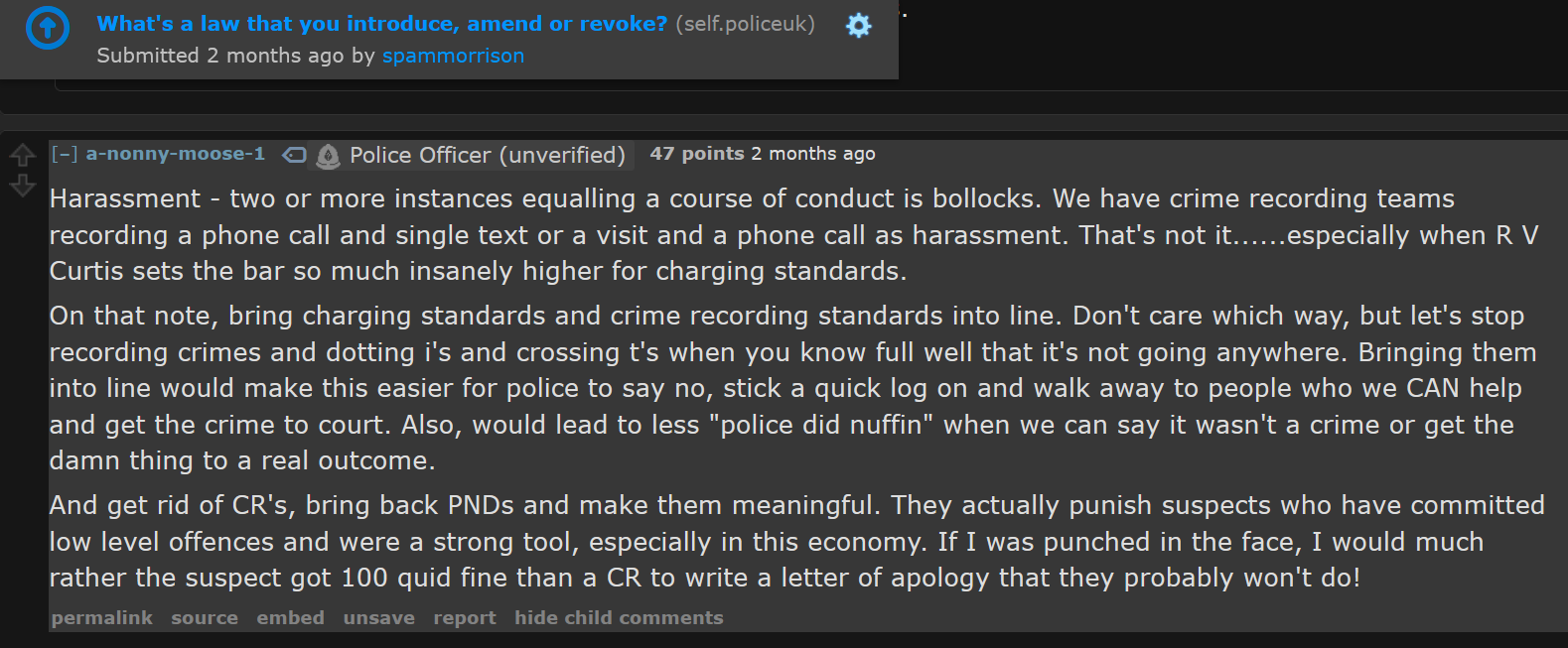
That mismatch is obvious in a discussion on the policing subreddit r/policeuk . In that thread, one officer complains that recording “a phone call and single text or a visit and a phone call” as harassment is “not it” when R v Curtis sets the bar so much insanely higher for charging standards.
The same officer calls the current situation “bollocks”: recording standards say two or more unwanted contacts, whereas charging standards demand conduct that is oppressive, persistent and unacceptable. Crime logs are being created for behaviour that everyone in the process knows will never meet the test for prosecution.
The practical result is confusion. Members of the public are told “a harassment crime has been recorded” and understandably believe they are on the brink of criminalisation, even where the legal test is nowhere near satisfied.
You do not “harass an organisation” in the abstract
The Protection from Harassment Act is written around conduct directed at a person. In practice:
- Harassment is about how someone treats identifiable individuals, not about someone criticising a brand or logo.
- It is possible for staff to feel harassed and to be protected by the law as individuals.
- It is not legally precise to say that an abstract entity is harassed in isolation from the people who work for it.
That distinction matters because it keeps a clear line between:
- Legitimate scrutiny of organisations, policies and decisions, including complaints, follow up emails and appeals.
- Improper pressure on named individuals through targeted, oppressive personal conduct.
The law is intended to restrain the latter, not to give institutions a veto on criticism by labelling it “harassment”.
What feels like harassment but usually is not, at least in law
One way to see how high the legal bar really is, is to look at some real world behaviour that many people would casually call harassment, which the law either tolerates entirely or only catches in the most extreme cases.
Paparazzi and media intrusion
Tabloid photographers waiting outside a hospital, trailing someone down a public street, shouting questions, taking photographs at their lowest point. To most people, that looks and feels like harassment.
In legal terms, it often sits in a different box, privacy and misuse of private information, sometimes defamation. Only where the conduct becomes truly obsessive, targeted and oppressive does it even start to look like harassment under the Protection from Harassment Act. A couple of unpleasant press scrums, however ugly, will almost never be charged as a criminal course of conduct.
If the law can tolerate paparazzi swarming a public figure on a pavement, it should be obvious that it was not written to criminalise someone who sends a few firm emails chasing a statutory information request.
Protest, campaigning and loud opinions
Campaigners outside a workplace with placards and megaphones. Regular protests outside a town hall. Strident criticism of public bodies on social media. To the target, this can feel relentless and deeply unwelcome. That does not make it harassment in law by default.
Protest and political speech sit under freedom of expression protections. Harassment law does not turn every forceful slogan into a criminal offence. Only when protesters cross into targeted, oppressive behaviour against named individuals, or start making threats or stalking them personally, does the line come into view.
Debt collection and commercial pressure
Repeated letters from a debt collection agency. Automated calls. Template emails that keep arriving. Again, people will describe this as “harassment” in everyday language.
Regulators in this space, such as the Financial Conduct Authority, have rules on unfair or aggressive practices. Harassment law can apply if collectors cross into oppressive, targeted behaviour towards particular individuals. But the basic fact that a company has written to someone several times about money they say is owed does not automatically reach the Curtis standard.
Online pile ons and public comment
Public figures often face storms of critical comments, replies and quote tweets. Large parts of that behaviour are unpleasant and corrosive, but most of it is still not criminal harassment in the Curtis sense. The law looks for a course of conduct by a defendant, not for the overall mood of a crowd on a given day.
Again, the pattern is the same. The legal test looks for genuinely oppressive conduct by identifiable people towards identifiable victims, not for the fact that someone is angry, persistent or outspoken in ways that make others uncomfortable.
These examples are not excuses for bad behaviour. They simply show that the criminal law already tolerates a large amount of pressure, conflict and noise in public life. Against that backdrop, describing a handful of structured, lawful emails as “harassment” starts to look less like legal analysis and more like reputation management.
How harassment labels get weaponised
Once the gap between recording and charging is understood, it becomes easy for powerful bodies to weaponise the word “harassment”. A common pattern looks like this:
- Someone persists with questions or complaints through official channels.
- The focus shifts from the substance of the issue to the “tone” and “frequency” of their contact.
- Warnings appear that further contact will be treated as harassment of staff.
- Threats follow about “taking advice from the police” or “making a formal report”.
The aim is not just to protect staff from genuine abuse. It is often to create a chilling effect. The person on the receiving end is expected to withdraw, not because their concerns lack merit, but because the risk of being labelled a harasser feels too high.
Where someone is already in a weaker position, the pressure is even heavier. People who rely on services, housing, education or healthcare are easily intimidated by the idea that continuing to push their case might be seen as criminal.
Civil empowerment: staying within the law while refusing to be silenced
The point of understanding R v Curtis and the actual harassment threshold is not to encourage abusive behaviour. It is to show that the law still leaves room for firm, persistent challenge. Criminal law sets an upper boundary on what you cannot do. The civil route under section 3 of the Protection from Harassment Act, explained in more detail in The Protection from Harassment Act 1997: A Legal Lifeline for the Powerless , gives an option when an institution is genuinely crossing the line.
1. Focus on conduct, not labels
The label “harassment” on its own does not answer anything. What matters is the underlying conduct:
- Is there a pattern of targeted, unreasonable pressure on specific individuals
- Is it persistent enough and oppressive enough to go beyond ordinary friction
- Is it intended, or obviously likely, to cause distress rather than to resolve a legitimate issue
If the answer to those questions is no, it is unlikely that the Curtis standard is met, even if someone has managed to convince a call handler to log a crime.
2. Keep communication precise and purposeful
One of the easiest ways to stay on the right side of the line is to write as if everything could be read out in court:
- Stick to facts, dates and specific questions.
- Reference policies, law or previous commitments instead of trading insults.
- Avoid personal attacks and focus on decisions, processes and outcomes.
3. Recognise that persistence is not automatically harassment
Following up, escalating via proper channels, copying in oversight bodies, using subject access rights or lodging appeals are all established civil tools. They are not, on their own, evidence of harassment.
The case law does not criminalise people simply for using the systems that exist to hold organisations to account. It is about how those tools are used, not the mere fact that they are used.
4. Ask clear questions if police become involved
If a harassment allegation is made, it is reasonable for a person to ask officers to explain:
- Whether a matter is being recorded as a crime for statistical purposes only.
- Whether there is any realistic prospect of charge given the Curtis and Hayes standards.
- Which specific acts are said to be oppressive, persistent and unacceptable.
That kind of conversation respects the role of the police while insisting that the legal threshold is applied properly, not just assumed.
5. Use parallel routes when engagement breaks down
When a body resorts to loose harassment accusations instead of addressing the problem, there are often other routes:
- Escalation to regulators, ombudsmen or professional bodies.
- Freedom of Information requests or data rights where information is being withheld.
- Independent legal advice in serious cases where rights may have been breached.
None of those steps depend on an organisation’s willingness to be comfortable. They are grounded in law, not in reputation management.
Resources and references
- Protection from Harassment Act 1997
- Overview of harassment law in the United Kingdom
- Hayes v Willoughby [2013] UKSC 17 – Supreme Court judgment
- r/policeuk discussion: “What law would you introduce, amend or revoke”
- The Protection from Harassment Act 1997: A Legal Lifeline for the Powerless
This article is for general information only and should not be treated as legal advice. Anyone facing a specific allegation should obtain advice based on their own circumstances.



Be First to Comment