
2025 traffic report for The Reasonable Adjustment
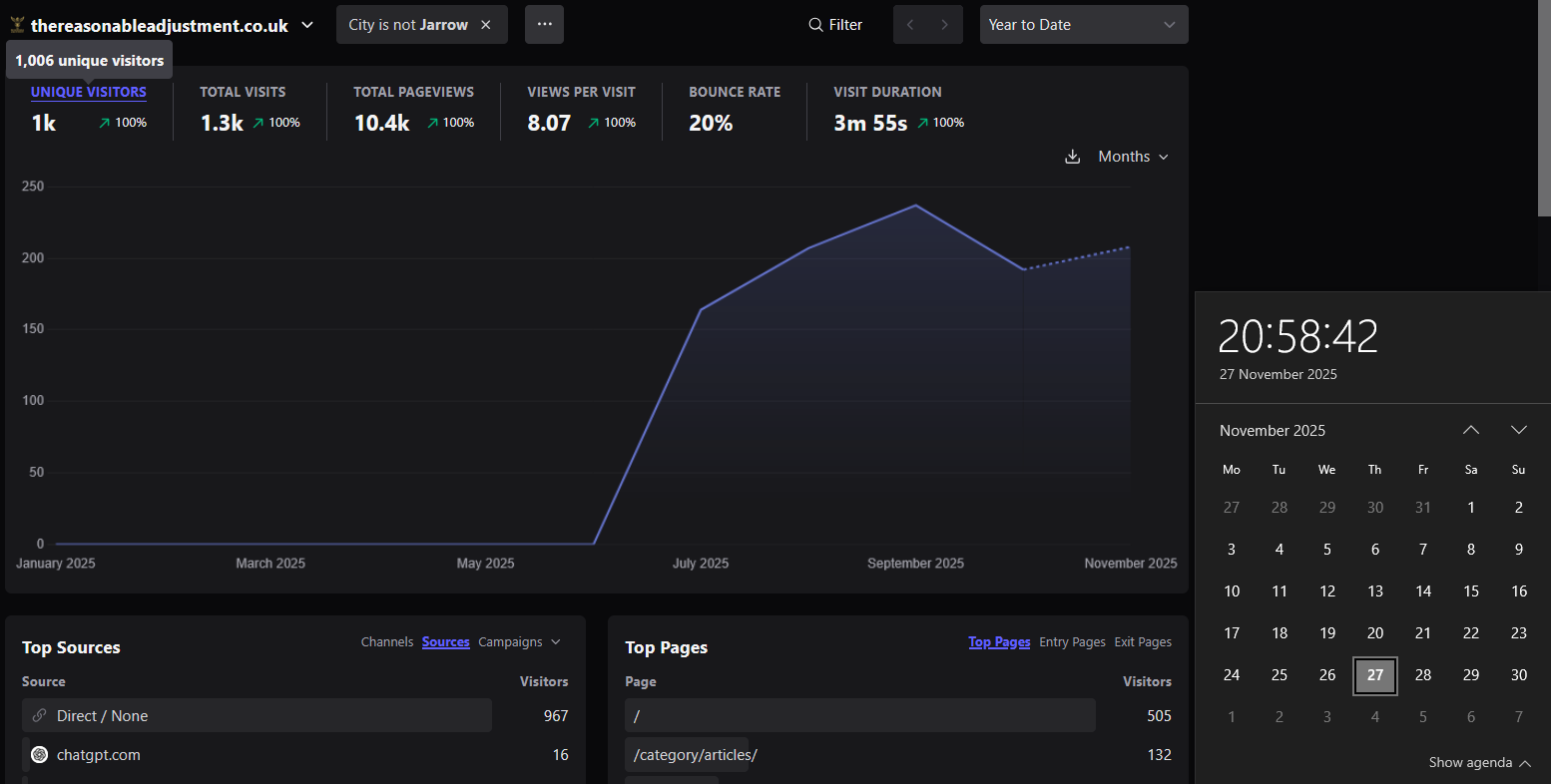
The Reasonable Adjustment went from a quiet personal rebuild to a live evidence hub in the middle of 2025. Since July, more than one thousand individual readers have generated over ten thousand pageviews, and the typical visit now involves around eight pages and almost four minutes on site.
Headline numbers for 2025 so far
- Unique visitors: just over 1,000 people
- Total visits: 1,301 sessions
- Total pageviews: 10,490 views
- Views per visit: around 8 pages per session
- Average visit duration: about 3 minutes 55 seconds
- Overall bounce rate: roughly 20 percent
For a site that launched mid year with no paid promotion, this is a strong start. People are not skimming headlines and leaving. They are clicking through timelines, case files and supporting documents, which is exactly what the platform is built for.
Growth over the year
Traffic effectively starts in July 2025. Before that, the analytics graph is flat while the site structure and first investigations were being put in place.
- July: 164 visitors, 1,071 pageviews
- August: 207 visitors, 3,245 pageviews
- September: 238 visitors, 3,504 pageviews
- October: 192 visitors, 2,192 pageviews
- November: 208 visitors with data still accumulating
The August and September spike lines up with the publication of the first full case files on The Recruitment Junction and the later coverage of Robson Laidler and the National Pharmacy Association. Once those were live, average views per visit quickly climbed into double digits for several months.
Why these numbers are a conservative baseline
The figures in this report come from Plausible Analytics, which is privacy-friendly and does not use cookies, browser fingerprinting or any intrusive tracking. This is a strength for users, but it also means Plausible only counts visitors who load the lightweight script on each page. Anyone using a content blocker, DNS-level filter, hardened browser settings or certain VPN configurations will bypass the script entirely.
Based on other network-level indicators we operate, including server-side logs, Cloudflare fingerprints and direct request patterns, the true number of unique readers is almost certainly higher. The wider activity suggests the site likely passed 2,000 unique readers at least a couple of months before Plausible shows the milestone. Plausible provides a reliable minimum, not a full count.
The pages people visit first
Most readers start on three entry points and then fan out into specific investigations.
- Homepage: thereasonableadjustment.co.uk carries more than 2,000 pageviews on its own, acting as the main hub.
- Articles hub: Articles sits at over 1,600 pageviews and is usually the second click from the homepage.
- Posts index: Posts index provides a simple chronological list and has been opened almost 1,000 times.
From there, readers either head into casework and accountability pieces, or into the medical cannabis guidance that sits alongside the justice content.
Most read accountability and casework articles
The strongest engagement comes from long form investigations where the underlying documents are provided in full. These are some of the standout pieces by traffic and time on page.
- TRJ public funding accountability timeline has more than 100 pageviews and an average time on page of around eight minutes. It pulls together council documents, emails and timelines so readers can see the gap between public statements and funding reality.
- Caught in 4K: CEO denies public funding, documents say otherwise remains a core reference piece for new readers trying to understand the wider dispute.
- Casefile: The Recruitment Junction bundles the evidence and correspondence into one place so people can follow the case without hopping between posts.
- Robson Laidler whistleblowing update and the earlier whistleblower dismissal analysis show sustained interest in how professional advisers handle complaints.
- The wider probation material, including Probation Service FOI breach and the background note Probation Service, background and context , continues to draw readers who are dealing with similar roadblocks.
Pharmacy privacy, NPA scrutiny and data rights
The second clear cluster in the analytics centres on pharmacy privacy failures and the conduct of the National Pharmacy Association and related bodies.
- NHS Pharmacy and GP reception privacy failures is already drawing visitors despite being a recent article. The bounce rate is high, which likely reflects people arriving directly from email or social shares, reading in full and then leaving rather than browsing further.
- NPA SAR refusal, no reply threats and network logs and NPA SRA allegation response failure both sit near the top of the time on page rankings. Readers are clearly taking time to work through the evidence and logs.
- Supporting pieces such as the NPA statement and invitation to comment and the earlier privacy policy work around Puro, IPS Pharma and NPA also show strong scroll depth, which suggests people read right to the end when they land on these pages.
Medical cannabis guides that people actually use
Alongside the investigations sit practical guides for UK medical cannabis patients. These pieces are less dramatic but the analytics show a steady trickle of search traffic and repeated visits.
- UK medical cannabis delivery and specialist providers walks through what actually happens when couriers, clinics and pharmacies fail to coordinate. It is one of the most visited medical pages.
- Medical cannabis and driving in the UK covers legal limits, evidence and recent case law, and is steadily building search impressions.
- Attending events with medical cannabis gives a practical checklist for festivals and venues.
- UK medical cannabis travel guide is picking up readers who are trying to navigate flights and cross border checks with a lawful prescription.
- On the lighter side, the Zookies review and strain spotlight is one of the most read single product pieces on the site, showing there is an appetite for frank, patient written strain reviews that still sit inside a rights based framework.
About pages and policy hubs still matter
It is easy to assume that nobody reads about pages. The data disagrees.
- Our mission and The Reasonable Adjustment advocacy page both sit comfortably in the top tier by traffic. People want to know who is behind the work and how far the platform will go.
- Domain ownership notice and the policy hub confirm that readers care about independence, transparency and the fine print, especially in cases where multiple domains are in play.
- AI transparency statement gives a short, clear account of how AI tools are used on the site. The page does not chase volume, it exists so readers can see the process.
What this tells us about need
The pattern across all of these numbers is simple. People will put in the time when you give them full documents, clear timelines and practical guidance that they cannot find elsewhere. They are not looking for slogans. They are looking for receipts, context and a way through systems that were not built with them in mind.
For The Reasonable Adjustment, the takeaway is clear. The work that combines lived experience, primary evidence and concrete how to steps is what keeps people on the page and brings them back. That is the direction the site will keep moving in during 2026.
If you want to follow or support the work
If you are finding the articles useful, there are a few simple ways to help:
- Share specific articles with people who need them, especially professionals who can fix problems.
- Link to relevant pages from your own blogs, newsletters or guidance notes.
- Get in touch through the contact page if you have documents, case studies or patterns that should be on record.
The numbers are encouraging, but they are not the point. The point is that people who are usually ignored are starting to find practical information that recognises what they are dealing with. That is the metric that matters.
This article is a factual summary of site analytics and public traffic trends. It does not use any tracking beyond the privacy friendly setup already described in our policy hub.


Be First to Comment