NHS Front Desks Are Leaking Dignity: Pharmacies and GP Reception Need Privacy by Default
Patients should not have to announce names, addresses, exemptions, and medical context in front of strangers just to collect a prescription or book an appointment. This is not good customer service, it is not trauma informed, and it is not safe. Privacy centric workflows exist. The NHS simply has not deployed them.
Pharmacy counters still expose personal data in public
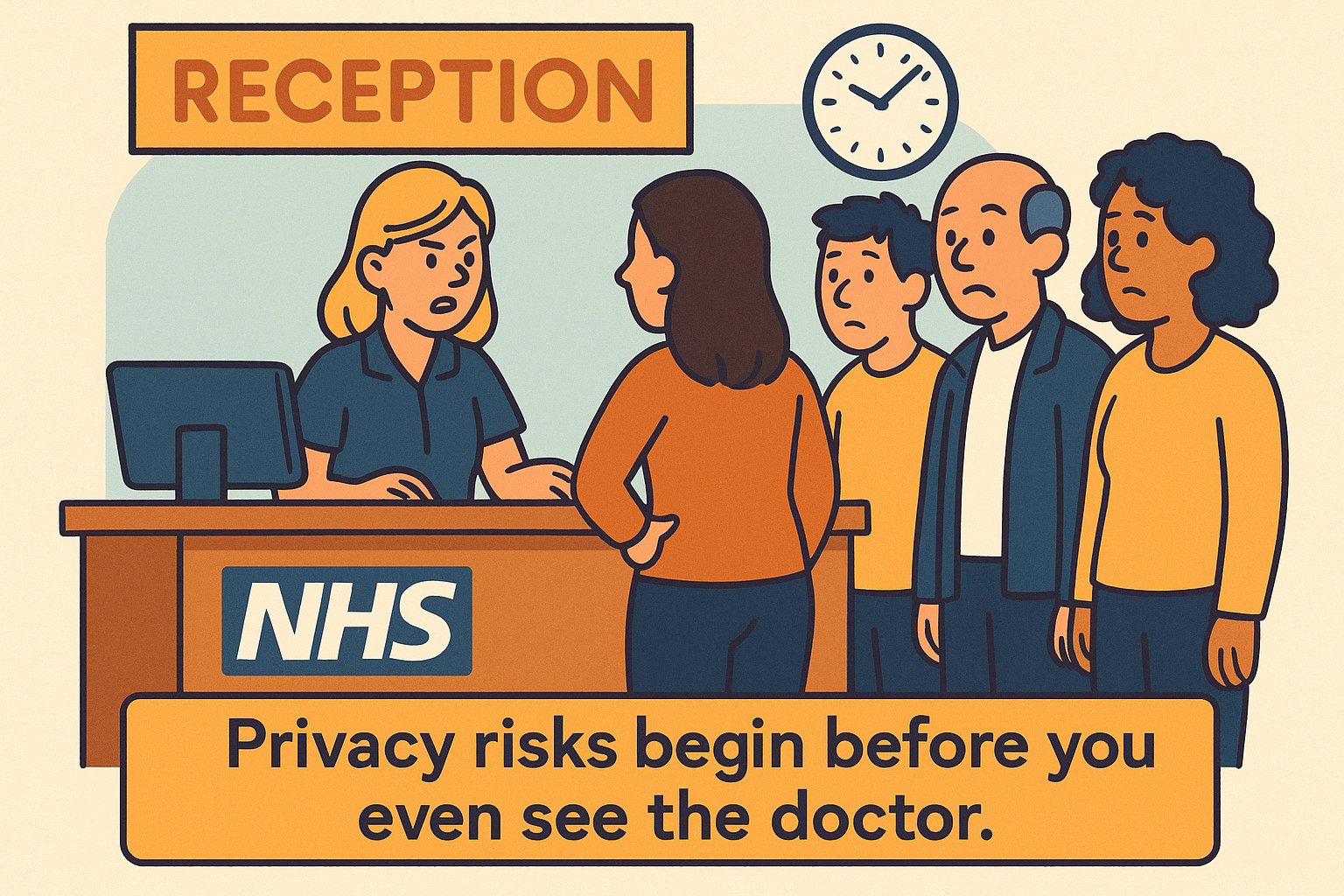
A standard NHS pharmacy interaction still begins with a public identity recital. Full name, postcode, sometimes date of birth, sometimes exemption status. All of this within earshot of other patients, delivery drivers, and whoever is browsing paracetamol nearby.
That might feel trivial to someone collecting antibiotics. It is not trivial for people managing ulcerative colitis, stoma supplies, hormone therapy, mental health medication, HIV medication, or anything that attracts stigma. Spoken data is data. Once heard, it cannot be retracted.
Then you meet the gatekeepers of the gatekeepers
GP receptionists have become the unofficial border control of primary care. The issue is not with individuals on the front desk. The issue is that the system has given them authority without giving them clinical clarity. They are expected to triage, police access, protect GP time, and manage queues. In practice this often means patients are asked to disclose sensitive medical information in a public waiting room just to prove they are worthy of a GP slot.
This creates a perverse situation. People with bowel disease, gynaecological issues, mental health crises, or domestic abuse concerns must explain themselves to a non clinical staff member within earshot of neighbours. If a private sector firm did this, it would be called a data handling failure. In the NHS it is called practice policy.
- Demanding reason for appointment in public
- Refusing to book without verbal disclosure
- Not accepting photo ID when it would reduce PII spoken aloud
- Failing to apply reasonable adjustments for autistic, anxious, or trauma affected patients
Patients are not asking for special treatment. They are asking not to broadcast their medical lives to the entire postcode.
Why are humans still doing work that software can do better
Almost everything that creates conflict at GP reception is mechanical. Identity verification, appointment availability, routine routing to nurse or pharmacist, repeat prescription status, and standard signposting can be handled by digital tools or AI chat flows that already exist. Those tasks do not need human mood, human bias, or human curiosity. They need accuracy and privacy.
AI would ask the same red flag questions every time. AI would not roll its eyes at ulcerative colitis for the fifth time that day. AI can offer a private text box instead of a public interrogation. AI can escalate to a human only when there is distress, safeguarding, or complexity. That is the correct order.
The NHS does not need more gatekeepers. It needs fewer, better trained ones, supported by automation that respects privacy.
In small communities, this becomes a safeguarding risk
In towns and estates where everyone knows each other, front desk disclosure is not just embarrassing, it is operationally risky. A patient who has moved to escape an abusive ex can have their new address heard and passed on. A vulnerable adult in supported accommodation can be identified. A person under pressure from family can have their medication recognised.
Healthcare must not rely on the hope that people in the queue are decent. Safeguarding is meant to be structural, not social.
Low friction fixes the NHS can deploy now
None of this requires reinvention of the NHS. It simply requires privacy by default.
1. QR based prescription pickup
Manage Your Meds or any NHS prescription service can generate a one time QR code once the prescription is ready. The patient walks in, scans, and the system retrieves the prescription. No postcode recital. No shouting across the room. Faster for staff and safer for patients.
2. ID first option
Patients should always be able to hand over ID quietly and have the staff member do the look up. This alone would remove most of the awkward scenarios.
3. Privacy aware reception scripts
GP receptionists should be trained to say:
- “You do not have to say that here. We can note it on the system privately.”
- “If this is domestic or safeguarding, I can move you to a private room.”
- “If you prefer, you can write it down and I will add it to the GP notes.”
That is not extra work. That is basic trauma informed service design.
4. Inclusive by design
Some people cannot or will not use technology. They can continue to use existing methods. Privacy features should be offered, not imposed. The current situation forces exposure on everyone, which is the worst possible version.
Why this matters for chronic and invisible conditions
For people living with ulcerative colitis, Crohn’s, IBS, urology issues, endometriosis, or mental health medication, discretion is not about shame. It is about control. Being forced to explain a flare, urgency, or stoma supply in public removes that control. A modern healthcare system should make it easier to manage long term conditions, not more exposing.
Frequently asked questions
Is this blaming pharmacy or GP staff
No. The criticism is aimed at process, training, and design. Frontline staff are delivering the system they were given.
Is this a GDPR issue
It can be. Spoken data in a clinical context should be minimised, especially when it can identify a person and their condition. Privacy by default is the safer interpretation.
Is this fix expensive
No. QR pickup, ID first workflows, reception scripts, and AI based triage are low cost compared to the cost of complaints, harm, or litigation after a safeguarding breach.

Be First to Comment