Last updated on March 18, 2026
Can UK Police Verify a Medical Cannabis Prescription? A Home Office FOI Reveals They Don’t Know Either
A Freedom of Information request returned one document on CBPM policy: a 2025 email from a serving response officer asking whether prescriptions require a Home Office exemption licence. They don’t. They haven’t since November 2018.
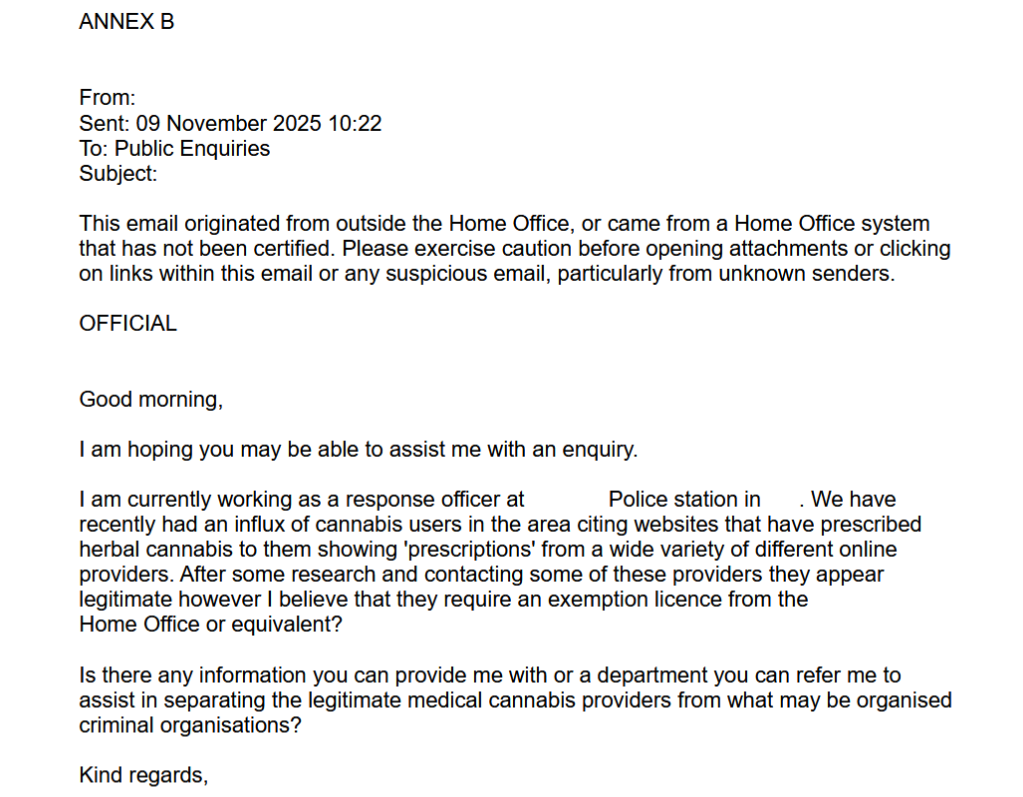
In November 2025, a serving police response officer in England emailed the Home Office public enquiries inbox. They had been dealing with an influx of people in their area presenting herbal cannabis alongside prescriptions from online providers. They were trying to work out how to distinguish a legitimate prescription from criminal supply and, in the email, raised whether a Home Office exemption licence might be part of the picture.
It isn’t. Cannabis-based products for medicinal use were moved from Schedule 1 to Schedule 2 of the Misuse of Drugs Regulations 2001 on 1 November 2018, allowing doctors on the GMC Specialist Register to prescribe CBPMs without any individual Home Office authorisation. The Home Office does issue controlled drug licences, but those cover producers, manufacturers, and commercial importers, not prescribers or patients.
This FOI was submitted in February 2026 as part of a batch of eight requests following the Albert Hall Manchester incident, in which a patient was refused entry and told cannabis flower “can’t be legitimately prescribed.” The request asked for any finalised policy documents, guidance notes, briefing papers, or written advice held by the Home Office on CBPM recognition and handling. The response contained one document.
It was the officer’s email.
The officer’s email
The email, dated 9 November 2025, describes an area that had recently seen an increase in people presenting herbal cannabis alongside prescriptions from “a wide variety of different online providers.” The officer had done some research and contacted some providers directly, concluding they appeared legitimate, but was unsure how to tell those apart from organised criminal supply. Their email ends with the following:
“I believe that they require an exemption licence from the Home Office or equivalent?” Serving response officer, emailed to Home Office public enquiries, 9 November 2025
The officer had clearly done some groundwork before writing. The issue is not with them individually. The NPCC published operational guidance on CBPMs for officers (PDF) a year after the legal change. Six years on from that, a response officer handling this on the ground was still working from a mistaken premise, and had to email a public enquiries inbox to get an answer.
What the Home Office replied
The reply, dated 21 November 2025, is accurate. It covers the 2018 rescheduling, confirms there is no approved list of prescribers (all specialists on the GMC register can initiate prescribing of unlicensed CBPMs), and sets out a practical process for verifying a prescription:
- Check the provider on the Care Quality Commission register. Note: not all providers fall within the CQC’s scope.
- Check the prescribing doctor’s name on the GMC Specialist Register. The clinician signing the prescription may be acting under the direction of a specialist rather than being one themselves.
- Look for the six-digit prescriber identification number on the private prescription form (FP10PCD, or the Welsh or Scottish equivalent).
- If there is reason to suspect the prescription is false, contact the prescriber or clinic directly to verify.
The response notes these checks do not cover every lawful prescription, which is a fair caveat. Even so, this is the most detailed verification guidance on CBPMs that any central government body appears to have produced for a public audience. It has not been formally published or issued to police forces. It was written in response to one email and has sat in a mailbox since November 2025.
If you are stopped, questioned at a venue, or refused entry, the steps above are now public. Original pharmacy packaging with a dispensing label matching your ID is standard evidence of a lawful prescription. The prescriber’s details can be checked against the GMC Specialist Register by anyone with internet access. If you are told “only oils can be prescribed” or that flower requires a special licence, ask which law that comes from. It is not in the Misuse of Drugs (Amendment) Regulations 2018. For how this plays out at a venue in practice, see the Albert Hall Manchester piece.
What the Home Office holds on Albert Hall Manchester
Points two and three of the request asked whether the Home Office held any complaints, correspondence, or meeting notes relating to Albert Hall Manchester and medical cannabis. The search returned nothing.
That is consistent with what was already known. The Albert Hall incident was resolved at venue level without escalating anywhere that would produce a central government record. There is no national mechanism for logging these incidents. Those that get sorted out quietly generate no data, and leave nothing for policymakers to act on.
The same pattern came up in the DVLA FOI on medical cannabis and driving. Across multiple institutions, the legal position has been settled since 2018. At frontline level, it frequently hasn’t filtered through.
Be First to Comment