
Clean Slate Solutions and The Recruitment Junction both work in the same sensitive space, helping people with criminal records move into paid work. This piece looks only at their public facing homepages as they appeared on 5 December 2025 and asks a simple question: what story does each site tell in the first few seconds a visitor arrives?
We have no affiliation with either organisation and we do not endorse or oppose either of them. The aim is to walk through what a visitor actually sees, side by side, so readers can form their own view about tone, focus and trust.
Why homepages matter for trust
Most visitors, including funders, commissioners and potential service users, will decide how they feel about a charity within a few seconds of landing on the homepage. They may not read a full report or annual review, but they will see:
- Who or what is shown in the main image
- What the biggest heading says
- Where the first scroll takes them
- Whether the page loads quickly or feels sluggish
With that in mind, we captured two views for each charity: the initial view when the homepage opens, and the next section after a single scroll.
Clean Slate Solutions – first impression
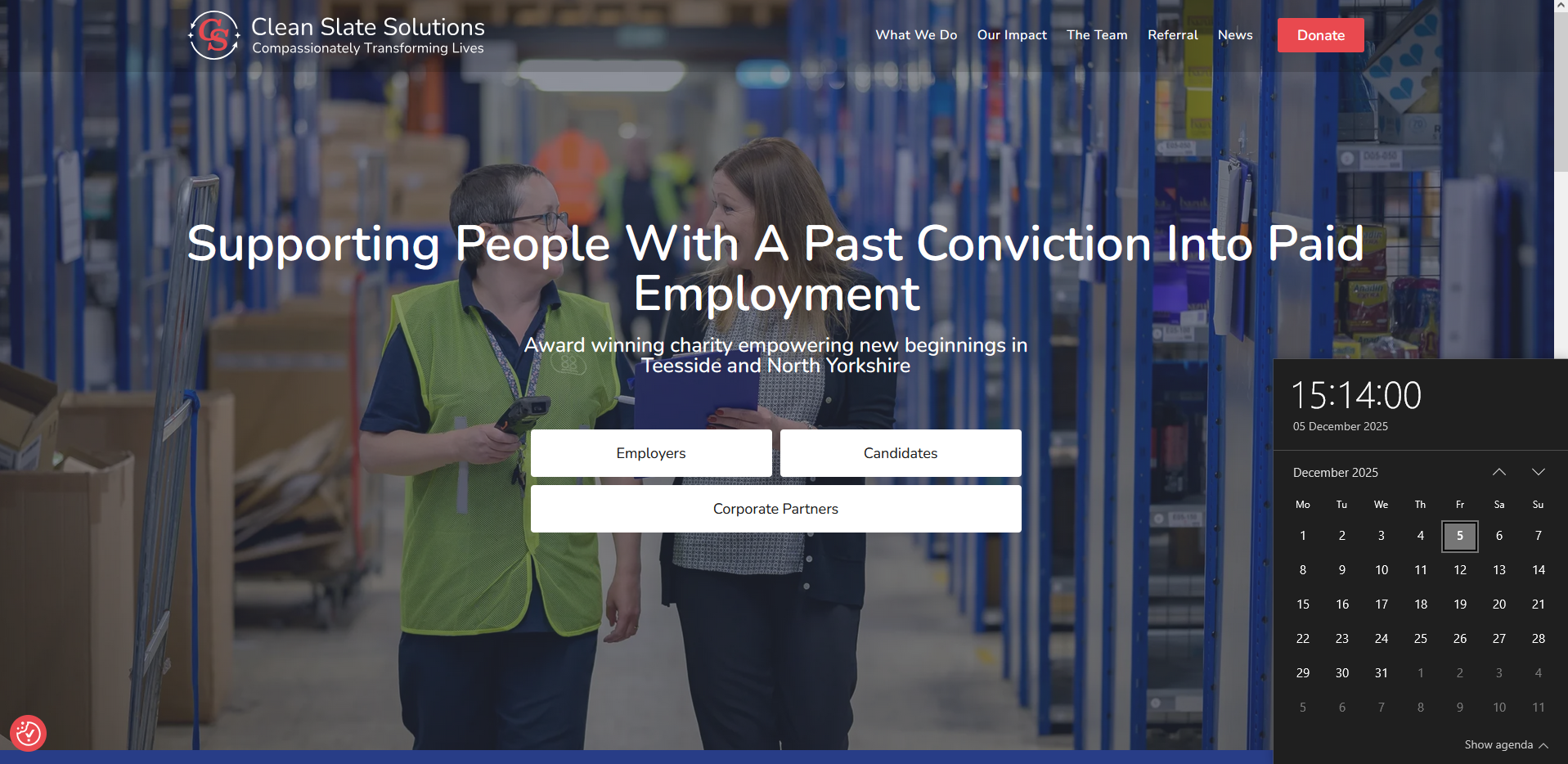
The first view of Clean Slate Solutions is dominated by a full width photograph. Two people are talking in a warehouse setting, one in a high visibility vest, the other holding a folder. It feels like real work, not a stock lifestyle shot.
Across that image sits a clear headline: “Supporting People With A Past Conviction Into Paid Employment”. Underneath, a simple line explains that this is an award winning charity working in Teesside and North Yorkshire.
Three central buttons invite visitors to choose their route: Employers, Candidates and Corporate Partners. Navigation in the top right offers “What We Do”, “Our Impact”, “The Team”, “Referral” and “News”, plus a red “Donate” button. In a single glance, a visitor can see:
- Who the charity supports
- Roughly where they operate
- How to start if they are an employer, a candidate or a partner
Nothing here centres an individual personality. The focus is on people with past convictions, their employment journey, and the partners who may hire them.
Clean Slate Solutions – first scroll
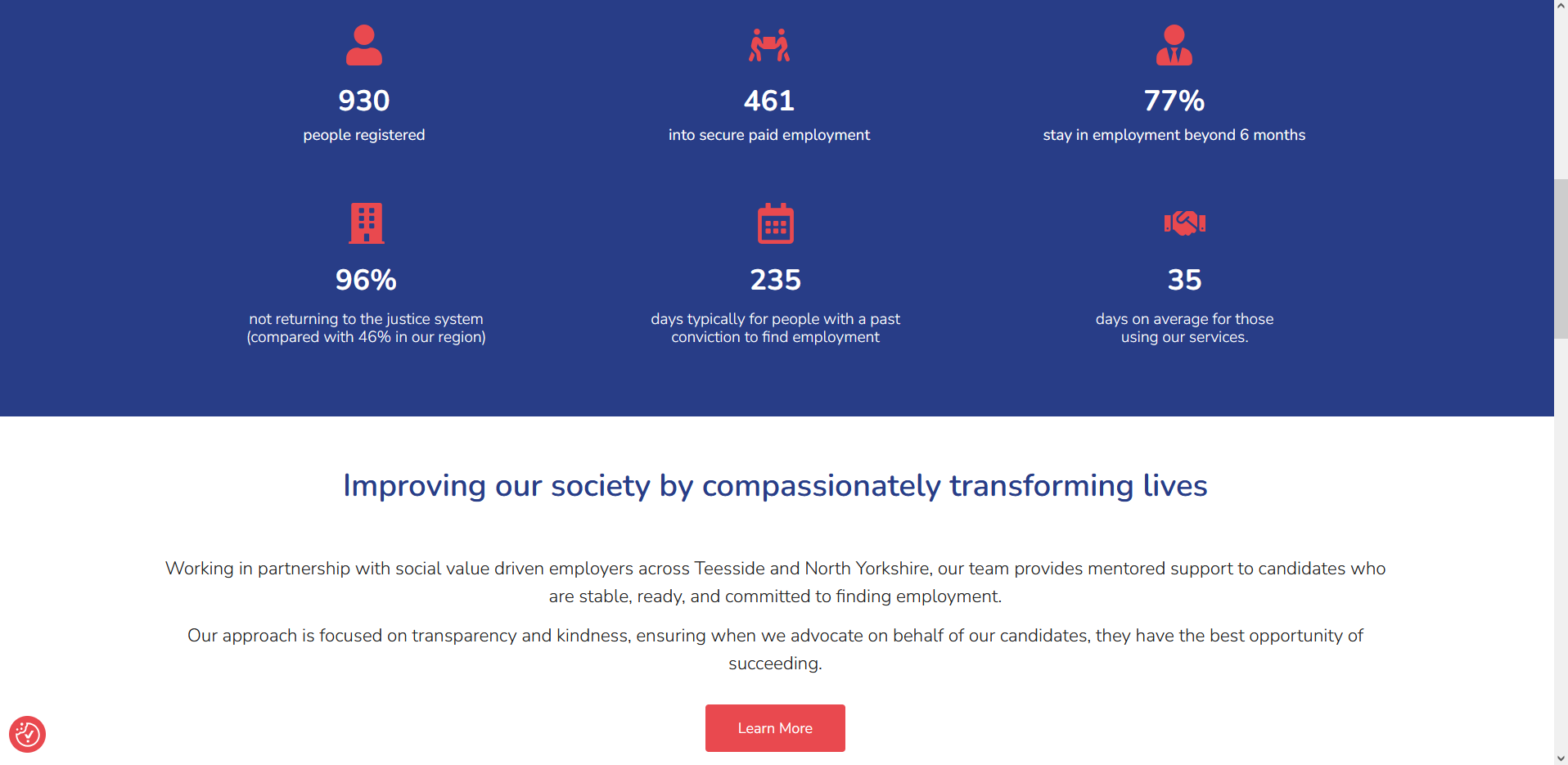
One scroll down, the page moves straight into impact data. A bold blue panel presents headline numbers:
- People registered
- People into secure paid employment
- Percentage not returning to the justice system, compared with the regional figure
- Average days to secure employment
- Average days of engagement for those using the service
These are not long stories or emotional appeals. They are simple metrics that answer the question, “Does this organisation achieve anything in practice?”
Beneath the numbers sits the line: “Improving our society by compassionately transforming lives” and a short paragraph about working with social value driven employers, transparency and kindness. The emphasis is still on candidates and employers, backed by numbers rather than personal biography.
The Recruitment Junction – first impression
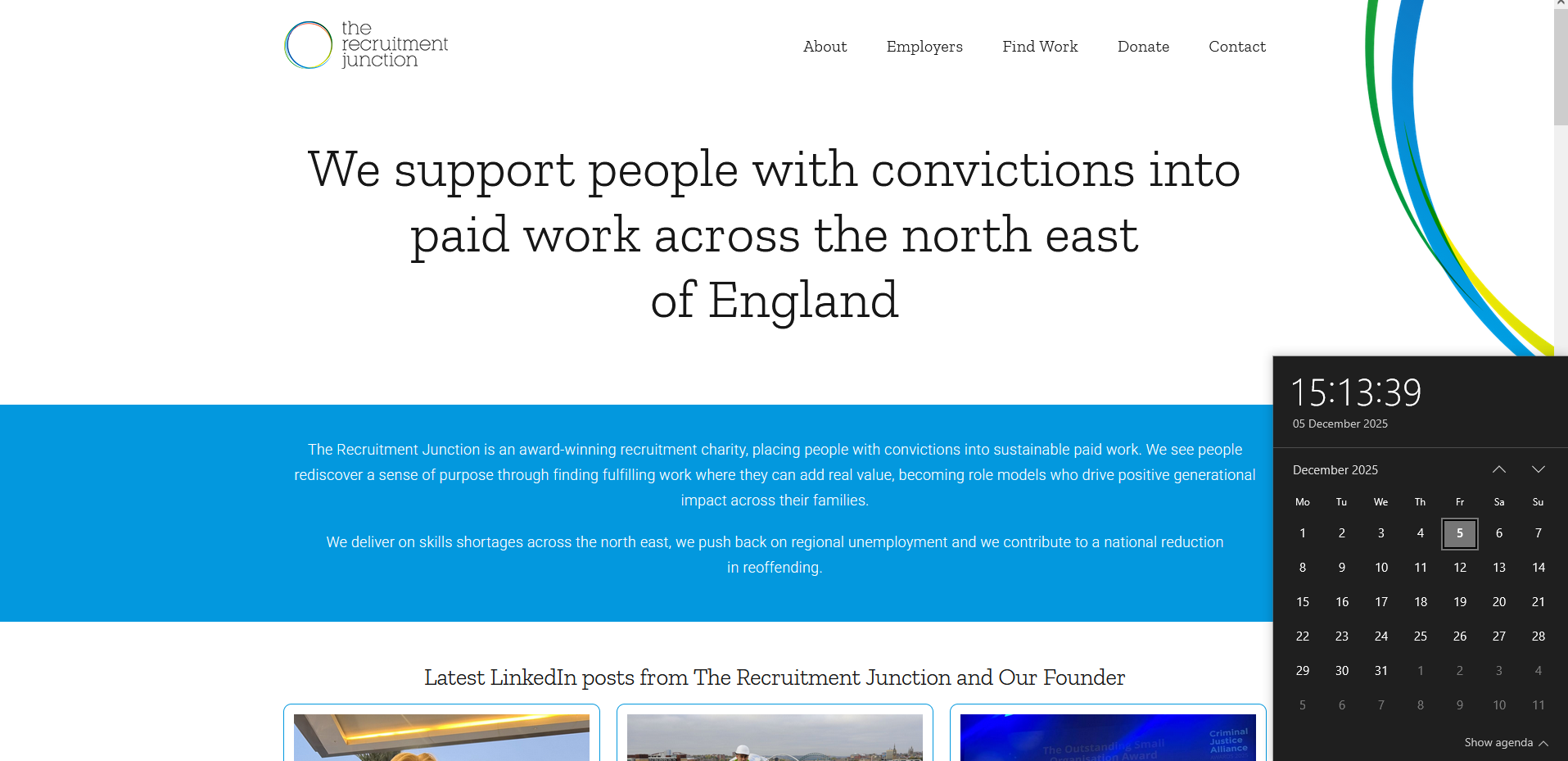
The Recruitment Junction homepage opens with a white background and a large slogan: “We support people with convictions into paid work across the north east of England”. It is a clear statement of intent, similar in subject matter to Clean Slate Solutions.
Underneath sits a wide blue band of text explaining that the charity is “award winning”, focused on sustainable paid work, and helping people rediscover a sense of purpose. It also mentions skills shortages, regional unemployment and national reduction in reoffending.
Compared with Clean Slate Solutions, the first view is more abstract. There is no image of people at work, no immediate call to action for employers or candidates, and no visible statistics. The headline explains what the charity does, but the page feels visually sparse before the visitor scrolls.
The Recruitment Junction – first scroll
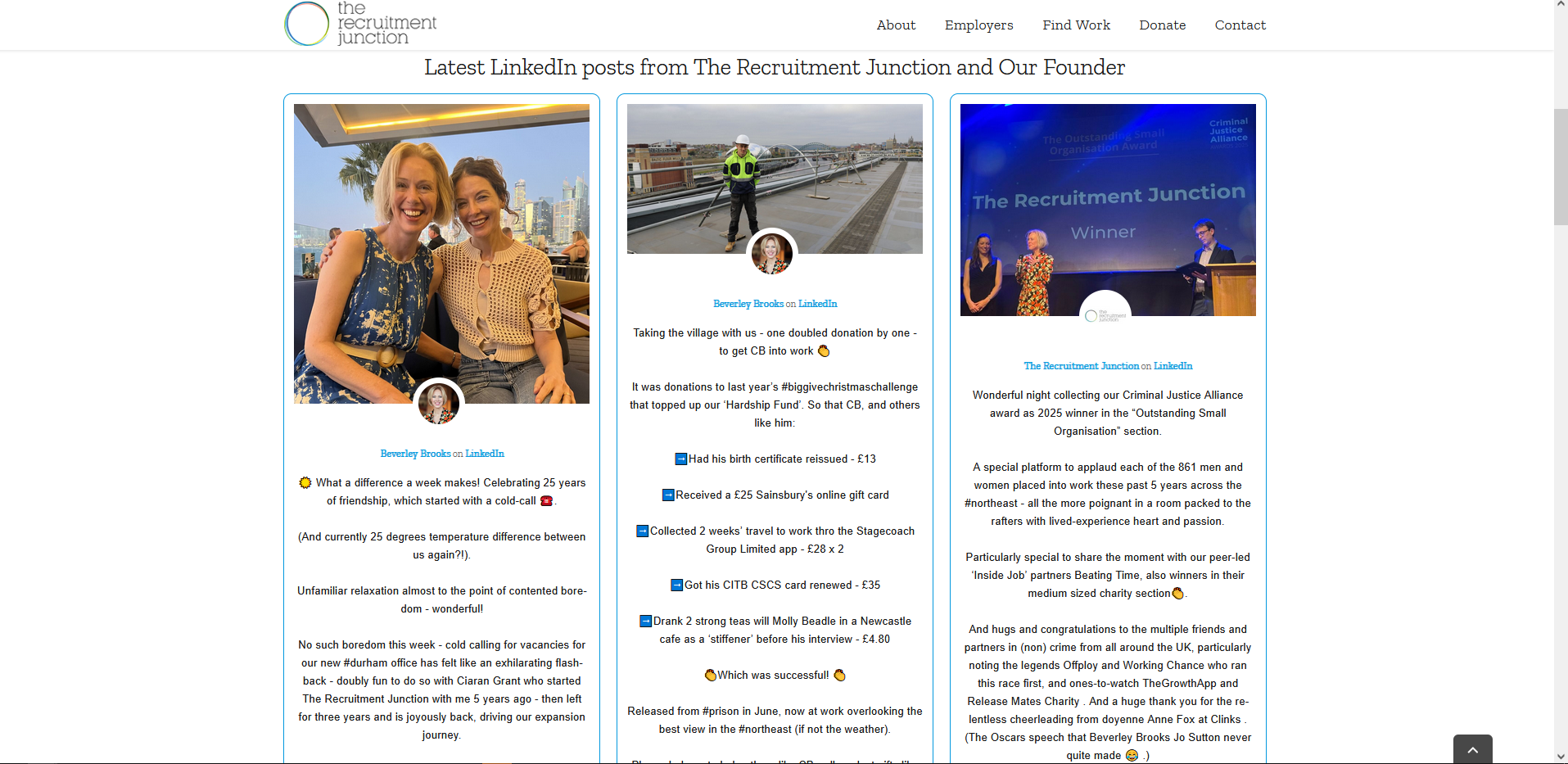
A single scroll down takes the visitor straight into a section titled “Latest LinkedIn posts from The Recruitment Junction and Our Founder”.
Three embedded LinkedIn cards dominate the view. The first shows the founder in a relaxed holiday style photograph with a friend and a long caption about friendship, weather, boredom and the charity’s new office. The second presents another founder post, this time about a candidate story and a local interview. The third is a post from the charity account celebrating an awards ceremony, with the founder pictured on stage.
There is no impact data here, no breakdown of outcomes, and no plain summary of services. The visitor’s first extended view of The Recruitment Junction is essentially a live feed of the founder’s LinkedIn activity and an awards celebration.
For some readers, this may create a sense of personality led branding. The founder’s image and voice are central, and the charity’s homepage is being used as a window into her social media presence.
Homepage by homepage, scroll by scroll
Looking only at these two views for each charity, several contrasts appear.
Who is visible
- Clean Slate Solutions shows people in a work setting, with the focus on the candidate and the mentor rather than on a named individual leader.
- The Recruitment Junction shows its founder prominently in multiple LinkedIn embeds, including holiday style and awards photos.
What is measured
- Clean Slate Solutions uses the first scroll to present outcome statistics: registrations, employment, non reoffending, time to job and engagement duration.
- The Recruitment Junction uses the first scroll to highlight narrative posts and an award, with no numerical impact data in view.
Where attention is drawn
- Clean Slate Solutions directs visitors toward “Employers”, “Candidates” and “Corporate Partners”, plus an explanation of their impact.
- The Recruitment Junction directs visitors toward the founder’s LinkedIn timeline and a recent award ceremony before anything else.
None of this proves that one organisation is inherently better than the other, or that their internal work matches their homepages. It does, however, show two very different choices about what to place in front of the public first.
Why these choices matter
For employers deciding whether to partner with a charity, for candidates looking for support, and for public bodies responsible for funding and commissioning, small design choices can send strong signals:
- A homepage that leads with beneficiaries, data and clear routes into the service may feel practical and grounded.
- A homepage that quickly pivots to founder centred social content may feel more like personal branding or public relations.
Visitors may not consciously analyse these differences, but they will notice the overall tone. In sectors involving safeguarding, justice and high levels of vulnerability, trust is often built on quiet signals of competence and humility rather than visible celebration.
No affiliation, no endorsement
The Reasonable Adjustment and Ki Ki have no formal relationship with Clean Slate Solutions or The Recruitment Junction. This article is based only on what is visible on their public homepages at a single point in time. Websites change and organisations evolve, so readers should treat this as a snapshot, not a final verdict.
We are not asking anyone to fund, avoid, support or oppose either charity. The purpose is to show how two organisations working in a similar field present themselves online, and to invite readers to pay closer attention to the digital signals that shape trust.
With that in mind, a final question is left deliberately open: if you knew nothing else and saw only these two homepages and their first scroll, which organisation would you instinctively feel more confident approaching, and why?
Further reading on The Recruitment Junction
If you found this homepage comparison useful, you may want to explore these other pieces that examine The Recruitment Junction in more depth.
- The Recruitment Junction website critique: founder vs team
A closer look at how the official site balances founder focused content against team visibility and frontline work. - The Recruitment Junction casefile
A structured timeline of events, correspondence and decisions affecting one disabled service user. - Evidence index: The Recruitment Junction
An organised index of documents, emails and public material used across The Recruitment Junction coverage. - Caught in 4K: The Recruitment Junction public funding story
A walk through public funding disclosures and how they sit alongside the charity’s public narrative. - Fact check: The Recruitment Junction public funding claims
A fact checking piece that tests specific public statements about funding against available records. - Must Not Tell Lies: The Recruitment Junction public statements
Commentary on accuracy and consistency in TRJ messaging when compared with documents and timelines. - Christian values vs The Recruitment Junction response
A reflection on stated Christian values, safeguarding language and how they align with lived experience. - The Recruitment Junction privacy notice vs practice
An examination of TRJ’s published privacy notice compared with actual handling of data rights requests.
For a full list of coverage related to The Recruitment Junction, you can also visit the The Recruitment Junction tag archive .



Be First to Comment