Last updated on August 29, 2025
Dissecting The Recruitment Junction’s Board Response, 27 Aug 2025
By: Kieron JH
Summary: The Board’s letter narrows my correspondence to three mid July emails, ignores statutory requests and safeguarding concerns, and declares the matter closed. In our view this does not close anything, it compounds liability and increases cost exposure.
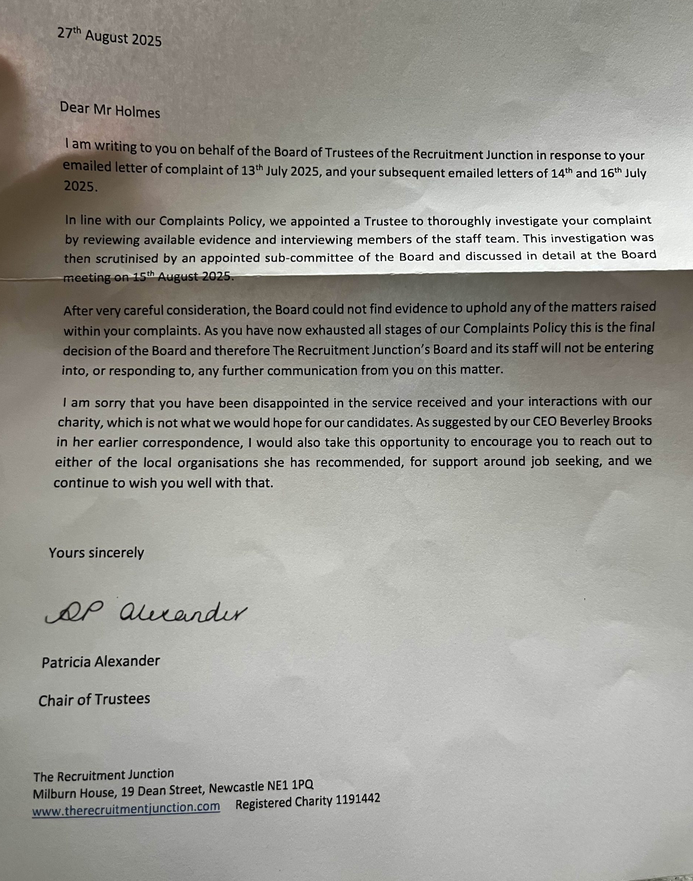
The document they sent
Patricia Alexander, you can tell this to the judge.
What the letter admits, and what it omits
The letter claims to respond to a complaint dated 13 July 2025 with follow ups on 14 and 16 July. That is it. Everything below is missing, despite being squarely in scope for lawful response.
| Date | Our correspondence or request | Status in Board letter | Why it matters |
|---|---|---|---|
| 07 Jul 2025 | Right to Erasure request, separate from any complaint | Not addressed | Statutory right under UK GDPR Article 17, not something a complaints policy can close |
| 11 Jul 2025 | Subject Access Request for all data about or referring to me | Not addressed | Statutory disclosure duty with a legal deadline, failure increases risk of damages for distress |
| 15 Jul 2025 | Request for Equality Act policies and neurodiversity training detail | Not addressed | Goes to reasonable adjustments and discrimination exposure |
| Late Jul 2025 | Safeguarding escalation to trustees regarding abrupt withdrawal of support | Not addressed | Safeguarding is not optional, it is a governance duty |
| Late Jul 2025 | Privacy Notice discrepancy escalation, including blocked email accounts and claimed deletions | Not addressed | Potential breaches of transparency and lawfulness, directly relevant to ICO scrutiny |
| Aug 2025 | Trustee governance and GDPR training queries | Not addressed | Trustees must be competent in the frameworks they oversee |
| 15 Aug 2025 | Request for board meeting notes, attendance, agenda, and audit trail | Not addressed | Evidence preservation, accuracy, and accountability for the decision they now rely upon |
Internal complaints cannot extinguish statutory rights
My Subject Access Request and my Right to Erasure are legal entitlements. They do not live inside a complaints flowchart, and they do not become optional because a board says the complaint is closed. Folding statutory requests into a narrow complaints frame is a category error that reads like governance failure.
Safeguarding and Equality are not side quests
The letter reduces a disabled service user’s experience to service disappointment. That framing avoids the real questions. Were reasonable adjustments offered in practice. Were abrupt withdrawals considered through a safeguarding lens. Were staff trained for neurodiversity in line with policy. Those are not courtesy questions, they are compliance questions.
Trustee liability and the price of stonewalling
- The letter is signed by the Chair of Trustees. That puts the decision squarely in the lap of governance, not just staff process.
- Declaring no further communication while statutory requests remain unresolved will be read as deliberate non engagement, not administrative delay.
- When a charity chooses finality over accuracy, the likely result is higher regulatory and litigation cost, not closure.
If you slam the door, check first what is still in the hallway. In this case, it is SAR, erasure, safeguarding, Equality Act duties, and meeting records.
How this compounds our claim for court
- GDPR distress due to non disclosure and confusion created by inaccurate handling of statutory requests.
- Equality Act injury to feelings where reasonable adjustments were not made and where withdrawal of support had foreseeable impact.
- Aggravation from the decision to declare finality while live requests remained unanswered, which increases perceived unreasonableness.
- Governance risk for trustees who sign off on defective processes without remedial action.
What we will submit as evidence
- The Board letter of 27 Aug 2025 shown above, with its narrow scope and finality language.
- The full sequence of statutory requests and escalations listed in the table.
- Records showing blocked email addresses and attempts to communicate in good faith.
- Any internal policy documents and training materials once disclosed, or a record of non disclosure if withheld.
Closing note
This analysis is based on documented correspondence and the Board’s printed letter. It is a fair and honest opinion on matters of public interest that involve charity governance, safeguarding, and data protection. We remain open to resolution that respects statutory rights and the dignity of disabled service users. Until then, we will continue to publish accurate information and our analysis of it.
Patricia Alexander, you can tell this to the judge.


Be First to Comment