
Last updated on July 27, 2026
By Kieron JH • Originally published 25 August 2025 • Updated 27 July 2026
Update, 27 July 2026: Kate Osborne MP is now facing national criticism after placing Reform UK, GB News and the Islamist terrorist attack on Berlin Pride within the same account of an “escalation of hate”.
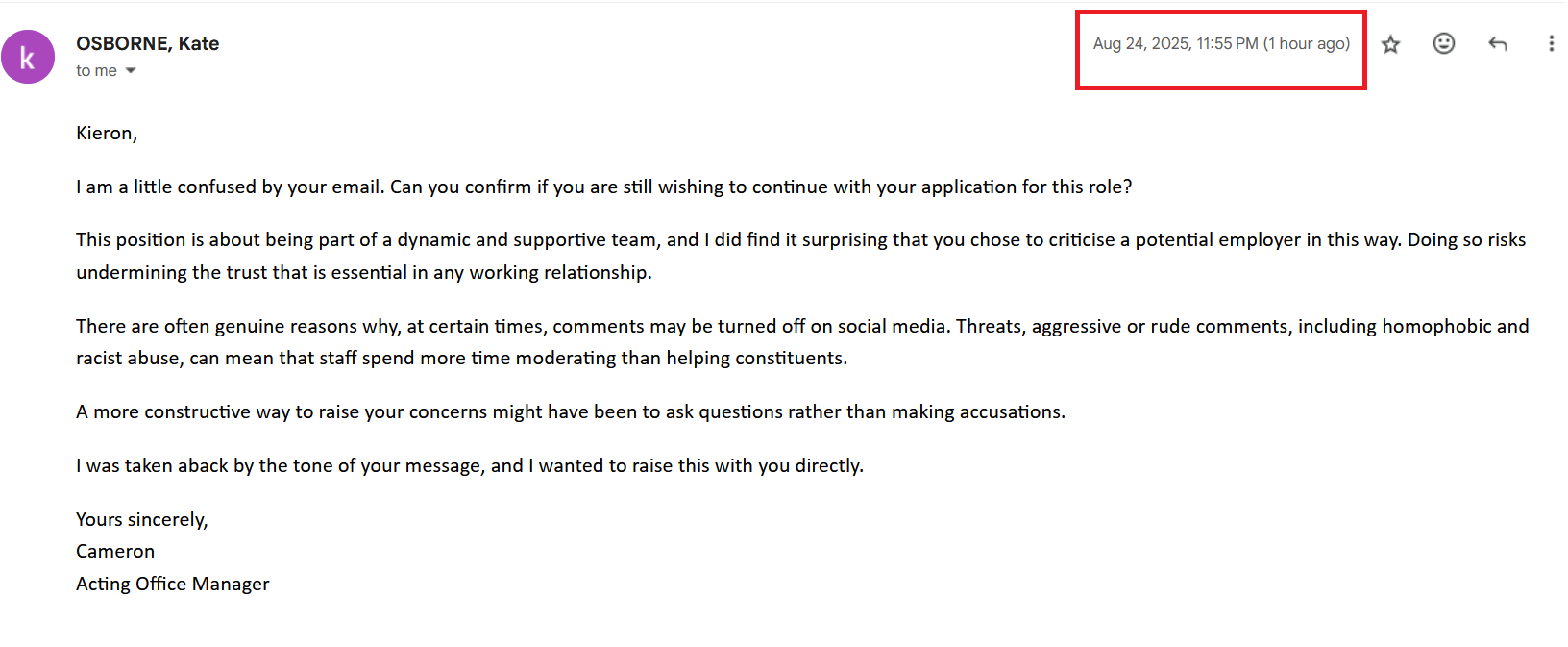
The controversy provides new context for the exchange below, in which a straightforward criticism of the office’s public communication was described as accusations and later reframed as a question of distress.
Read: Kate Osborne Faces Fresh Scrutiny Over Berlin Pride Post
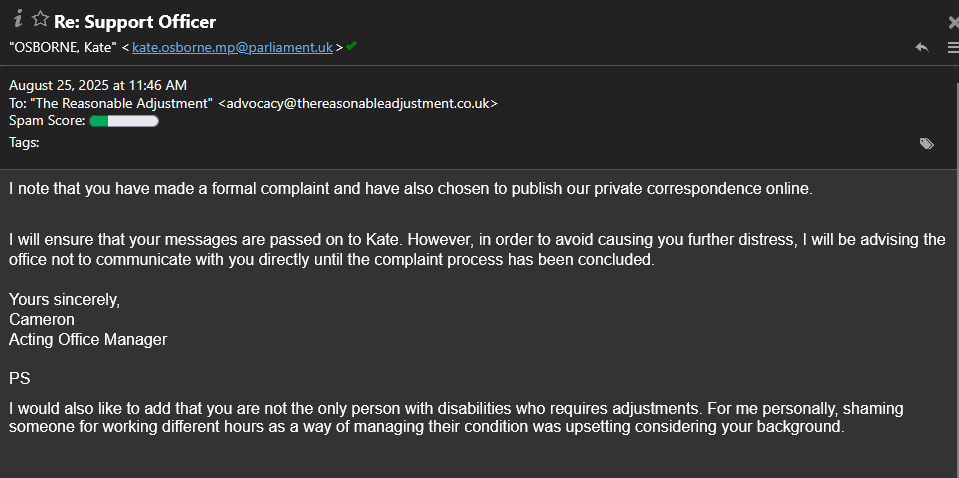
The email from Osborne’s office
I note that you have made a formal complaint and have also chosen to publish our private correspondence online.
I will ensure that your messages are passed on to Kate. However, in order to avoid causing you further distress, I will be advising the office not to communicate with you directly until the complaint process has been concluded.
Yours sincerely,
Cameron
Acting Office ManagerPS
I would also like to add that you are not the only person with disabilities who requires adjustments. For me personally, shaming someone for working different hours as a way of managing their condition was upsetting considering your background.
What led to this response
This followed an email in which I criticised comments being disabled on Kate Osborne’s public Facebook page during scrutiny concerning public spending.
I hadn’t accused Osborne or her staff of breaking the law. I said that disabling comments was lawful but created poor democratic optics while the MP was under scrutiny.
Cameron’s earlier reply described that criticism as accusations. I then published both emails so readers could compare what I’d written with how the office characterised it.
The original correspondence is reproduced in Facts, Not Accusations: Comments Disabled During Scrutiny.
What the response did
The email above didn’t answer the criticism about public comments being disabled. Instead, it shifted the discussion onto three other subjects: publication of the correspondence, my supposed distress and Cameron’s working hours.
I hadn’t asked the office to stop communicating with me. I’d made a complaint about how a public concern was handled. Advising the office not to respond “in order to avoid causing you further distress” turned that complaint into a supposed welfare measure.
The postscript then introduced Cameron’s own disability and said my reference to the timing of his earlier email had been upsetting.
Working late wasn’t the complaint. The earlier response had been sent at 11:55pm on a bank holiday Sunday, but the problem was its content: a factual criticism had been labelled accusations without the underlying point being answered.
Was the correspondence private?
Calling correspondence “private” doesn’t settle whether publishing it is justified. Nor does the fact that someone works for an MP make every email they send automatically public.
The relevant point is what the correspondence concerned. These emails dealt with the operation of an MP’s public Facebook page, constituent criticism, the conduct of parliamentary staff and the handling of a formal complaint.
I published the relevant wording because it showed how the office responded to scrutiny concerning its public duties. Personal contact details and unrelated information weren’t included.
Who should have handled the complaint?
Cameron was responding to a complaint about his own emails. I asked that he stop handling the matter and that it be considered by someone who wasn’t directly involved in the exchange.
That wasn’t a claim that he was legally barred from replying. It was a basic point about fair complaint handling: the person whose conduct is being challenged shouldn’t be the only person deciding how the challenge is answered.
The record
The emails remain published because they show the exchange rather than asking readers to rely entirely on my description of it.
My original criticism can be read alongside Cameron’s responses. Readers can decide whether it contained accusations, whether the office answered the point raised and whether restricting further communication was an appropriate response.
Publication note
Cameron introduced his own disability while responding in his official capacity to a complaint about his conduct. The passage is reproduced because it formed part of the office’s explanation and is necessary to understand how the complaint was answered.

Be First to Comment