Last updated on July 27, 2026
Democratic accountability
Update, 27 July 2026: Kate Osborne MP is now facing national criticism after placing Reform UK, GB News and the Islamist terrorist attack on Berlin Pride within the same account of an “escalation of hate”.
I’ve published a new article looking at that controversy alongside the emails below and Osborne’s later misreading of a High Court judgment.
Read: Kate Osborne Faces Fresh Scrutiny Over Berlin Pride Post
What happened
In August 2025, I was applying for a caseworker position in Kate Osborne’s office. During the application process, I noticed that comments had been disabled on her public MP Facebook page while she was facing scrutiny over public spending.
I emailed the office because I thought that was poor democratic practice. Turning comments off wasn’t unlawful, but doing it during public scrutiny looked bad and prevented constituents from responding openly.
I didn’t accuse Osborne of breaking the law or claim to know why the comments had been disabled. I described what had happened and explained why I thought it damaged public trust.
My original email
This is the email I sent. It’s included in full so the wording can be checked against the response from the office.

The reply from Osborne’s office
At 11:55pm on Sunday 24 August 2025, Cameron, the acting office manager, replied.
He described my email as making “accusations” and said I should have asked questions instead. He also referred to the work involved in moderating abusive comments.
That didn’t answer the point I had raised. I hadn’t accused anyone of wrongdoing, and general concerns about moderation didn’t explain why comments had been disabled while the MP was under scrutiny.
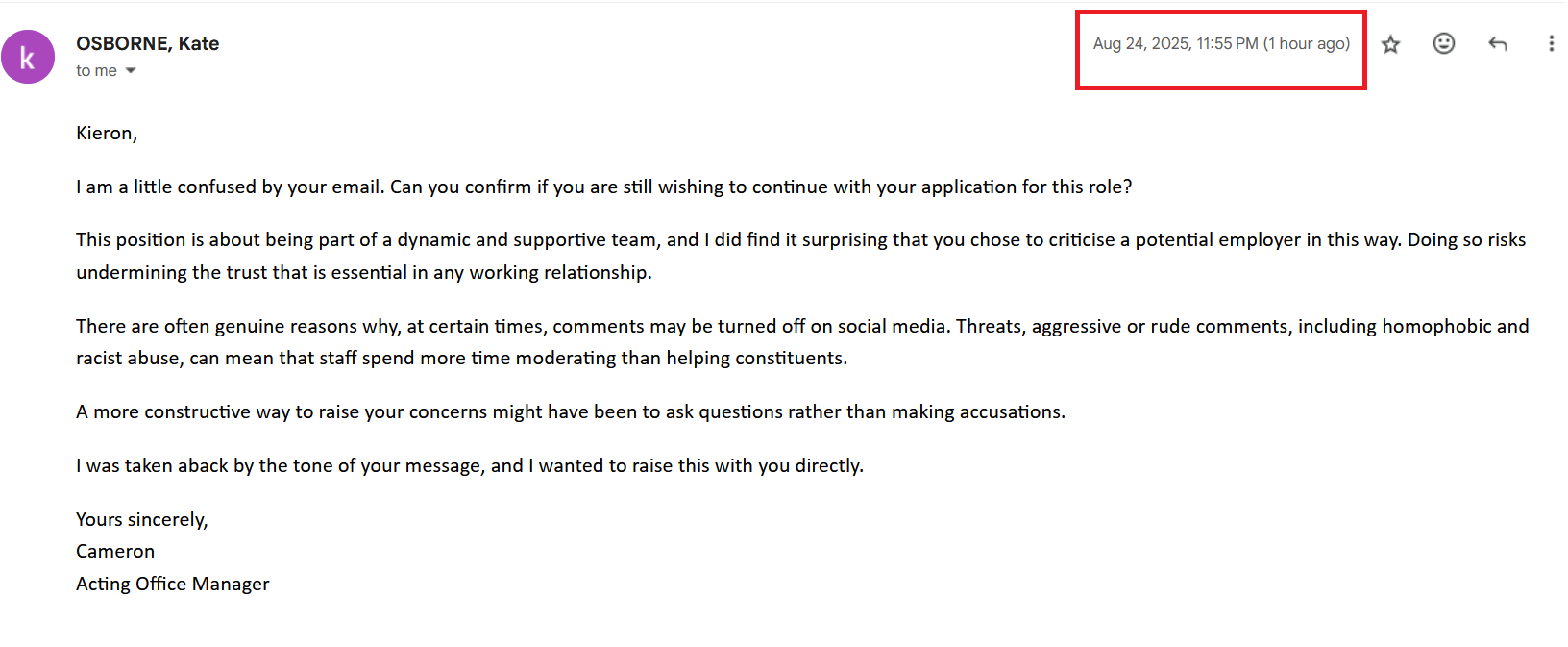
The time of the email wasn’t wrongdoing. People work unusual hours for all sorts of reasons. It was notable because a defensive response was sent close to midnight on a bank holiday weekend without dealing with the substance of what I’d written.
What remained unanswered
- The reply didn’t dispute that comments had been disabled during public scrutiny.
- It described a factual criticism as accusations without identifying what I had supposedly accused anyone of doing.
- It referred to general moderation problems without explaining the decision to disable comments.
- It treated criticism of an MP’s public communication as though it were mainly a problem within my job application.
A parliamentary office should be able to receive criticism from a constituent without turning it into a dispute about the constituent’s tone or intentions.
The original email was direct, but it wasn’t abusive. It made a simple argument: public representatives shouldn’t close down public engagement when scrutiny becomes uncomfortable.
What happened afterwards
Further emails followed. Cameron later said he would advise the office not to communicate with me directly “in order to avoid causing you further distress”.
I hadn’t asked the office to stop contacting me. A disagreement about democratic accountability had been reframed as though communication needed to be restricted for my own welfare.
I covered that exchange separately in Kate Osborne’s Office Misses the Point on Parliamentary Standards.
The job application
My application didn’t progress. I can’t prove that my criticism influenced the decision, so I don’t claim that it did.
The emails are still relevant because they show how Osborne’s office responded when a constituent identified an avoidable problem with its public communication. Instead of answering the criticism, the office labelled it accusations and later presented restricted communication as a way of protecting me from distress.
For the record
Disabling comments on a Facebook page isn’t inherently unlawful. This article doesn’t claim to establish why Osborne’s comments were disabled or who made the decision.
It records the timing, the concern I raised and the response sent in the MP’s name. Both emails remain reproduced above.

Be First to Comment