West Lancashire Borough Council’s response to a Freedom of Information request about prescribed medical cannabis in council housing raises a simple question: has the council actually updated its approach, or is it still treating any cannabis complaint as a police matter first and a legal reality second?
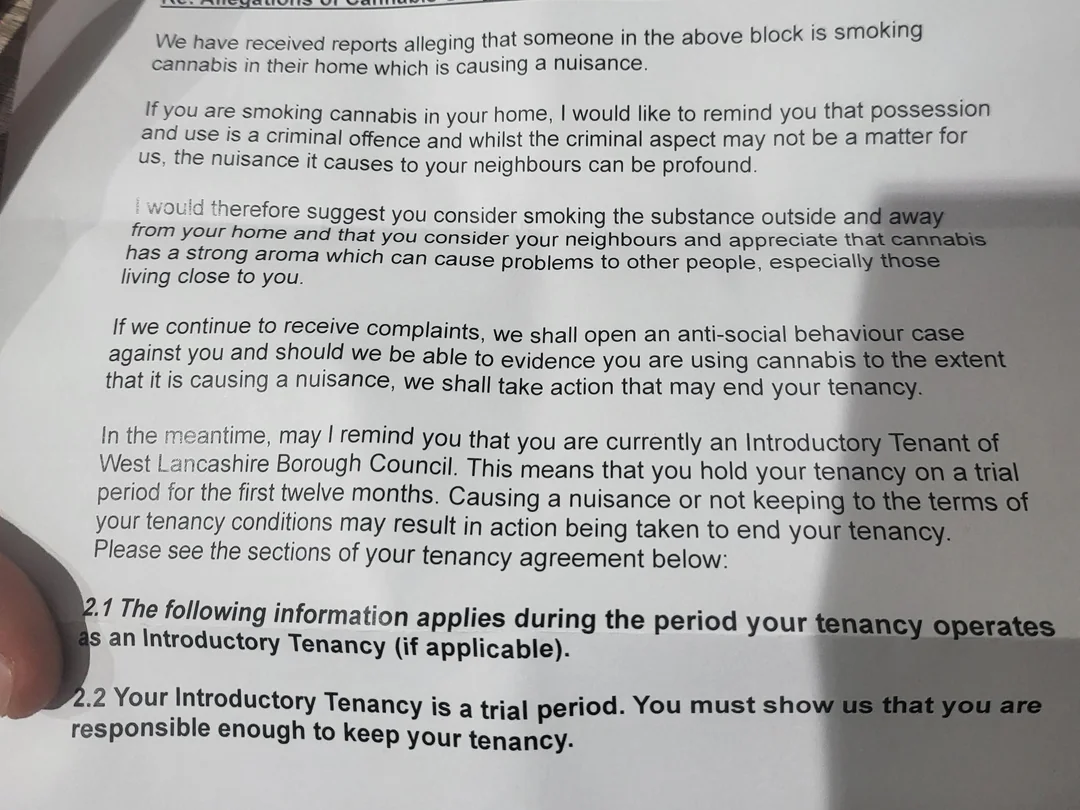
The issue did not come out of nowhere. It followed a Reddit thread in r/ukmedicalcannabis, where a tenant shared what appeared to be a West Lancashire housing letter about alleged cannabis use in their block. The wording was blunt. It said possession and use of cannabis was a criminal offence, suggested using it outside and away from the home, and warned that continued complaints could lead to anti-social behaviour action and even loss of tenancy.
That sort of wording is bad enough in general. It becomes far worse when prescribed medical cannabis has been lawful in the UK since 2018.
The real problem
A council can deal with genuine nuisance. No serious person disputes that. But nuisance is not the same thing as criminality, and lawful prescribed cannabis use is not the same thing as unlawful drug use.
That distinction is the whole point. If a housing provider cannot separate those issues properly, it risks sliding into lazy enforcement, bad recordkeeping, and discriminatory treatment of disabled tenants.
The “outside and away from your home” line is especially telling. That is not a careful, modern response to lawful medication. It is old template thinking. It treats cannabis as something to be removed from sight, rather than asking whether there is an actual nuisance issue and how that should be handled proportionately.
The FOI response did not help
To test what policy sat behind this sort of approach, I submitted an FOI request to West Lancashire Borough Council seeking recorded information on how Housing and ASB staff are trained and guided when a tenant says they are a lawful medical cannabis patient.
The request asked for the obvious things: staff guidance, workflows, templates, training materials, recording guidance, police referral guidance, and safeguards against malicious or vexatious complaints.
You can read the FOI here: Handling of prescribed medical cannabis in council housing.
The council’s response was weak. It admitted the request had been missed in its system, then said:
“Any reports of cannabis use we would refer to the Police or ask the customers to contact the Police directly.”
That is not much of an answer. It does not properly engage with the request. It does not clearly set out what documents are held, what is not held, or what staff are actually told to do when lawful prescribed cannabis is in play.
Worse, it suggests a blanket mindset. Not “we distinguish lawful prescribed use from unlawful use.” Not “we assess nuisance separately from criminality.” Just: cannabis report, police.
Why this matters
There are two possibilities here, and neither flatters the council.
- It holds relevant templates, guidance, or internal material and failed to disclose them properly.
- It holds very little and officers are operating on assumption and habit.
Either way, that is a problem. If the council is still using housing letters that state cannabis possession and use is criminal without recognising lawful prescribed use, that is outdated at best. If it is referring “any reports of cannabis use” to police without first accounting for prescription status, that looks even worse.
This is not just about cannabis. It is about whether institutions can adapt when the law changes, or whether disabled tenants are left dealing with stale templates, crude assumptions, and enforcement-first reflexes.
The questions still hanging
The FOI response leaves some very basic questions unanswered:
- Does the council hold template housing or ASB letters dealing with cannabis complaints?
- Does it distinguish between unlawful cannabis use and lawful prescribed medical use?
- Are staff told to consider prescription evidence before involving police?
- Is there any guidance on recording these cases accurately, especially where health data is involved?
- Are there safeguards against malicious or mistaken neighbour complaints?
Those are not niche questions. They are basic governance questions.
Final thought
The striking part is not just the housing letter. It is the pattern. A publicly discussed letter appears to treat cannabis use as inherently criminal. An FOI asking for the policy behind that approach then receives a reply saying, in effect, that any reports of cannabis use go to the police.
That is not clarity. It is a warning sign.
If councils are going to deal fairly with disabled tenants and lawful medical cannabis patients, they need to do better than old wording and stale instincts. “Any reports of cannabis use” is not a serious policy. It is just an admission that the system has not caught up.
Further reading
- CBPM privacy policy audit, how UK providers handle medical cannabis patient data
- Home Office medical cannabis policy, what current CBPM guidance actually says
- DVLA and medical cannabis, what FOI disclosures reveal about driving licence handling
- The Sal Aziz case and what it shows about medical cannabis, driving, and legal confusion
Be First to Comment