
Summary
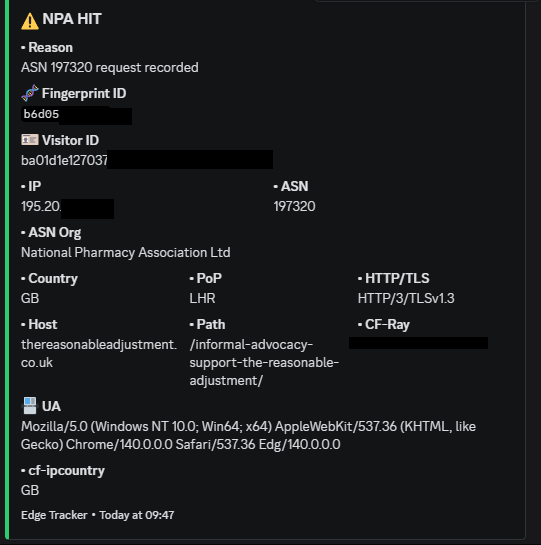
On October 1, 2025 we observed repeated visits from the National Pharmacy Association network. The same visitor fingerprint and visitor ID appeared across multiple pages, including our NPA coverage and our informal advocacy support page. This article explains what those fingerprints mean, how our evidence stack works, and why the signals are hard to avoid in practice. All sensitive values are redacted to match the screenshot.
What is a digital fingerprint?
A fingerprint is a bundle of network and browser signals captured at the moment you connect. Each item alone is ordinary, together they are specific:
- Egress IP and ASN identify the organisation providing the connection.
- Protocol and TLS handshake traits describe how the browser talks to the server.
- User agent and platform hints describe the software stack.
- Request path and timing show intent and sequence.
- Per session IDs join related hits without using invasive tracking bloat.
What we saw from NPA
Key facts taken directly from our logs, with redactions aligned to the published screenshot:
- ASN: 197320, National Pharmacy Association Ltd
- IP: 195.20.***.***, country GB, PoP LHR
- Visitor ID:
ba01d1e12703…(redacted) - Fingerprint ID:
b6d05c…(redacted) - User agent: Edge 140 on Windows 10
- Paths:
/,/informal-advocacy-support-the-reasonable-adjustment/(revisited),/2025/09/17/npa-sra-allegation-response-failure/,/2025/09/22/ips-npa-privacy-misrepresentation-sep-2025/,/2025/09/27/npa-sar-refusal-noreply-threats-network-logs/ - CF-Ray: redacted
How our stack links requests
We do not rely on a single signal. We correlate several independent layers:
- Server edge logs record IP, ASN, protocol, and per request IDs.
- Header and handshake traits give a stable technical profile across reloads.
- Lightweight session IDs associate back to back page views during the same visit.
- Timing and path analysis shows human navigation versus automated scans.
When these layers agree, confidence goes up. In the NPA sequence, the ASN, IP range, user agent, fingerprint ID, and visitor ID all line up across the set, even with redactions.
Why this is hard to avoid
You can hide one signal. Hiding several at once without breaking the page is a different sport.
- Egress gives you away. Corporate networks exit through known ranges. That maps to an ASN and an organisation name. A VPN can mask this, but then other signals shift in a visible way.
- Handshake traits are sticky. Browser and OS stacks speak in specific patterns. Spoofing user agent text does not change those lower level traits.
- Behavioral sequence matters. Humans click in human patterns. Automated fetchers do not read, they scrape. The NPA pattern reads like a person.
Could someone evade all of this? Yes, with clean residential proxies, hardened browsers, and discipline. Most corporate desktops will not do that. So in practice, if you connect, you leave a trace.
What this means for readers
We publish in the public interest. Whether or not organisations reply to emails, they will still read regardless. These visits confirm attention and relevance. They also reinforce our choice to run a reader first site with minimal overhead while keeping strong evidence capture.
Limits and fairness
We do not publish private personal data. We minimise data to what is needed for security and verification. Fingerprints are probabilistic, not magical. Two users behind the same corporate egress can share an IP and ASN. That is why we correlate multiple layers and talk in terms of confidence, not clairvoyance. Identifiers such as IP octets, Visitor ID, Fingerprint ID, and CF Ray are redacted here to match the screenshot.
Receipts
ASN 197320 · National Pharmacy Association Ltd
IP 195.20.***.*** · LHR · GB
Visitor ID ba01d1e12703…  (redacted)
Fingerprint ID b6d05c…    (redacted)
UA Edge 140 on Windows 10
09:44 /
09:45 /informal-advocacy-support-the-reasonable-adjustment/
09:45 /2025/09/17/npa-sra-allegation-response-failure/
09:46 /2025/09/22/ips-npa-privacy-misrepresentation-sep-2025/
09:46 /informal-advocacy-support-the-reasonable-adjustment/  (multiple refreshes)
09:58 /informal-advocacy-support-the-reasonable-adjustment/
14:05 /2025/09/27/npa-sar-refusal-noreply-threats-network-logs/
CF-Ray: [redacted]
Why we log at all
Security, accuracy, accountability. Our logs help defend the site, prove timelines, and demonstrate who engages with what. We keep data proportionate, store it securely, and can provide full unredacted copies to regulators or a court if required.
What “egress” means
Egress is the connection a network uses to leave for the public internet, usually a shared gateway IP owned by an organisation and advertised under its ASN. It is like a building’s front door. Individual devices may differ, but they still step out through the same door. That is why egress is a strong anchor for linking visits to an organisation while avoiding personal identification.
Takeaway
Incognito is not invisible. Corporate egress is a name badge. If you connect to our site, the network handshake and your path through the pages will speak for you. The NPA visits are a textbook example.
Evidence note: We publish technical indicators only where necessary to verify facts in the public interest. We do not invite readers to contact any individual. Contact details that appear in source material are shown only as part of original headers for authenticity.



Be First to Comment