Public bodies logged almost 100,000 recruitment adjustment requests, but many couldn’t say how many were actually provided.
A Freedom of Information investigation by The Reasonable Adjustment asked 15 public authorities how they handle reasonable adjustments during recruitment. The requests sought policies, staff guidance, common adjustment types, data on disabled applicants and adjustment requests, outcome figures where held, and any internal reviews of whether the system is working fairly.
The responses received so far show a familiar public-sector problem. There is often a policy, a training slide deck, or a well-written internal guide. In some cases, the guidance is thoughtful and detailed. But when the question moves from process to accountability, the picture becomes far less convincing.
Several major organisations can count disabled applicants. Some can count requests for recruitment adjustments. Many cannot say how many were actually granted, implemented, or completed.
Almost 100,000 recorded adjustment requests
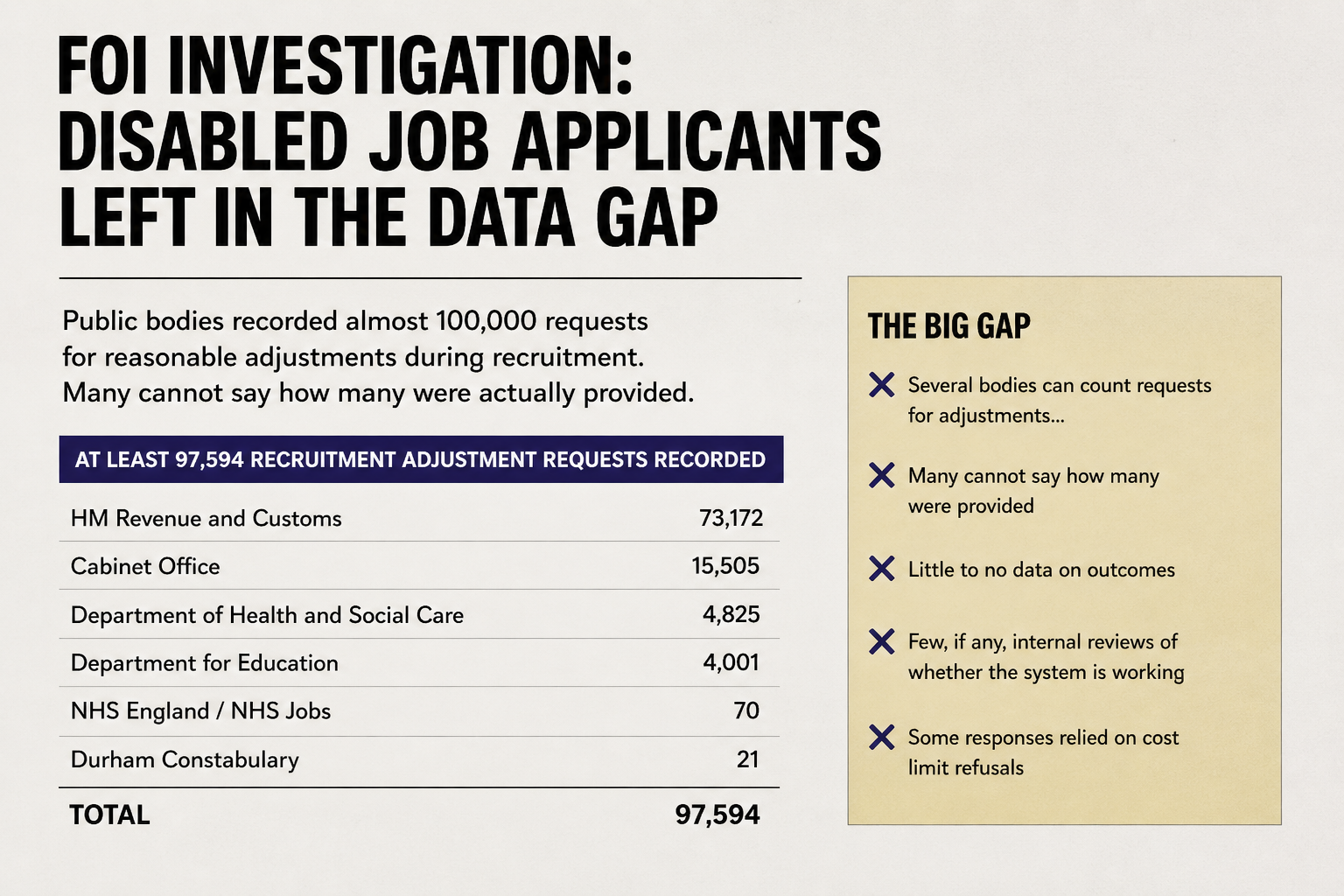
Across six bodies that disclosed usable figures, at least 97,594 recruitment reasonable-adjustment requests were recorded over the periods covered by their responses.
- HM Revenue and Customs: 73,172 requests across 2024/25 and 2025/26 to 22 April 2026.
- Cabinet Office: 15,505 requests.
- Department of Health and Social Care: 4,825 requests.
- Department for Education: 4,001 requests.
- NHS England / NHS Jobs: 70 requests recorded on Trac during the available 12-month period.
- Durham Constabulary: 21 requests.
These figures aren’t perfectly interchangeable. HMRC made clear that its numbers count requests rather than unique candidates, so someone applying for more than one post may appear more than once. NHS England also warned that its Trac figure may understate the true number because some candidates contact recruiting managers directly rather than recording the request through the application system.
Even with those caveats, the scale is substantial. Across eight bodies that supplied disability declaration figures, there were at least 147,971 disability declarations or disability-declared applications in the relevant periods.
The unanswered question: what happened after the request?
The most striking finding is not that reasonable-adjustment requests are rare or poorly understood. It is that several bodies have built processes for receiving them without building an equally clear way to track what happens next.
HMRC disclosed the largest adjustment-request figure by some distance, with 73,172 requests across two financial years. But it said it only captures the number of requests made, not whether they were “subsequently actioned”.
DHSC disclosed 4,825 requests over the latest 24-month period, then said it does not record the number of candidates provided with adjustments. It also said it holds no outcome data comparing candidates who requested adjustments with those who did not, and no internal reports, audits or reviews assessing whether the process is fair or effective.
DfE reported 4,001 requests and 7,289 disability declarations. It said it does not hold data on how many candidates were provided with adjustments, does not hold comparative progression or success rates, and does not hold any internal evaluation of recruitment adjustments.
NHS England / NHS Jobs reported 70 recorded adjustment requests during the available 12-month period, while acknowledging that some requests may bypass the Trac system entirely. It could not say how many adjustments were provided and said it holds no internal evaluation material.
The Cabinet Office disclosed 15,505 requests and did provide some comparative outcome data. Candidates requesting adjustments had a 13.1% sift pass rate, compared with 11.1% for those who did not, while final appointment rates were broadly similar at around 2.2% for both groups.
But when asked how many candidates were actually provided with adjustments, the Cabinet Office said it does not “centrally track the granted adjustments in a reportable format”. That answer is now subject to internal review. Its own disclosed guidance says vacancy holders should decide whether and how an adjustment will be implemented, communicate the outcome in writing, and seek advice before refusing certain requests, including requests for interview questions in advance.
The question is straightforward. If decisions are being made, communicated and in some cases escalated, what records are created, and why can’t they be reported even at a high level?
Some of the guidance is good. The oversight often isn’t.
The FOI responses do not suggest that every body is careless about disability access. Some of the disclosed material is genuinely useful.
HMRC provided a detailed vacancy-holder guide and three training video transcripts. Its material tells managers that if an adjustment is reasonable, HMRC has a legal duty to provide it. One training transcript goes further, explaining that HMRC is a large employer with significant resources, which raises the bar when deciding whether something is too difficult or costly to implement.
Its written guidance also tells managers to consider requests individually, avoid making medical judgements, confirm agreed adjustments in writing, and look for alternatives where a specific request cannot be met.
NHS Business Services Authority disclosed one of the strongest guidance packs in the batch. Its material explains that candidates may ask for support before applying, during assessments or at interview, and that managers should ask candidates what they need rather than making assumptions. It also says it is good practice to offer interview questions in advance as standard, because some candidates who would benefit may not feel comfortable disclosing a disability or neurodivergence.
NHSBSA also released an internal adjustments library created by its Disability and Neurodiversity Colleague Network. The material includes practical examples for autism and ADHD, such as concise communication, clear deadlines, summarising lengthy information, preferred communication methods, buddy systems, reduced sensory pressure, flexible breaks, captioning, and tools to support planning and task management.
Yet NHSBSA’s data position remains limited. It disclosed 4,587 applications from candidates who declared a disability between April 2024 and March 2026, but said it does not routinely record how many candidates request recruitment adjustments, how many are provided with them, or whether outcomes differ for candidates who did and did not ask for support. It also said it holds no internal reports evaluating the fairness or effectiveness of recruitment adjustments.
This matters because policy quality and measurement are different things. A well-written internal guide may help individual managers act properly, but it cannot show whether the organisation as a whole is consistently delivering what candidates ask for.
Durham Constabulary offered a rare fulfilment figure
Durham Constabulary provided an interesting contrast. It said that, during the relevant period, 21 candidates requested reasonable adjustments and 21 were provided with them.
The response was not spotless. Durham said it has no specific training for recruitment staff or assessors on reasonable adjustments, and it could not provide outcome data because it has no applicant tracking system. Still, it was one of the only bodies in the batch to give a clean figure for adjustments provided.
Its recruitment procedure also contains several practical measures that are offered to all candidates at interview. These include a point of contact on arrival, interview questions presented both verbally and in writing, paper and a pen, and sensory fidgets available at the candidate’s discretion.
Those details are worth noting. They reduce the need for some candidates to disclose personal information simply to receive basic support that can make interviews more manageable.
MoJ says older recruitment data is no longer accessible
The Ministry of Justice disclosed detailed guidance on Disability Confident recruitment, prison officer online tests, prison officer assessment centres, and template correspondence for applicants requesting adjustments.
The material is fairly comprehensive. It explains that applicants do not always need a formal diagnosis, refers specifically to neurodiversity including autism, dyslexia, dyspraxia and ADHD, and tells vacancy managers to contact candidates, discuss their needs, and agree suitable support.
But the Ministry could not provide the aggregate data requested. It said recruitment activity moved to a new Applicant Tracking System during the relevant period, and data from the previous system is “no longer accessible”.
That answer has also been challenged through internal review. The request deliberately asked for the most recent 24-month period available. If older data has become inaccessible, the Ministry still needs to explain whether figures exist for the period covered by the replacement system, even if that means providing a shorter dataset.
DWP and the Home Office turned to cost-limit refusals
Some authorities gave little substantive data at all.
The Department for Work and Pensions relied on section 12 of the Freedom of Information Act, arguing that the figure for candidates provided with reasonable adjustments would exceed the appropriate cost limit. It said the information is spread across multiple systems and would require a large amount of manual processing.
That response is under internal review. DWP did not provide a meaningful cost breakdown, did not identify the systems involved, and did not explain whether any narrower version of the provision data could be answered. Its response also suggested removing the costly part of the request and narrowing the remainder to items it appeared to regard as manageable, which raises an obvious question about why those manageable parts were not simply disclosed.
The Home Office took an even broader approach. It aggregated this request with a separate recruitment-diversity FOI and then relied on section 12 to avoid answering substantial parts of both. It argued that reasonable-adjustment information is managed locally by vacancy holders and that gathering it across the Home Office would exceed the cost limit.
That refusal is also under internal review. Several national departments and large public bodies responded substantively to the same reasonable-adjustments request, including HMRC, Cabinet Office, DfE, DHSC, NHSBSA and the Ministry of Justice. The Home Office may hold information differently, but its refusal still needs to be properly evidenced. A generic reference to “Home Office wide” searching is not enough on its own.
DfE disclosed guidance still referring to the Disability Discrimination Act 1995
The Department for Education response contained another unusual detail. In material described as central guidance available to staff regarding candidates with disabilities, DfE disclosed text referring to the Disability Discrimination Act 1995.
That is a surprising reference to find in a 2026 response about current recruitment guidance. Elsewhere in the same reply, DfE correctly refers to the duty to make reasonable adjustments under section 20 of the Equality Act 2010. The older wording may be a stale extract, or it may still sit within live guidance. Either possibility deserves clarification.
An internal review has asked DfE to confirm whether the text is genuinely current, whether newer guidance was missed during the FOI search, and whether the Department considers it appropriate for current recruitment assessor material to rely on that older statutory wording.
Has anyone checked whether the system works?
One of the most consistent answers across the batch concerns internal evaluation. Many bodies said they do not hold reports, audits or reviews assessing the effectiveness or fairness of reasonable adjustments in recruitment.
HMRC said it does not hold reports relating to those issues. DHSC said the same. NHSBSA said the same. DfE said the same. NHS England said no internal reports, audits or reviews were held. Cabinet Office also said it does not hold that information. MoJ likewise said it holds no internal reports, audits or reviews assessing recruitment adjustments.
This is a serious gap. Reasonable adjustments are central to whether disabled applicants can take part in recruitment fairly. If organisations receive thousands of requests, but do not track delivery and do not evaluate effectiveness, they are left without a reliable organisational view of how well that part of the process is functioning.
Three responses remain delayed, and six are under review
At the time of publication, three authorities had still not provided a substantive response within the expected timeframe or remained unresolved following clarification issues: Durham County Council, South Tyneside and Sunderland NHS Foundation Trust, and Northumbria Police.
Six responses have been challenged through internal review:
- Department for Education
- Department for Work and Pensions
- Cabinet Office
- Home Office
- Ministry of Justice
- Sunderland City Council
Those reviews may produce further disclosure, fuller explanations, or confirmation that the original answers stand. The broader finding, however, is already well established.
Across major public bodies, disabled applicants are asking for recruitment adjustments in very large numbers. Some organisations have produced thoughtful guidance for managers and candidates. But several cannot provide a simple aggregate answer to one of the most important questions in the entire process:
Of the candidates who asked for reasonable adjustments, how many actually received them?
That is a basic accountability question. If an organisation cannot answer it, it should be cautious about presenting its recruitment process as demonstrably accessible.
Evidence bundle
The full evidence bundle for this investigation has been organised by authority. Each folder contains the relevant WhatDoTheyKnow correspondence and, where available, the disclosed supporting documents.
The bundle is not limited to headline figures and FOI correspondence. Several disclosures also contain detailed examples of the types of recruitment adjustments public bodies say candidates request or may be offered, including extra time, advance interview questions, written questions during interviews, altered assessment formats, interpreters, readers, scribes, breaks, environmental adjustments and neurodiversity-related support.
Download the reasonable adjustments in recruitment FOI evidence bundle
Delayed responses, internal reviews and further disclosures will be assessed as they arrive. This article may be updated, or a separate follow-up may be published where that better serves the context.
Further reading
- Tony Blair’s welfare reform comments and what they reveal about disabled claimants
- Home Office medical cannabis policy: what the department’s own documents show
- Newcastle City Council’s FOI redaction failure in a Recruitment Junction disclosure
- Met Police recorded 737,198 speeding cases in 2025, FOI response shows
Be First to Comment