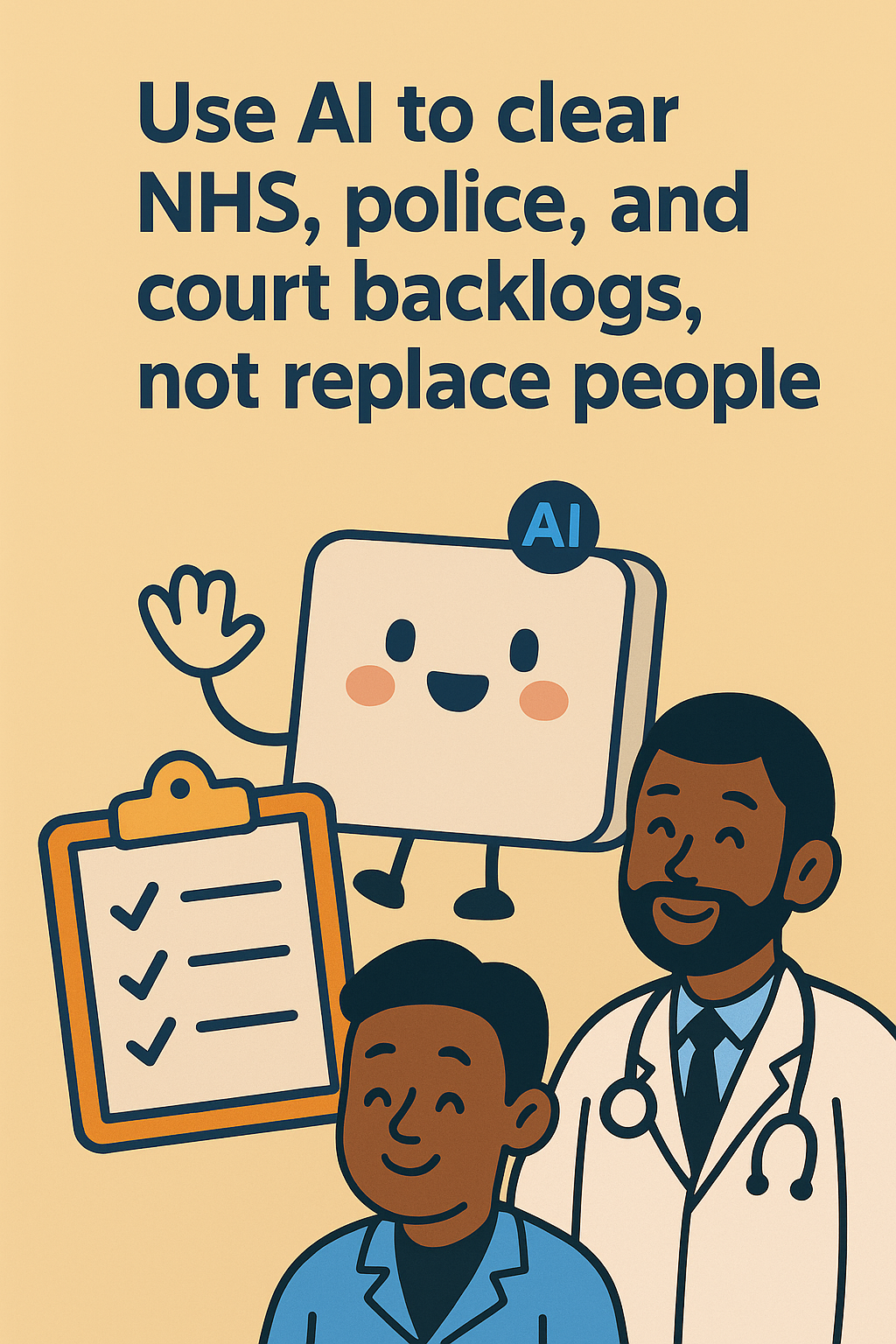
The UK’s problem is not a lack of talent, it is a lack of capacity. Use AI to lift routine load, keep humans for judgement and care.
The public debate around AI keeps missing the point. The useful question is not whether machines will replace humans. The useful question is how to delegate repetitive, rules based work to machines so that clinicians, investigators, and caseworkers can do the work only they can do.
Replacement is a distraction. Delegation is the upgrade.
Healthcare, move routine load off the GP diary
A large share of GP demand is routine or administrative, fit notes, prescription queries, low acuity symptom checks, form processing, and reassurance calls. The state’s own data shows rising volumes of fit note activity, which is workload even after digital reforms NHS Digital.
Where targeted AI already has traction is narrow clinical pathways under supervision. Dermatology is the clearest case. NICE has conditionally recommended AI for suspected skin cancer triage for a three year evidence period NICE HTE24, NICE news. NHS England’s pathway note sets out the logic, AI can discharge benign cases and prioritise suspicious lesions, which frees specialist time NHS England.
This matters because A&E has been absorbing upstream access failure. NHS England reported 1.2 million more A&E attendances by October 2024 than the pre pandemic baseline NHS England press release, while long waits and corridor care have become a year round crisis in some trusts Guardian, Guardian FOI analysis.
What to automate now
- Symptom intake, routing, and safety netting with human oversight
- Scripted follow ups, medication queries, eligible self care guidance
- Structured documentation and letter generation in the background
- Photo led screening support in dermatology and other high volume pathways
What not to automate
Safeguarding, diagnostic uncertainty, complex multi morbidity, end of life conversations, longitudinal relationship decisions. These stay human.
Justice and policing, stop paying experts to rearrange information
The Crown Court backlog remains historically high. Parliament’s Public Accounts Committee recorded 73,105 open cases at the end of September 2024, a ten percent rise year on year PAC report. The National Audit Office has documented that the target to cut the backlog was no longer achievable without deeper change NAO and the Financial Times reached the same conclusion in its reporting FT.
On the policing side, productivity is throttled by administrative drag, especially redaction and case prep across ballooning digital evidence. The Institute for Government summarises pilots where forces cut redaction time by 80 to 92 percent and cites Home Office and ACE analysis that scaled tools could save hundreds of thousands of investigator hours per year IfG Performance Tracker 2025. The NAO’s 2025 Police productivity report adds the system view, savings and productivity gains are essential to meet commitments NAO press summary, full report PDF.
Where AI fits today
- Evidence triage and smart search across exhibits and statements
- Consistent redaction and bundle assembly with audit trails
- Scheduling, witness comms templates, document generation
- Risk scoring to prioritise limited investigator time, with human review
The principle, capacity beats rhetoric
The country does not lack talent. It lacks capacity. AI does not threaten capable professionals. It threatens the inefficiency that keeps them from doing the work only they can do.
Deploy AI where the task is repetitive, rules based, or pattern recognition heavy. Keep humans where the task is ambiguous, relational, or high stakes. That cuts queues without cutting standards, and it restores dignity to professional work in the NHS, in policing, and across public services.
Editor’s note: Evidence links are included inline. This article argues for delegation to AI under human oversight, not occupational replacement.



Be First to Comment