
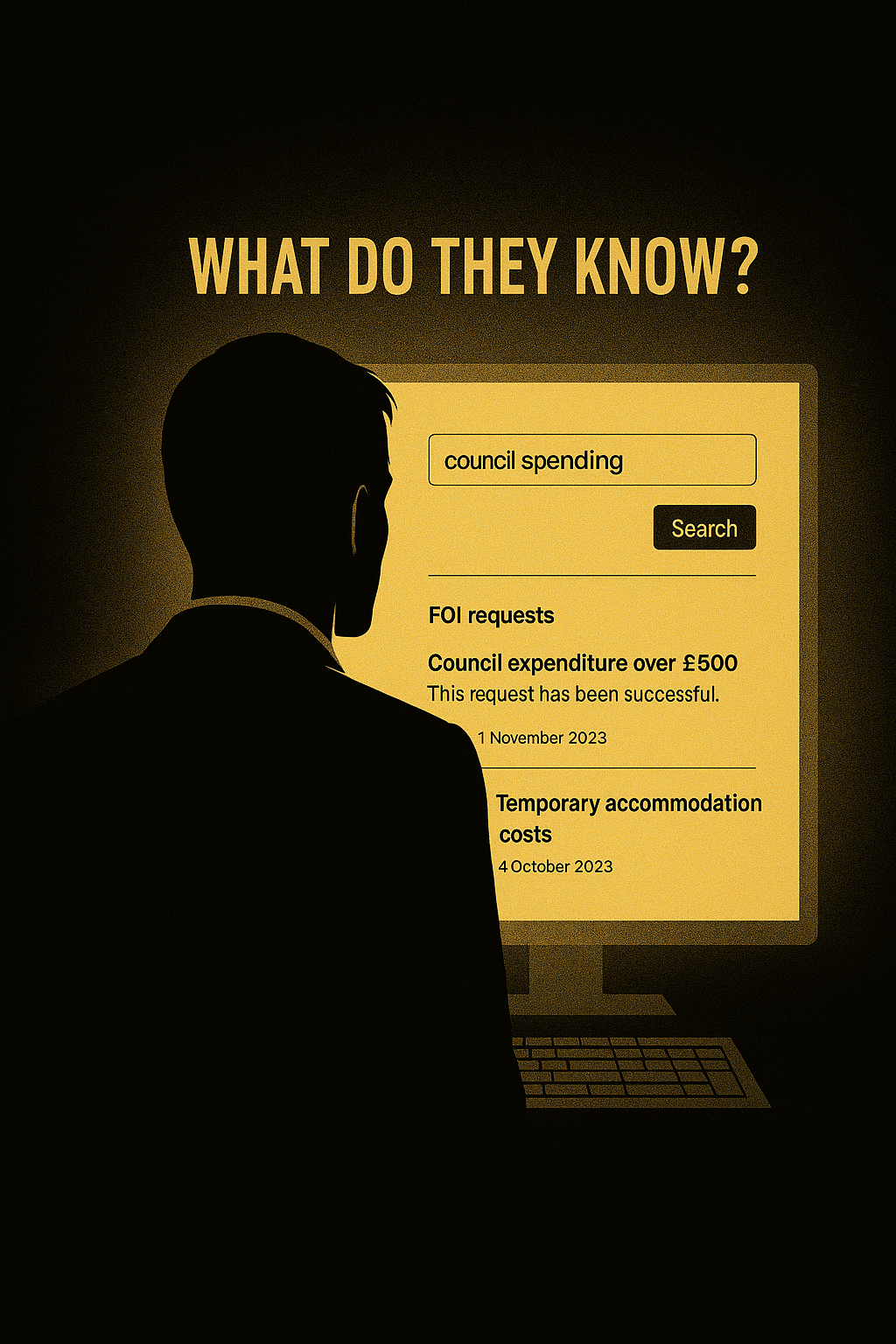
Why WhatDoTheyKnow Beats DIY FOI
Most people never use their right to ask public bodies for information. When they try, they get lost in stale inboxes, polite evasions, and PDF limbo. WhatDoTheyKnow cuts through that and leaves a permanent public trail. You get the data, and everyone else gets receipts.
WhatDoTheyKnow in one minute
WhatDoTheyKnow is a free website run by the civic tech charity mySociety. It helps people send Freedom of Information requests to UK public bodies and publishes both the request and the response in a searchable archive. It handles routing, timestamping, reminders, and threading. Under the hood it runs on Alaveteli, an open source platform that mySociety created in 2008 and continues to maintain.
The short version: why not email direct
- Public pressure works. A late or flimsy response is visible to everyone, including journalists and the ICO.
- You skip admin pain. No hunting for the right FOI inbox, no lost chains, no messy forwarding.
- The clock is visible. Authorities have 20 working days to respond under law. The timer sits on your request for all to see.
- Search beats guesswork. You can often find a similar past request, then refine it and get a better answer.
Real world wins
- A parent used WhatDoTheyKnow to obtain the ratio of teaching assistants to pupils across local primary schools, then pushed for better resourcing at a governors meeting.
- A resident tracked spending on long-term office leases that sat half empty, then shared the figures with a local reporter.
- A campaigner compared waiting time definitions across NHS Trusts using multiple FOIs, then published a chart that forced a policy clarification.
None of that needed a lawyer. All of it needed a URL.
How to get better results
- Be specific and bounded. Name the dataset, date range, and format. Example: “Please provide the number of repairs completed by your housing maintenance team by month from Jan 2023 to Jun 2024, broken down by emergency, urgent, routine. CSV preferred.”
- Use plain English. Write like a reasonable person who expects a reasonable answer.
- Search first. If a near match exists, link it and say what is missing.
- Ask for machine-readable formats. Request CSV or XLSX, not scanned PDFs, unless the data only exists on paper.
- Reference the duty to advise and assist. A short reminder about section 16 FOIA often nudges an officer to help refine scope.
- Respect cost limits. If the request risks exceeding the limit, invite the authority to advise on narrowing the scope.
- Follow the chain. If refused, request an internal review. If that fails, appeal to the ICO with your WhatDoTheyKnow thread as evidence.
See also: FOI vs SAR – understanding your data rights.
Why the public archive is your advantage
- Reusable knowledge. Your request teaches the next person how to ask smarter.
- Cleaner refusals. Officers know their reasoning will be read by peers and by the ICO.
- Media-ready citations. Reporters love tidy URLs with dates, attachments, and a story baked in.
- Stronger appeals. The full history is compiled and timestamped already.
When not to use it
- Personal data about you. That is a Subject Access Request under data protection law. Use the authority’s SAR route, not a public FOI platform.
- Sensitive personal details. Everything on WhatDoTheyKnow is public by default. Do not expose confidential information about yourself or others.
- Commercial negotiations. If you are a supplier or partner, use private channels and mark correspondence appropriately.
- Live safeguarding or security content. Use the proper reporting route, not a public archive.
Timing and appeals
- Deadline. Under FOIA, authorities must respond within 20 working days. Under EIR, the same baseline applies, with limited extensions for complexity or public interest tests.
- Internal review. If you receive a refusal or a non-answer, request an internal review on the same thread.
- ICO complaint. If still unsatisfied, complain to the Information Commissioner. Link your WhatDoTheyKnow thread, cite missed deadlines, and state which exemptions you dispute and why.
WhatDoTheyKnow Pro, if you need it
Heavy users can use a paid tier that adds batch requests, saved drafts, team collaboration, and temporary embargoes before publication. If you coordinate a campaign or newsroom project, those features save time.
Common mistakes that cost weeks
- Fishing trips. “All information about X” usually triggers a cost refusal. Tight scopes win.
- Ignoring format. If you do not ask for CSV or XLSX, you may receive scans that need retyping.
- Arguing by volume. Long follow-ups rarely help. Clarity wins.
- Mixing FOI and SAR. If you want your own data, that is not FOI. Use SAR.
FAQ
- Is WhatDoTheyKnow official?
- No. It is independent of government. Authorities are used to receiving requests from it, and the legal duties under FOIA and EIR still apply.
- Can I be anonymous on WhatDoTheyKnow?
- FOI law requires a real name so the authority can correspond. Many authorities accept initials plus a surname. Obvious pseudonyms can be refused. If privacy matters, use a simple real-name variant and avoid personal details in the text.
- Does it work for Environmental Information Regulations?
- Yes. You can request environmental information the same way. Some rules differ, but the site handles routing and publication just fine.
- Can I ask for internal emails?
- Yes, but precision matters. Name the subject, roles involved, and a date range. Expect redactions for personal data. Be ready to narrow scope to stay under the cost limit.
- What if an authority ignores me?
- Nudge once. If still nothing, request an internal review for failure to respond. After that, go to the ICO. The visible timeline on your thread strengthens your case.
The bottom line
Bureaucracy thrives in the dark. WhatDoTheyKnow turns the lights on and keeps them on. If you want answers without drowning in admin, use the tool that timestamps everything, files it neatly, and lets the public see what institutions are doing. FOI gives you the right to ask questions. WhatDoTheyKnow gives you proof.




Be First to Comment