
Curaleaf Tripoli built its name on being affordable, available, and decent enough to keep around. The problem is that one of those claims has started to wobble.
Curaleaf Tripoli has been knocking around UK prescriptions long enough to earn a proper reputation. Not hype, not novelty, not one lucky batch followed by collective delusion. An actual reputation. It’s one of those strains patients often end up circling back to because it’s usually available, broadly functional, and for a long time it sat in that useful category of flower that didn’t feel like daylight robbery.
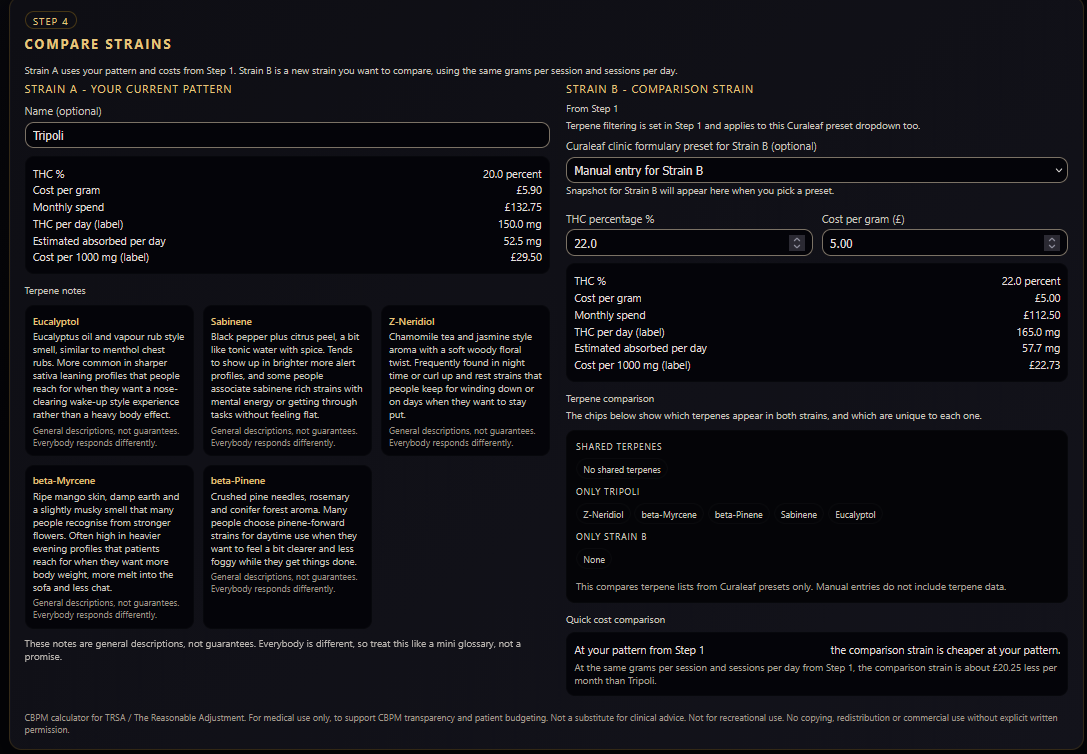
That last bit matters, because Tripoli’s old identity as a cheap and cheerful fallback now needs updating. At £5.90 a gram, it’s no longer the cheaper option against Wedding Pop Triangle at £5.00 a gram. So while Tripoli still has a place, the lazy assumption that it’s the sensible budget pick doesn’t really survive contact with basic maths.
That’s especially obvious once you run the numbers through our UK CBPM Cost Calculator public tool. And once you’ve read our piece on Curaleaf’s hidden monthly allowance issue, the wider cost picture starts looking even more relevant.
Curaleaf Tripoli at a glance
- Strain: Tripoli
- Label: Curaleaf Tripoli, previously circulated as Adven EMT-1
- Type: Usually treated as an indica-leaning hybrid
- THC: Commonly around 19 to 20%
- CBD: Less than 1%
- Confirmed top terpenes: Alpha-Pinene, Myrcene, Beta-Pinene
- Sterilisation: Electron beam sterilisation
- Minimum order size: 10g
- Producer: Terra Verde
- Main distributor: Curaleaf Pharmacy
- Country of origin: Portugal
- Current pricing: Around £5.90 per gram
On paper, Tripoli is straightforward. Roughly 20% THC, simple terpene profile, and positioned as an accessible, dependable flower. It isn’t sold on glamour. It’s sold on familiarity.
Why Tripoli still matters
Tripoli is worth covering because it’s one of the clearest examples of a UK medical flower that survives on utility rather than mystique. People don’t keep ordering it because it’s some terp-heavy masterpiece. They order it because it usually does enough, often turns up in stock, and doesn’t pretend to be hand-delivered from the gods in a velvet jar.
That practicality matters. A lot of patients don’t need a strain that looks sexy in a forum photo. They need something repeatable. Something they can understand. Something that doesn’t vanish every other week while the clinic plays stock roulette. Tripoli has often filled that role.
But being established isn’t the same as being the best current choice. That’s where things get awkward for it.
Packaging, presentation and first impressions
Tripoli doesn’t come in tubs. It usually arrives in a plastic vacuum-sealed 10g bag inside a cardboard box, with a separate cardboard box for each 10g unit. Functional, yes. Elegant, no. Wasteful, also yes.
So the experience is less boutique flower and more mildly overpackaged pharmacy logistics. That isn’t a clinical issue in itself, but it’s worth noting because packaging still shapes first impressions, and Curaleaf’s setup here feels more like repetitive disposal admin than thoughtful presentation.
Patient impressions suggest the flower itself is often dense enough, serviceable enough, and visually respectable enough for the price bracket. Some reports describe it as not overly dry, which in UK medical cannabis is practically a standing ovation. Others describe batches that were grassy, muted, oddly damp-smelling, or generally a bit lifeless.
That inconsistency is part of the Tripoli story. It’s rarely framed as an elite flower, but it also isn’t universally poor. It’s more that the good batches come across as solid value, while the weaker batches remind you why nobody writes love poetry about this strain.
Terpene profile, smell and flavour
Tripoli’s confirmed terpene profile is fairly simple:
- Alpha-Pinene
- Myrcene
- Beta-Pinene
That combination helps explain why some patients find Tripoli calming without it always becoming fully flattening. The pinene side can keep things a bit clearer and less swampy than you’d expect from a cheap evening strain, while myrcene adds the body softness and heavier landing.
In theory, that should give Tripoli a mildly woody, herbal, pine-forward profile with enough body to suit evening use. In practice, patient reports are more chaotic than elegant.
Common flavour and aroma descriptions include:
- grassy
- woodsy
- earthy
- slightly sweet
- muted and generic
- occasionally chocolatey or mint-choc when ground
- occasionally like something has gone wrong in a shed
That’s the honest version. Some people describe it as pleasant enough, some call it boring, and some have had batches that smelled like wet sponge, wet earth, cow dung, or worse. So if flavour is your priority, Tripoli probably isn’t your hero strain. Even when people like it, the praise usually goes to the effects or value, not the sensory experience.
Effects and how it seems to behave
This is where Tripoli becomes more interesting than its flavour profile suggests.
The broad pattern from patient reports is that it’s often calming, functional, and useful for evening unwinding, but not always a guaranteed knockout. That’s an important distinction. Some people clearly get sleep support from it. Others find it settles them, improves mood for a bit, eases pain or anxiety, but doesn’t fully switch them off.
Reported effects commonly include:
- reduced anxiety
- a calmer headspace
- decent pain relief
- relaxation without complete mental shutdown
- short-lived euphoria or mood lift
- better appetite
- help getting to sleep or staying asleep
What’s notable is that Tripoli seems fairly dose-sensitive. Some patients report that if they go easy with it, it feels balanced, clear enough, and useful for anxiety or focus. Push it harder and it can become much more sleep-oriented. A few even report the opposite at higher doses, where it becomes oddly more alerting or “coffee-like” rather than sedating.
So no, Tripoli isn’t a universal sleep hammer. It’s more of a flexible evening strain that can tilt sedating depending on dose, tolerance, temperature, and the batch in front of you.
Where Tripoli seems strongest
Based on the overall shape of patient feedback, Tripoli looks strongest for:
- evening decompression
- anxiety support
- mild to moderate pain relief
- appetite support
- help with settling down at night
- patients who want something familiar and usually available
It seems weaker for:
- people chasing bold flavour or strong aroma
- patients who need a guaranteed heavy sedative effect
- patients who are sensitive to batch inconsistency
- anyone looking for a flower that feels especially polished or premium
There’s also the mood question. Some patients report decent calm and euphoria, while others say it leaves them feeling a bit flat or low. That’s not unusual with cannabis, but it’s enough to say Tripoli isn’t emotionally neutral for everybody.
Batch consistency, and the usual warning
Tripoli’s reputation rests partly on being dependable, but “dependable” in UK medical cannabis doesn’t mean tightly consistent. It means more like, usually present, usually usable, occasionally rough around the edges, and sometimes weird enough to make you question whether the bag was packed in a greenhouse or a compost bin.
That sounds harsher than it is. Plenty of patients still regard Tripoli as a no-frills regular because it tends to do enough clinically without causing too much drama. But there are also enough reports of bad-smelling or disappointing batches that you shouldn’t walk into it expecting craftsmanship.
Tripoli is function-first. When it misses, it tends to miss on flavour, smell, or general refinement rather than on pure usefulness.
Cost, value, and why WPT matters now
This is the part where Tripoli loses one of its oldest selling points.
At £5.90 per gram, Tripoli is more expensive than Wedding Pop Triangle at £5.00 per gram. That’s not a tiny rounding error. That’s enough to matter over a month, especially once you factor in repeat prescriptions, clinic review costs, and the general tendency of CBPM spending to quietly creep upward while everyone pretends it isn’t happening.
Our own comparison work makes the problem obvious. On the calculator example shown below:
- Tripoli comes out at roughly £132.75 per month
- Wedding Pop Triangle comes out at roughly £112.50 per month
- That makes WPT about £20.25 cheaper per month
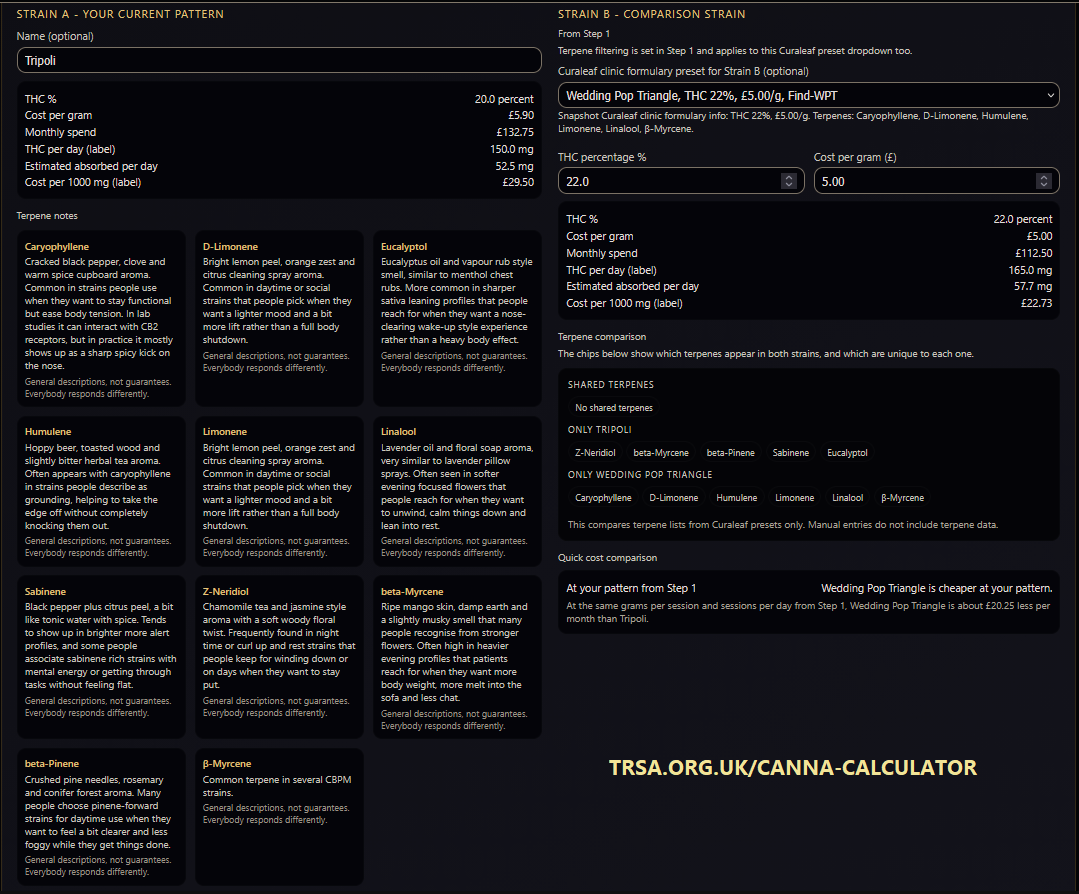
So if someone is still defending Tripoli mainly on the basis that it’s the cheap one, that logic is outdated. It’s not. Not anymore.
If you want to see how that plays out on your own pattern, use the UK CBPM Cost Calculator public tool. It’s a much better way of understanding your actual intake and spend than relying on vague clinic assumptions or whatever the portal chooses to make obvious this week.
Tripoli vs Wedding Pop Triangle
This is the real fork in the road.
If you already know Tripoli works for you, that still counts for something. Reliable symptom control beats theoretical savings if the alternative doesn’t suit you. But if your attachment to Tripoli is mostly built on habit, price, or the idea that it’s the sensible budget option, then Wedding Pop Triangle deserves serious attention.
The clean version looks like this:
- Tripoli: familiar, functional, decent enough for many patients, but often muted in flavour and now harder to defend on price
- Wedding Pop Triangle: cheaper, stronger on paper, and according to our calculator comparison, better value at the same pattern of use
Tripoli still makes sense for patients who already know it works for their anxiety, pain, or evening wind-down. But the days of treating it like the obvious budget king are over. WPT has stepped into that conversation and frankly made it uncomfortable.
Final verdict
Rating: 3.7 out of 5
Best for: Patients who want a familiar, usually available evening flower that can help with anxiety, pain, relaxation, appetite, and sometimes sleep.
Main weakness: It’s no longer the bargain people think it is, and the flavour side can range from acceptable to deeply uninspiring.
Tripoli still earns respect because it has done the hard bit. It has stayed relevant in a market full of rotating stock issues, inflated pricing, and flowers that cost more while offering very little extra beyond marketing perfume. It usually works. That’s why it lasted.
But the landscape has shifted. At £5.90 a gram, Tripoli isn’t the cheap fallback anymore. It’s the familiar fallback. That’s different.
If you like what Tripoli does and it suits your symptoms, fair enough. Keep it in the conversation. But if you’re choosing it because you think it’s the budget-smart option, you’re probably overdue a look at Wedding Pop Triangle.
Related reading
- Strain Spotlight: FIND Wedding Pop Triangle (WPT)
- Strain Spotlight: MUZO Lemon Mac
- Zookies Review: FIND ZKS T23
- Strain Spotlight: Curaleaf Lavender Cake
- UK CBPM Cost Calculator Public Tool
- Curaleaf Portal Monthly Allowance Hidden
Important disclaimer
This article is for informational purposes only and reflects aggregated patient themes and general commentary. It isn’t medical advice. Always follow your prescription, speak to a qualified clinician about adverse effects or suitability, and don’t drive or operate machinery while impaired.
Use the CBPM cost calculator
Trying to work out how much THC you’re actually using, what your flower really costs over a month, or whether a cheaper alternative actually stays cheaper once you compare it properly? Use our UK CBPM Cost Calculator public tool.
- Estimate THC per day and per month
- Compare two strains side by side
- See when a “cheap” flower isn’t actually the better value
- Budget more intelligently across repeat prescriptions
Be First to Comment