14 February 2026 · By Kieron JH, Founder, The Reasonable Adjustment
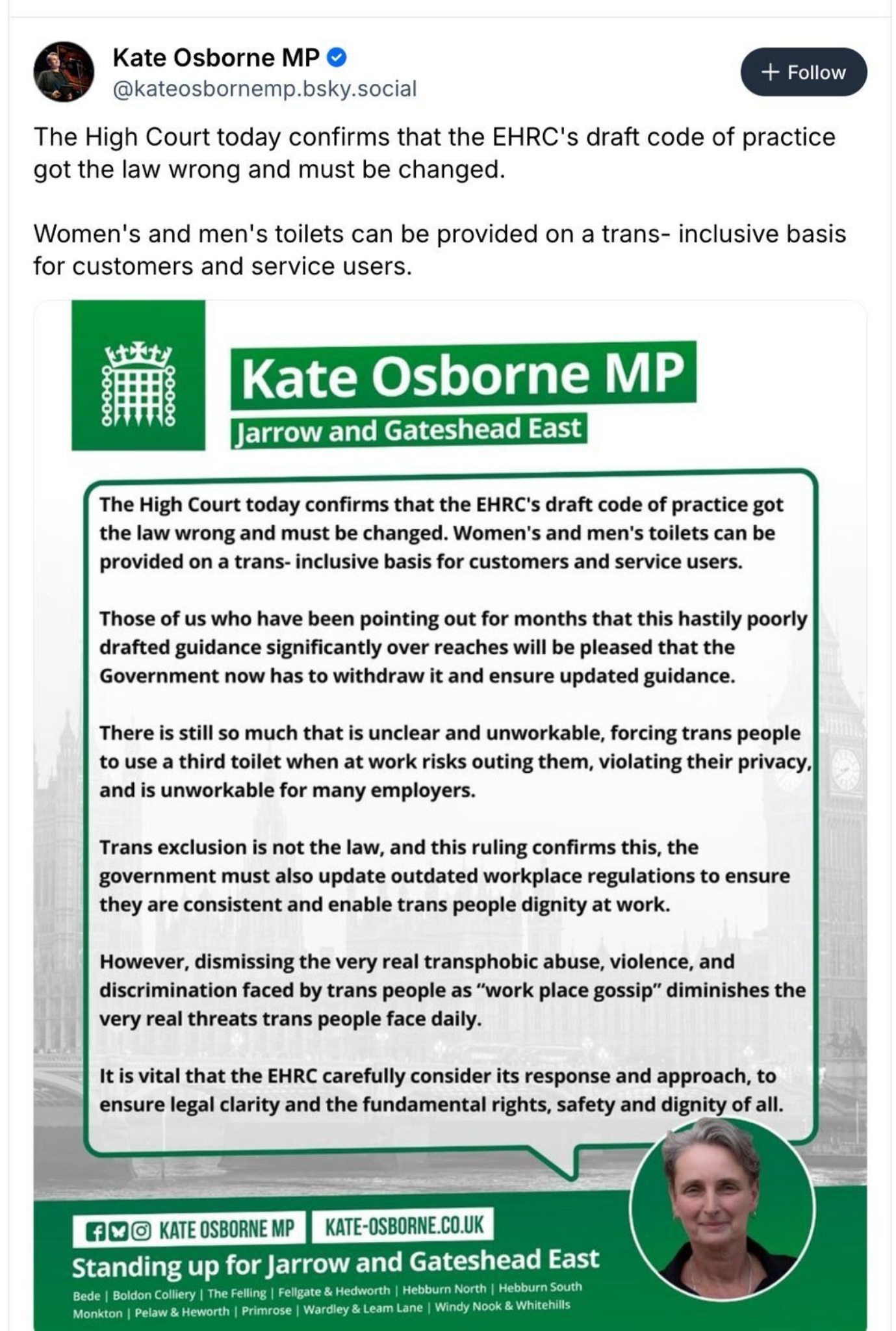
Kate Osborne MP has come under fresh scrutiny after reacting to the High Court judgment in Good Law Project Ltd v Equality and Human Rights Commission with a social post that appears to say almost the exact opposite of what the court actually decided.
Legal YouTuber and barrister BlackBeltBarrister (Daniel ShenSmith) has already walked through this in detail in a fifteen-minute breakdown of the judgment and the political spin now attached to it. His video is here for anyone who wants to see the primary sources on screen rather than trust my summary: Good Law Project loses EHRC toilet guidance case.
It is not just one YouTube barrister saying it. Akua Reindorf KC, a leading employment and discrimination silk, shared Osborne’s graphic on X with a four word verdict: “This is beyond a joke now.”
For once, the inadequacy of at least one North East MP is not just a local problem, it is on full display for the rest of the country to watch in real time.
What Osborne told the public
On social media, Osborne published a graphic using green styling which looks more Green Party coded than Labour red. That is her aesthetic choice, but it is an odd look for a Labour MP, particularly one whose office is already under question on basic standards of communication and accuracy.
In that post, she told the public that:
- The High Court had confirmed that the EHRC’s draft code of practice “got the law wrong” and “must be changed”.
- Women’s and men’s toilets can be provided on a “trans inclusive” basis for customers and service users.
- The government now has to withdraw guidance and ensure updated guidance.
- Trans exclusion “is not the law” and the ruling confirms this.
Taken at face value, a lay reader would reasonably conclude that the court had sided with the Good Law Project, found the EHRC’s interim guidance unlawful, and forced a rewrite of the code of practice.
That is not what the judgment says.
What the High Court actually decided
The judgment, handed down by Swift J on 13 February 2026 in Good Law Project Ltd and others v Commission for Equality and Human Rights [2026] EWHC 279 (Admin), does three simple things that matter for this discussion:
- It holds that the EHRC’s interim guidance on single sex facilities was lawful and within its powers under the Equality Act 2006.
- It finds that the Good Law Project lacked standing as the first claimant, and only the individual claimants could proceed on the human rights ground.
- It dismisses the challenge on all three grounds.
The key line, which even a time poor MP should be able to locate, is at paragraph 103:
“For the reasons set out above, each of the three grounds of challenge fails. The application for judicial review is therefore dismissed.”
The Equality and Human Rights Commission itself summarised the outcome in equally plain language:
“The High Court has rejected a legal challenge brought by the Good Law Project, relating to the interim update we published soon after the Supreme Court’s judgment on the definition of ‘sex’ in the Equality Act 2010.”
Independent legal commentary lines up with that reading. Coverage in The Guardian, Sex Matters, and commercial law outlets all note that the court dismissed the challenge and held the EHRC acted lawfully, while recognising that service providers may lawfully offer trans inclusive options and that the detail is fact specific.
There is real debate to be had about what this means for trans people in practice, especially around workplace facilities and outing risks. What there is not, is any honest way of describing this as a judgment that “confirms the EHRC got the law wrong and must change its code”.
Lawyers who actually read the judgment
Daniel ShenSmith’s video does what MPs should have done before posting. He puts the relevant paragraphs on screen, reads them out, and then lays Osborne’s statement alongside them. Viewers can pause, read, and decide for themselves.
Akua Reindorf KC’s four word comment, “This is beyond a joke now,” is not a law report, but it is a blunt professional reaction from someone who works with equality law for a living. Between them, you have a barrister and a King’s Counsel saying the same basic thing in different tones.
Their core point is simple enough that it deserves repeating here:
- The court did not order the EHRC to change its code.
- The court did not say the EHRC “got the law wrong”.
- The court dismissed the Good Law Project’s challenge on every ground, including standing.
So far, the only people who seem keen to defend Osborne’s wording are people with no legal training at all. The people who actually read and apply this legislation for a living are saying the graphic misrepresents the judgment.
You do not have to share anyone’s wider politics to follow the logic. The words on the page say what they say. If an MP tells the public the court said the opposite, that is either carelessness or indifference to the text.
North East representation and a pattern of sloppiness
If this was the first time Kate Osborne’s operation had played fast and loose with accuracy and process, it would still be serious. It is not the first time.
The Reasonable Adjustment has already documented:
- A drawn out, mishandled Subject Access Request that Labour’s own Data Protection team admitted had been significantly delayed, in Kate Osborne MP and the fabled Subject Access Request.
- An office response to Parliamentary Standards scrutiny that tried to recast legitimate concerns as “private correspondence”, while dodging the actual standards questions, in Kate Osborne MP, office culture, and parliamentary standards.
- A same afternoon rejection email following critical but polite feedback about moderation and political neutrality, as covered in RIP Charlie Kirk, email rejected by 3.57 pm.
- Comment controls and engagement settings quietly tweaked during periods of scrutiny, documented in Comments disabled during scrutiny.
Taken together, you get a picture of an office that does not cope well with being challenged, does not treat legal obligations as serious until pressed, and now publishes a confident public interpretation of a High Court ruling that does not match the ruling.
People in Jarrow and the wider North East are entitled to something better than this from their MP, regardless of their position on the underlying issues.
Why accuracy matters more than branding
Osborne can post in Labour red, Green green, or Comic Sans purple if she wants. Colour palettes do not change the law.
What matters is that when an MP tells the public what a court has just decided, they either:
- Have read the judgment,
- Understood it, and
- Describe it in a way that matches the text, even if they dislike the outcome.
On this occasion, that has not happened. The High Court did not “confirm the EHRC got the law wrong.” It confirmed the exact opposite, it dismissed the challenge and left the guidance standing.
If you want to know what the law says, read the judgment. If you want to know how your MP performs under pressure, watch how they behave when the paperwork is not on their side.
Be First to Comment