Equality Act 2010, understanding anticipatory vs reactive duties
People throw the phrase reasonable adjustments around like it is a magic shield. It only works when you know exactly who owes you what duty, and where to enforce it.
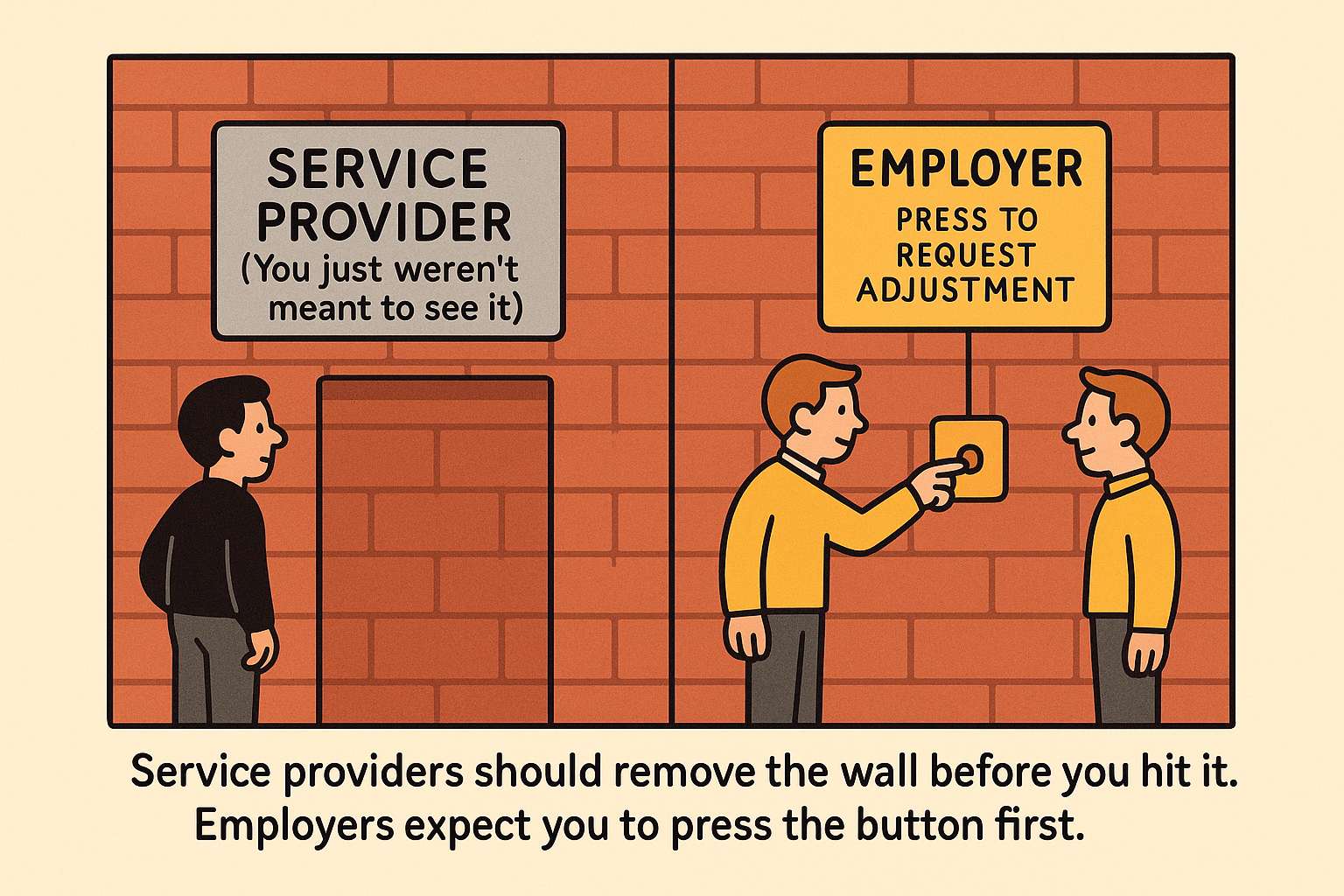
Employers react to individual needs once they know, or ought to know, you are disabled.
Service providers anticipate common needs for the public, they must design access in from the start.
Plain English, the short version
- Employer: they adjust after they know you are disabled. Think, react to you.
- Service provider: they should plan for common needs before you ask. Think, build it in.
- Employment support provider (agency or job support charity): treated like the work route. Claims go to the Employment Tribunal.
Who are you dealing with
- Are they your employer or are you applying to work there, yes, use the employer route.
- Are they helping you get work, for example an agency or job support charity, yes, use the employment support route.
- Are you just using a public service or website, yes, use the service provider route.
What counts as a barrier
- Rules that trip you up for example phone only contact, short reply deadlines, rigid appointment times.
- Physical stuff for example steps, lighting, noisy layout, cramped desks.
- Tools you need for example written communication, screen reader friendly docs, extra time, a quiet space.
How to ask, two tiny templates
Work
Subject, Reasonable adjustments request

Hello [Name],
I am disabled under the Equality Act. The [rule or set up] makes things hard for me because [why].
Could we try, 1) [adjustment], 2) [adjustment].
Please reply in writing. Thank you.
Services
Subject, Accessibility request

Hello [Name],
Your service is open to the public. I am facing a barrier, [what it is].
Please put in place, 1) [adjustment], 2) [adjustment], and confirm the plan.
When they push back
Equal rules can still exclude. Please adjust how this policy is applied so it does not disadvantage me, for example offer an alternative route.
Reasonableness scales with resources. Start with low cost, practical steps you can do now.
I need written communication as a reasonable adjustment. Please confirm you will use email or messaging.
You can consider my request without medical files. If you need more detail, tell me exactly what would help.
Where to take it and timelines
- Work or employment support, ACAS then Employment Tribunal, usually 3 months less a day from the act.
- Services and associations, County Court or Sheriff Court. Often 6 months less a day. Courts can extend if fair.
Deep dive, for the detail minded
Quick comparison
| Context | Who is covered | Trigger for duty | Examples of adjustments | Main forum | Typical time limit |
|---|---|---|---|---|---|
| Employers (Part 5) | Applicants, workers, contractors, some temps | Knowledge trigger, actual or constructive knowledge of disability | Flexible hours, remote or quiet space, written communication, targets adjusted, equipment | Employment Tribunal, start with ACAS Early Conciliation | Usually 3 months less 1 day |
| Service providers (Part 3) | Public or a section of the public, paid or unpaid | Anticipatory duty, not tied to disclosure | Accessible website and forms, alternative contact routes, staff training, layout changes, auxiliary aids | County Court or Sheriff Court | Often 6 months less 1 day, courts can extend if just and equitable |
| Employment service providers (s.55) | Agencies, job support charities, careers and training services | Duty to adjust applies, but claims usually route to the Employment Tribunal | Accessible communications, flexibility in processes, adjustments to selection steps | Employment Tribunal | Usually 3 months less 1 day |
| Education (Part 6) | Schools, FE, HE, qualifications bodies | Adjustments to avoid substantial disadvantage | Assessment adjustments, accessible materials, sensory environment changes | Specialist forums, Tribunal or County Court depending on route | Varies by route |
| Associations (ss.101-104) | Clubs and associations with 25 or more members | Anticipatory duty for members and guests | Accessible venues, policies, formats, auxiliary aids | County Court or Sheriff Court | Often 6 months less 1 day |
Note: section 55 employment service-providers are enforced in the Employment Tribunal. Their duty is designed with accessibility in mind, similar in spirit to the anticipatory services duty.
The three parts of the duty
1) Provision, criterion or practice, PCP
Rules or ways of doing things that put disabled people at a substantial disadvantage, for example a phone only contact rule. Adjust by offering a written route with extra time to respond.
2) Physical features
Layout, steps, signage, furniture, lighting. Adjust by altering layout, providing ramps or quiet areas, or relocating an activity.
3) Auxiliary aids and services
Equipment or services that bridge the gap, for example screen readers, notetakers, communication support, alternative formats, or a simple promise to use email.
Decision path, who owes you what
Step 1. Are you applying for, doing, or leaving a job with the organisation, including agency or contractor work, if yes, treat as Employer.
Step 2. Are you getting help to find work, from an agency, a job support charity, or a training provider, if yes, treat as Employment service provider.
Step 3. Are you using goods, facilities, digital tools, or services open to the public, if yes, treat as Service provider.
Step 4. Is this a school, college, or university matter, if yes, check the education route.
Step 5. Is this a private club or association with membership rules, if yes, check the associations route.
Employment service-providers, the hybrid under section 55
Some organisations sit in the employment field without being your employer, for example recruitment agencies, job support charities, and training providers. The Equality Act treats them as employment service-providers under section 55. Claims go to the Employment Tribunal. The duty mirrors the anticipatory idea from services, in practice they should design accessible processes from the start, not wait for a request.
Key points: forum is Employment Tribunal, ACAS Early Conciliation applies, the provider should embed adjustments in policies, communications, and selection steps.
What actually counts as a service provider
Any person or organisation providing goods, facilities, or services to the public, or a section of the public, whether paid or unpaid. That covers private businesses, charities, public authorities, clinics, councils, housing providers, banks, shops, gyms, websites and apps, and more. The duty is anticipatory in services, that means planning for common needs up front, not waiting for a request.
Myths vs reality
We can wait until someone asks
Reality, for services the duty is anticipatory. Build accessible routes, formats, and policies in advance.
We are too small
Reasonableness scales with resources, it never drops to zero. Low cost, high impact changes are usually expected.
Policies are the same for everyone
That is the point. A uniform rule can be a PCP that puts disabled people at a disadvantage, so you adjust the rule.
Online is optional
Websites and apps count as services. Accessibility is part of the anticipatory duty, not a feature request.
Case mini cards, what the courts said
Paulley v FirstGroup, UKSC 2017
Takeaway: Service providers must do more than politely ask when policies block wheelchair access. Policies may need redesign to make access effective in practice.
G4S Cash Solutions v Powell, EAT 2016
Takeaway: In principle, protecting pay when redeploying a disabled worker can be a reasonable adjustment, facts matter.
Griffiths v DWP, CA 2015
Takeaway: Attendance policies may need adjustment for disability related absence, adjustments must still be reasonable in context.
Archibald v Fife Council, HL 2004
Takeaway: Transfer to a suitable vacancy can be required where a worker can no longer do the original role.
Cordell v FCO, EAT 2011
Takeaway: Very high cost can defeat reasonableness at the far edge, the test is still what is right and just in the round.
Breach signals
- Service withdrawal after you raise a disability need or give feedback
- Communication blocks or refusal to use a written channel after disclosure
- Rigid standard process with no route for adjustments
- No disability policy or training information on request
- Website or app with obvious accessibility failures
What to do next
Template, employer request
Subject: Request for reasonable adjustments under the Equality Act 2010

Dear [Manager/HR],

I am disabled within the meaning of the Equality Act 2010. Your [policy or practice] is a provision, criterion or practice that places me at a substantial disadvantage compared with non disabled colleagues, specifically [explain the disadvantage].

I propose the following adjustments, each is practical, effective, and low cost:
1) [Adjustment A]
2) [Adjustment B]
3) [Adjustment C]

Please confirm within 14 days how you will implement these, or propose alternatives that achieve the same outcome. I am happy to discuss if it helps, please keep communication in writing.

Kind regards,
[Name]
[Job title or applicant]
Template, service provider request
Subject: Anticipatory reasonable adjustments under the Equality Act 2010

Dear [Service provider],

Your service is open to the public. The Equality Act places an anticipatory duty on service providers to remove common barriers. I am experiencing substantial disadvantage because of [PCP or barrier].

Please put in place the following adjustments now, and confirm your plan and timeline:
1) [Adjustment A]
2) [Adjustment B]

If this is not resolved promptly I will consider escalation, including a formal complaint and legal remedies. Written replies only please.

Kind regards,
[Name]
[Customer or service user]
Time limits and forums
Employment Tribunal: usually 3 months less 1 day from the act, start ACAS Early Conciliation within that time. Some claims differ.
County Court or Sheriff Court: services and associations claims are often 6 months less 1 day from the act. Courts can extend if just and equitable. For public law challenges by judicial review, the limit is usually 3 months.
Useful routes for help
- ACAS, Early Conciliation for work disputes.
- EASS, free discrimination advice for the public, not for employers.
- EHRC Codes, official guidance for both employment and services.
Legal and publishing notes
This guide is general information, not legal advice. If in doubt, seek qualified advice. The Equality Act covers England, Scotland, and Wales. Northern Ireland has different legislation.



Be First to Comment