
GutCheck: https://trsa.org.uk/gutcheck
If you’ve got ulcerative colitis, IBS, Crohn’s, reflux, coeliac disease, or some grim combination of the lot, food stops being simple. It’s not just “eat healthy” and crack on. It’s checking labels, second-guessing sauces, wondering whether a supermarket shortcut is going to cost you later, and trying to remember what actually set you off last time.
That’s the problem GutCheck is built to deal with.
GutCheck is a food trigger checker that helps people manage dietary triggers across digestive, inflammatory, and autoimmune conditions. Instead of throwing generic advice at you and pretending that covers it, it gives you practical tools you can actually use: a trigger food database, an ingredient decoder, barcode lookup, an eating out guide, a shopping list, and a symptom journal.
It’s built for real-world use, not for looking impressive in a product mock-up.
Why a food trigger checker is actually useful
Most people with chronic digestive issues end up doing the same thing: trial and error, over and over again. Sometimes that works. Sometimes it just means repeating the same mistakes with better branding.
The harder bit is that food advice is usually either far too broad or far too absolute. One site tells you tomatoes are fine. Another says avoid them. Someone else says the problem is dairy, or gluten, or onions, or seed oils, or joy itself. After a while it all turns into noise.
GutCheck cuts through that by letting you filter according to the conditions you’re actually managing. So if you’re dealing with ulcerative colitis, Crohn’s disease, IBS, coeliac disease, GERD / acid reflux, or related inflammatory conditions, the tool changes what it shows you based on that.
That matters because not every trigger hits every condition in the same way, and pretending otherwise is lazy.
Search foods by condition, not by vague internet folklore
The core of GutCheck is a searchable trigger food database. You can browse foods by category, search directly, and filter depending on whether you’re in a flare or just trying to maintain some sort of stability.
That means you’re not stuck with one blunt list of “bad foods”. You can look at what’s more likely to cause trouble in context, which is far more useful than the usual yes-or-no rubbish.
Each item is also tagged by evidence type, so there’s a clearer distinction between established clinical guidance, research-backed concerns, and patient-reported patterns. That won’t magically solve dietary uncertainty, but it does stop everything being presented as if it carries the same weight.
The ingredient decoder saves you reading labels like a hostage note
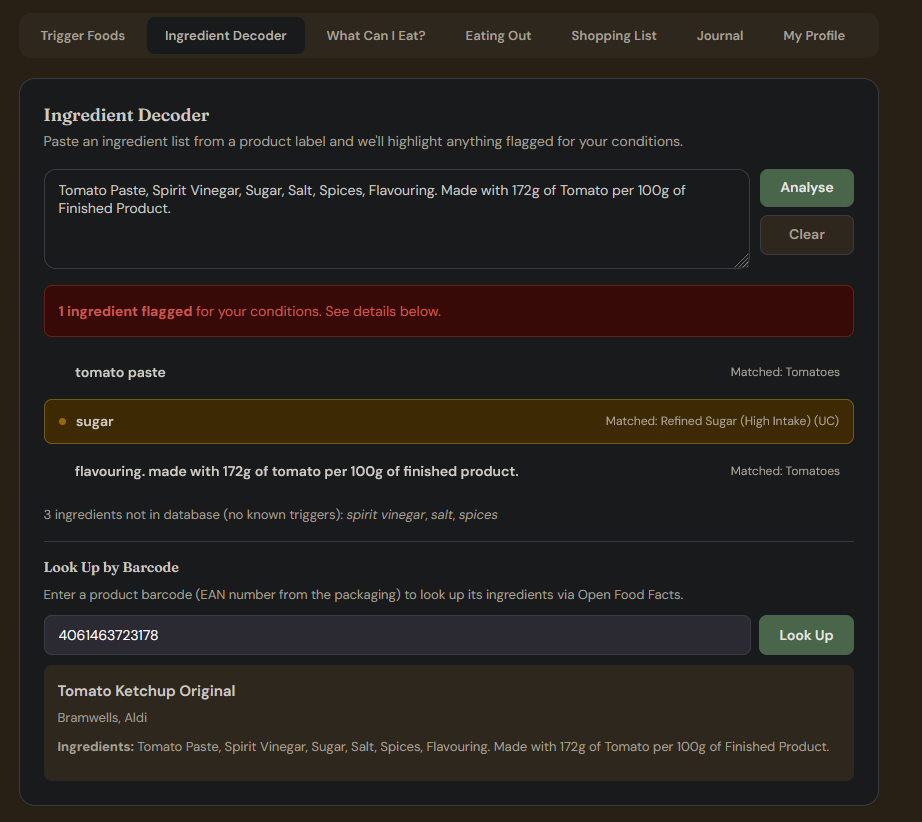
One of the most useful parts of GutCheck is the ingredient decoder. Paste in the ingredients from a label and it highlights anything flagged for your selected conditions.
That’s useful for obvious reasons. Most people don’t want to stand in Aldi trying to work out whether a sauce, dressing, snack or ready meal is likely to contain something that’ll set them off. They want a quick read on whether it looks fine, questionable, or stupid.
So instead of mentally parsing onion powder, garlic powder, sweeteners, flavourings, refined sugar, acidic ingredients and various bits of disguised nonsense, GutCheck does the heavy lifting for you.
It also shows what was matched and what wasn’t, which is important. Better a tool that’s clear about what it knows than one that acts omniscient and gets it wrong quietly.
Barcode lookup makes it even easier
If typing out ingredients sounds like needless faff, there’s also a barcode lookup feature using Open Food Facts. Enter the product barcode and GutCheck can pull in the ingredient list for you, then run the same checks against it.
That makes the tool far more usable in normal life. You’re not always sat at home with time to play food detective. Sometimes you just want to know whether the ketchup, cereal bar, or random cupboard item is likely to be a problem.
It doesn’t just tell you what to avoid
A lot of diet tools get trapped in restriction mode. Endless red flags, endless warnings, endless “don’t eat this”. That gets old quickly, especially if you’re already knackered and hungry.
GutCheck also includes a What Can I Eat? section, which focuses on foods that are lower risk across your selected conditions. That gives people somewhere to start, instead of leaving them with the impression that every ingredient on earth is part of a conspiracy against their bowel.
That shift matters. People need practical fallback foods. They need safer options. They need meal foundations. They don’t just need another list of things that might ruin their week.
The eating out guide deals with a common weak point
Managing food at home is one thing. Eating out is where it often goes sideways. Hidden ingredients, sauces, marinades, spice mixes, heavy oils, onions appearing where they’ve no business being, and menus that tell you almost nothing useful.
GutCheck includes an eating out guide that helps users look at common cuisine types and get a rough sense of what’s usually safer, what’s risky, and what needs more caution.
It won’t replace asking questions in a restaurant, but it does give you a better starting point than just hoping for the best and regretting it later.
The journal helps you stop guessing
No tool can tell you exactly how your body will react. Anyone claiming otherwise is selling fantasy. What GutCheck can do is help you build a clearer record over time.
The built-in journal lets users log foods, reactions and notes, so they can track patterns instead of relying on half-memory and vibes. That matters because symptoms blur together fast. A journal won’t make your condition disappear, but it can make your decisions less random.
Built with privacy in mind
GutCheck stores your selected conditions, journal entries, shopping list and preferences locally in your browser. In other words, the personal stuff stays on your device.
That’s how a health-related tool should work unless there’s a very good reason otherwise. People shouldn’t have to trade basic privacy just to keep track of what food might be making them ill.
Who GutCheck is for
GutCheck is for people who are sick of vague food advice and sick of wasting time. It’s for people dealing with chronic digestive or inflammatory conditions who want something more useful than a stale leaflet or a load of online contradictions.
If you’ve ever looked at a label and thought, “This is either completely fine or an absolutely terrible idea”, this is the sort of tool that makes that decision easier.
A better way to check food triggers
There’s no magic diet here, because there usually isn’t one. But there is a big difference between stumbling through trigger foods blindly and using a tool that helps you check ingredients, spot likely issues, keep track of reactions, and make less stupid food decisions.
That’s what GutCheck is for.
If you’re trying to manage ulcerative colitis, IBS, Crohn’s disease, coeliac disease, acid reflux, or related inflammatory conditions, GutCheck gives you a more practical way to handle food triggers without turning every meal into a research project.
Further reading
If you like practical tools built to reduce friction rather than add more of it, these are worth a look too.
- ReasonableRedactor, a local PDF redaction tool built for privacy-first document handling
- HotPot, a fast pothole logger designed for capture-first, report-later use
- Reasonable Case Management System, a cleaner way to organise evidence, timelines and case material
- UK CBPM Cost Calculator, a public tool for estimating prescription cannabis costs in the UK

Be First to Comment