
By Kieron JH, Founder, The Reasonable Adjustment
Note: This is commentary on media framing and public risk communication. It is not medical advice.
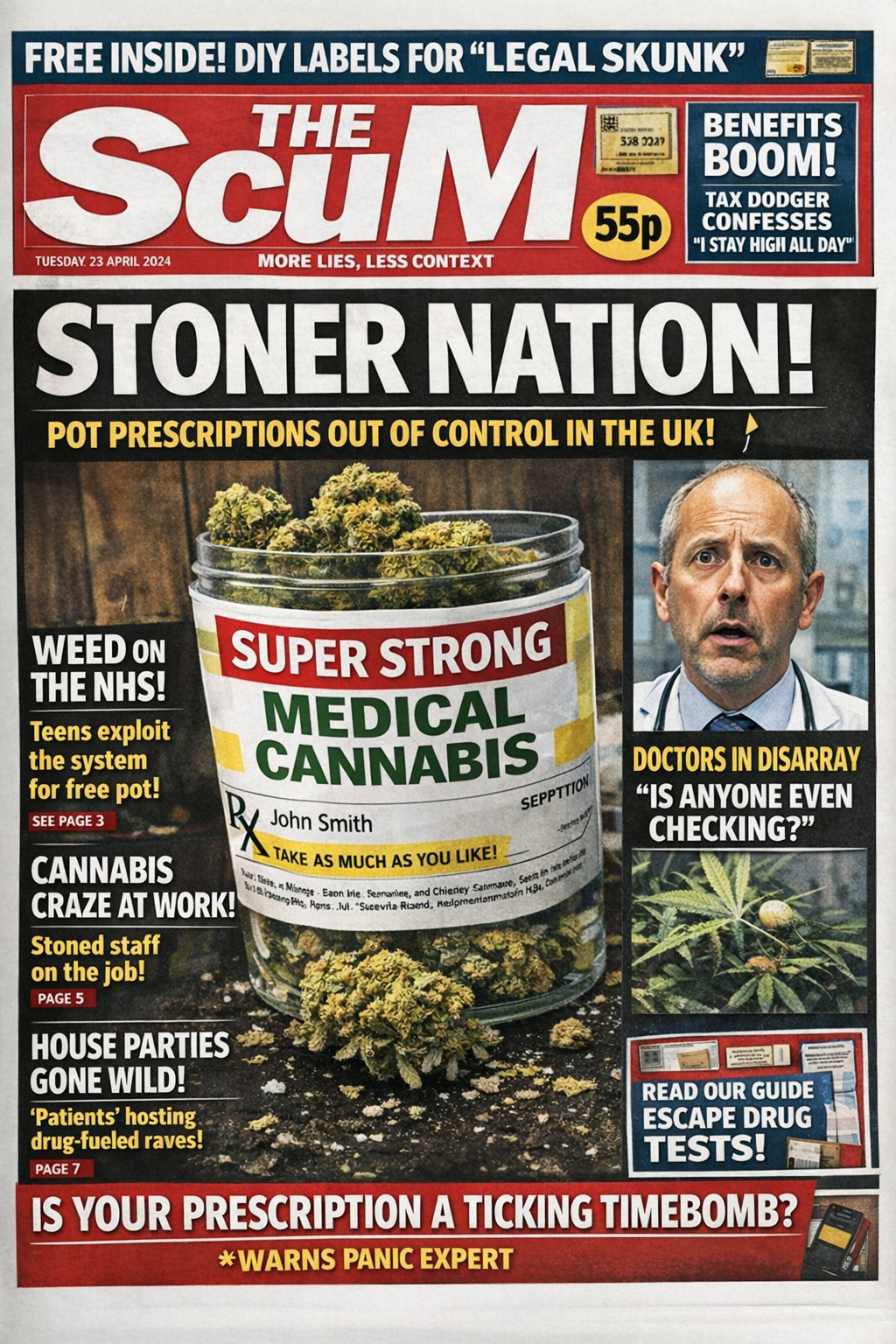
The Sun recently ran a “medical cannabis” story with a headline that tells you everything you need to know about the intent. “STONER NATION” is not health reporting. It’s a smear, printed in advance, then padded with numbers and scary words.
This article does two things. First, it explains why The Sun has a uniquely toxic reputation in Liverpool, and why that history matters. Second, it debunks the techniques the paper uses to turn prescribed patients into a punchline, especially those with psychiatric conditions.
Background: why Liverpool still treats The Sun like a social offence
The Sun’s reputation in Liverpool is tied to its coverage of the Hillsborough disaster in 1989. The paper published a front page that repeated false allegations about Liverpool supporters, and it helped cement a public narrative that blamed ordinary people while institutions avoided accountability.
That wasn’t a minor mistake. It was contempt aimed at a community in shock, packaged as certainty. Decades later, Liverpool’s boycott, often referred to as “Shun the S*n”, still holds because the underlying issue was never just “accuracy”, it was the willingness to dehumanise people for a story.
That context matters because the exact same method is visible in The Sun’s cannabis coverage. Different target, same playbook: pick a group, frame them as suspicious, then let stigma do most of the work.
The Sun’s method: load the language, blur the categories, then sell fear
“STONER NATION” is not a neutral headline. It primes the reader to see patients as “stoners” before any facts are discussed. The article then reinforces it with insinuations like “loopholes”, “taking advantage”, and “pseudo recreational”. It’s designed to make “legal prescription” feel like “scam”, without having to prove wrongdoing at scale.
The trick is simple:
- Label the patient group in derisive terms.
- Blur the line between illicit use and prescribed care.
- Pick a scary outcome, usually psychosis, and treat it as the inevitable destination.
- Skip the boring but essential parts like screening, contraindications, follow up, and dosage context.
If you want to debate prescribing standards or evidence thresholds, fine. That’s a real conversation. But if your argument needs the word “stoner”, you are not informing the public, you are telling them who to look down on.
The quiet cruelty: misrepresent psychiatric conditions, then attack the people treating them
A lot of The Sun’s punchiness comes from how it talks about psychiatric conditions. Anxiety, depression, OCD, ADHD, PTSD, mood disorders, the article leans on the idea that these diagnoses are flimsy, fashionable, or “easy” to claim.
Here’s what they never say clearly: these are the same conditions many people are actually trying to manage, often after multiple medications, side effects, incomplete relief, or years of being bounced around services.
When a tabloid treats psychiatric labels as suspicious by default, it does not just attack cannabis. It attacks the credibility of patients, and it encourages the public to treat mental health as a moral failure rather than a clinical reality.
You can hold two truths at once. Evidence for cannabinoids in several psychiatric indications is mixed and often limited, and it still does not justify treating patients like scammers. A debate about evidence is not a licence to smear people living with symptoms.
Psychosis and schizophrenia: real risk, wildly overstated headline logic
Cannabis is not risk free. There is credible evidence of an association between heavy cannabis use and increased psychosis risk, especially with frequent use and high potency products.
The problem is how tabloids translate that into “cannabis causes schizophrenia” as if it’s a simple, universal outcome. That is not what serious summaries say, and it’s not how risk works in real life.
What a responsible summary looks like
- Most users do not develop schizophrenia. This is about increased risk in some people, not a guaranteed outcome for everyone.
- Risk is not uniform. Frequency, potency, age of first use, and vulnerability factors matter.
- Vulnerability matters. Family history, prior symptoms, and earlier psychotic episodes are the obvious red flags.
- Clinical context matters. A legitimate prescribing pathway should screen, exclude, and monitor.
If a clinic is prescribing irresponsibly, criticise the clinic standards. If regulators are under resourced, criticise the regulators. But using psychosis as a panic lever to smear all prescribed patients is lazy and harmful.
“Super strength” is a scare phrase when they refuse to talk about dose and context
The Sun leans hard on “super strength” and “ultra strong strains” because potency sounds dramatic on a front page. But potency alone is not the full story. Dose, route, titration, monitoring, and patient history are the story.
Converting a clinical question into a horror headline is not protecting people. It’s click farming with a stethoscope costume.
If this is about safety, these are the questions that matter
- What are the clinic’s contraindications, especially around psychosis, schizophrenia, and bipolar spectrum risk?
- How do they screen for family history and prior episodes, and what excludes a patient?
- What does follow up look like after the first appointment, and how often are prescriptions reviewed?
- What formulations and THC ranges are typically used for the condition, and how is dose titrated?
- How do they handle impairment risk, driving guidance, and workplace safety?
- Which pharmacy dispenses, and can the patient choose a different pharmacy?
- How does the clinic handle SARs, corrections, and privacy complaints, and who is the data protection contact?
Notice what is not on the list. Calling people “stoners”.
Practical resources from The Reasonable Adjustment
UK clinics to compare
Not an endorsement, just a starting shortlist. Always check fees, prescribing approach, follow up, and which pharmacy dispenses your prescription.
Privacy warning: avoid IPS Pharma routes where you can
Privacy is not a side issue when you are sharing sensitive medical information. Based on our published analysis of IPS Pharma’s privacy posture and related concerns, we recommend avoiding IPS Pharma as a dispensing route where you have a choice, and being cautious about clinics directly connected via pharmacy partnership.
Read the evidence first, then decide what level of risk you are willing to accept:
- IPS Pharma privacy analysis, why the policy is a red flag
- IPS privacy policy vs patient portal reality
- IPS privacy concerns, what patients should know
Two questions that save you pain later
- Which pharmacy dispenses my prescription, and can I choose a different one?
- If I submit a Subject Access Request, who handles it, and what is the response timeline?
Conclusion: this is not “health reporting”, it’s stigma marketing
Liverpool’s long memory exists for a reason. When a powerful outlet decides a group is fair game, it prints contempt as certainty. The Sun’s “Stoner Nation” framing repeats that habit, and it lands on people managing real symptoms, real diagnoses, and real risk decisions.
Debate evidence standards, clinic governance, and regulatory oversight. Absolutely. But stop pretending the word “stoner” belongs anywhere near healthcare.



Be First to Comment