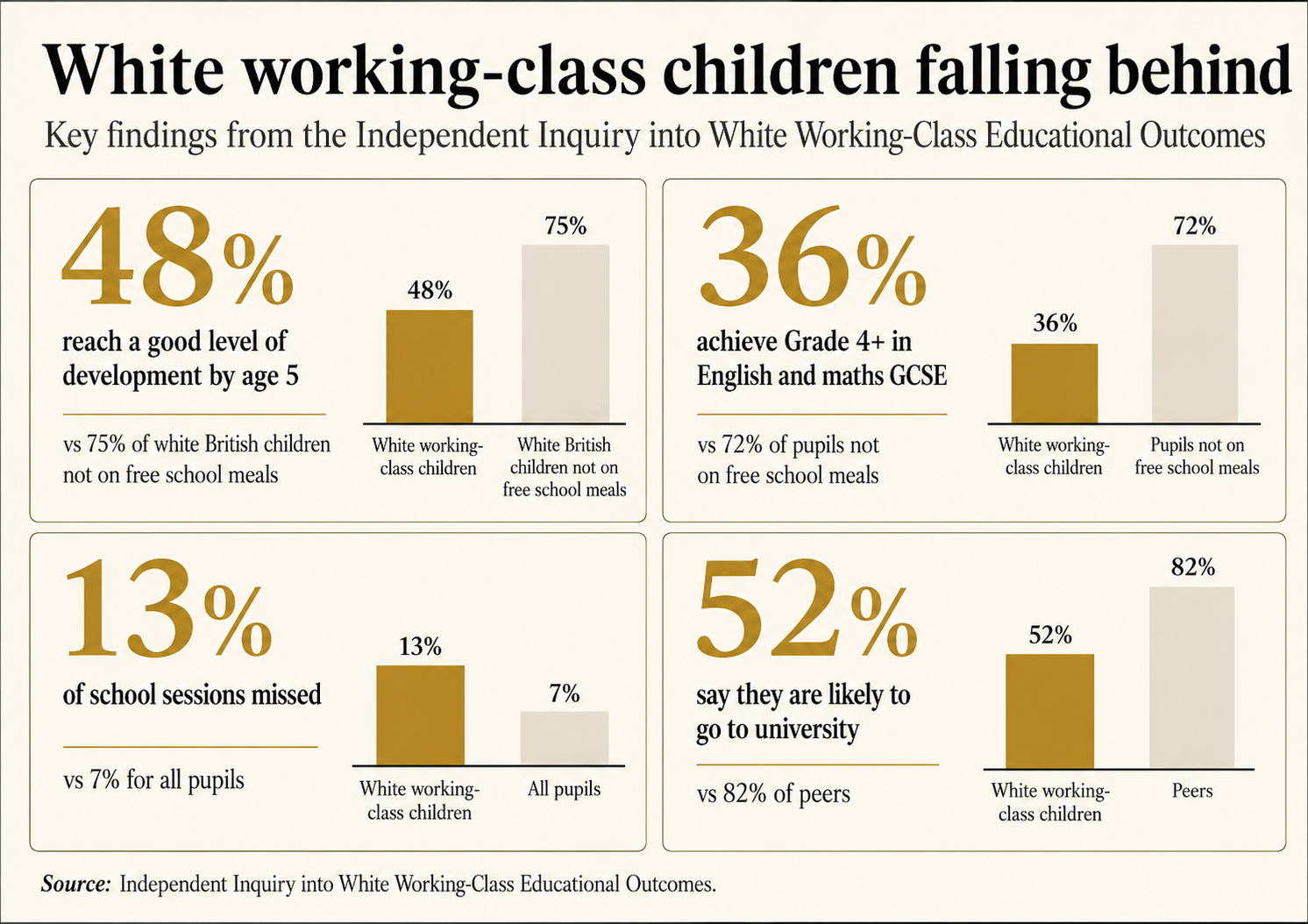
Only 48% of white working-class children reach a good level of development by age five, compared with 75% of white British children who aren’t eligible for free school meals, a new inquiry has found.
By GCSE level, 36% achieve a Grade 4 or above in English and maths. The equivalent figure for pupils not eligible for free school meals is 72%.
White working-class pupils also miss 13% of school sessions on average, compared with 7% across all pupils. Just 52% told the inquiry they were likely to go to university, against 82% of their peers.
The figures are set out in the Independent Inquiry into White Working-Class Educational Outcomes, commissioned by Star Academies. The inquiry examined national education data alongside research involving pupils, parents, teachers, schools and community organisations.
The figures from the inquiry
- 48% of white working-class children reach a good level of development by age five, compared with 75% of white British children not eligible for free school meals.
- 36% achieve a Grade 4 or above in English and maths GCSE, compared with 72% of pupils not eligible for free school meals.
- 13% of school sessions are missed by white working-class pupils, compared with 7% across all pupils.
- 52% say they are likely to go to university, compared with 82% of their peers.
The inquiry describes white working-class children as one of the largest groups with persistently poor outcomes in England’s education system.
Its analysis covers early years development, attendance, GCSE attainment, school experience, progression after 16 and access to work and training.
The gap starts before GCSEs
The largest difference in the report appears before pupils reach secondary school.
Less than half of white working-class children meet the expected development standard by the end of reception. The report then records lower attainment later in school, alongside higher absence and lower expectations of university attendance.
The inquiry identifies the move from primary to secondary school as a point where pupils can disengage. It says many young people and parents described a growing distance between what schools offer and the routes they believe are available to them after education.
It recommends additional early-years support, a national focus on reading fluency in primary school and more work on school-family relationships.
The Department for Education’s schools white paper, published in April, also identifies lower attainment, higher absence, more difficult transitions into secondary school and higher identified SEND among white working-class children.
Attendance is higher, and university expectations are lower
White working-class pupils miss 13% of school sessions, compared with an average of 7% across all pupils.
The report says attendance is part of a wider pattern of disengagement. Its research found that white working-class pupils were less likely to say they enjoyed school and less likely to believe that education would lead to a better future.
Only 52% said they were likely to go to university. The inquiry doesn’t present university as the only successful outcome, but says schools need to offer clearer routes into technical education, apprenticeships and local employment.
Its recommendations include a major expansion of apprenticeships, with access to a high-quality local apprenticeship for every young person who wants one.
Apprenticeships are one of the inquiry’s proposed answers
The report calls for stronger vocational routes, particularly for pupils who don’t see university as the right or most realistic option.
That includes more local apprenticeships, better careers advice and clearer progression between school, college, training and work.
The issue of what happens after an apprenticeship provider closes has already been examined by The Reasonable Adjustment’s reporting on JB Skills Training.
Department for Education records showed that 18 apprentices were enrolled when the provider closed in 2018. Five were supported by the department to find another provider. The department said the remaining 13 had secured new employers independently.
Further records disclosed through Freedom of Information showed that the department hadn’t independently verified those outcomes. It also didn’t hold a breakdown showing whether the 13 had found new employers, transferred to another provider, remained in work without completing their apprenticeship, or completed their training.
The inquiry’s recommendation concerns access to apprenticeships. The JB Skills records concern how outcomes are recorded when a provider fails. Both sit within the wider question of whether vocational routes are available and whether they remain in place once a young person has started one.
The inquiry recommends free public transport for under-21s
Another recommendation is free local public transport for all young people up to the age of 21.
The inquiry says this would improve access to education, training and work, particularly in areas where colleges, apprenticeships and jobs aren’t close to where young people live.
Transport costs and local service availability already affect access to education. The Reasonable Adjustment previously examined England’s school transport system, including the billions spent on home-to-school transport and the limits of an approach built mainly around statutory eligibility and local authority arrangements.
The inquiry doesn’t set out a delivery model for free under-21 travel. Its report recommends that national government, local authorities, transport providers and employers work together to improve access to education, training and employment.
SEND is also part of the picture
The Government’s white paper says white working-class children have higher levels of identified SEND than many other groups.
The inquiry includes SEND among the factors affecting the cohort, alongside early-years development, attendance, relationships with school, access to training and local opportunity.
The Reasonable Adjustment’s FOI reporting on SEND record retention examined how North East councils hold education and SEND records, including retention periods running decades into adulthood, missing historical guidance and incomplete disclosures.
That reporting does not explain the attainment figures in this inquiry. It does show the record-keeping systems families may have to rely on when challenging decisions about SEND support, exclusions, alternative provision or education records.
Government response
The Department for Education has said its response will include two place-based programmes, Mission North East and Mission Coastal.
The white paper says the programmes will focus on improving outcomes for young people in areas where disadvantage has become entrenched. It also refers to early family support, breakfast clubs, youth services, attendance, parental engagement, careers advice and further education pathways.
The inquiry makes 24 recommendations in total. They include expanded childcare for disadvantaged families, reading support, improved mental health provision, free local transport for under-21s and a larger local apprenticeship offer.
The report does not treat white working-class pupils as a single, uniform group. It notes that the term is difficult to define through official education data, and that free school meal eligibility does not capture every low-income family.
Its central findings are nevertheless clear: the attainment gap begins early, remains visible through school and is accompanied by higher absence and lower expectations of university progression.

Be First to Comment