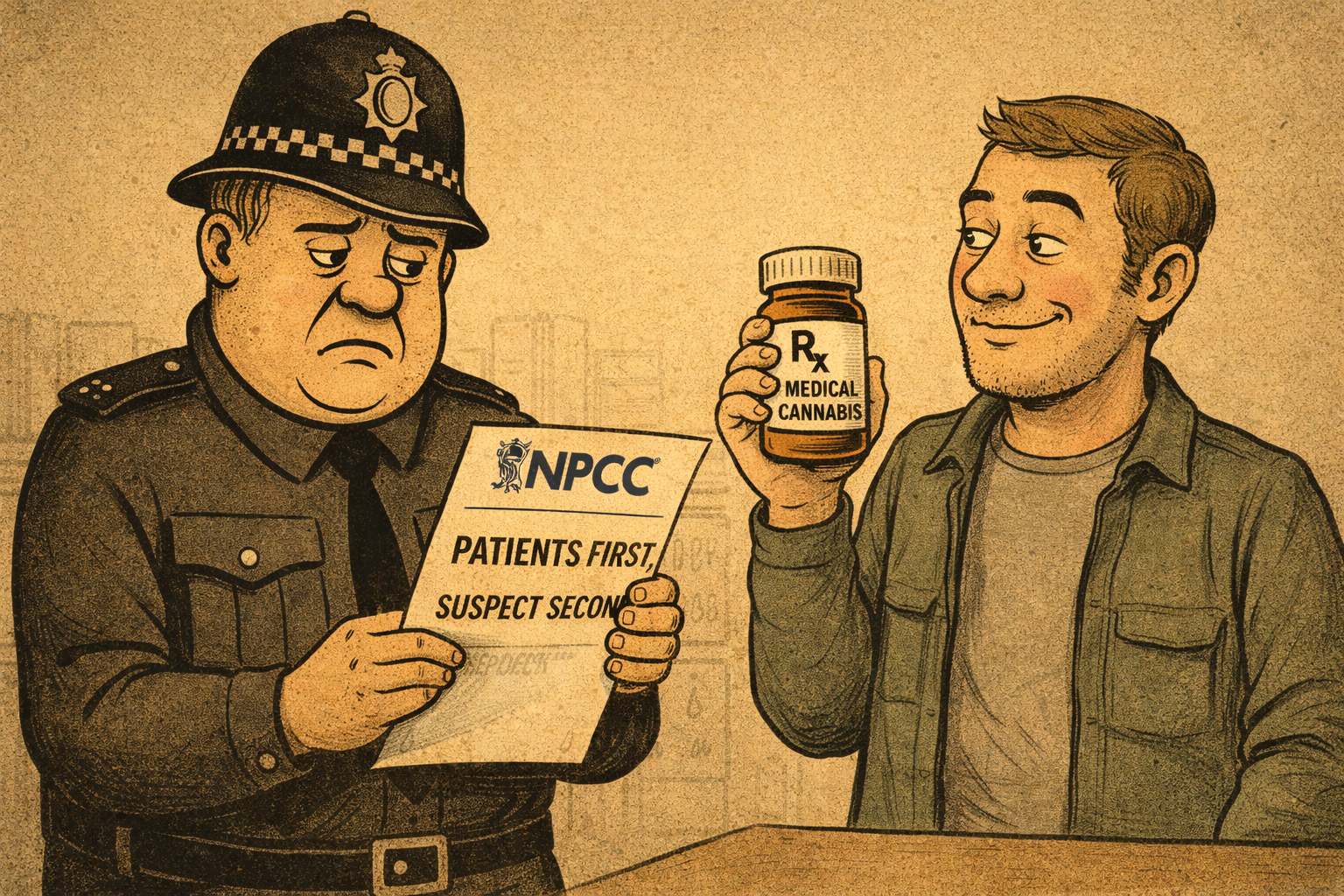
New NPCC approved guidance on prescribed medical cannabis instructs officers to treat people in possession of cannabis based products for medicinal use (CBPMs) as “patients first, suspects second”. That line matters because it resets the default behaviour that has been causing the same avoidable mess since CBPMs became lawful to possess with a prescription.
This article explains what the guidance says, what it means for real world stops, and where friction is still likely to happen.
Read the guidance: APCDLO Medicinal Cannabis and the Police (PDF)
What the NPCC medical cannabis guidance tells officers to do
The guidance is practical, not philosophical. It boils the encounter down to a short set of checks, designed to stop needless escalation.
- Ask to see the original packaging.
- Check the dispensing label, this is the core proof most people already have on the product.
- A prescriber letter or copy of the prescription can help, but patients are not legally required to carry it.
- Further police action should only follow where there are justifiable grounds to believe the person is not lawfully prescribed.
The biggest shift is the stated assumption, if someone has CBPMs, officers should treat them as a patient unless there is a real reason not to.
Why this matters, the law changed in 2018, behaviour didn’t
CBPMs moved into Schedule 2 on 1 November 2018. On paper, lawful possession with a valid prescription has been straightforward ever since. In practice, many patients have been forced to repeatedly prove they are not criminals, sometimes to officers relying on outdated briefings and “street knowledge”.
This is why guidance matters. It is not the law, but it influences what officers think they are “supposed” to do at the roadside, at stations, and in public spaces.
If you want the wider context of why unregulated supply creates real harm for patients, and why “just get it off a mate” is not a safe workaround, read Unregulated Cannabis Is Not As Safe As You Think.
Cancard: the guidance quietly says the obvious
The guidance addresses Cancard and draws a clean line that patients have been asking for.
A Cancard is not proof of a prescription. It indicates a condition that could be treated with cannabis, and that is not the same thing as lawful prescribed possession. The guidance also makes the uncomfortable point that prescribed patients have no need for a Cancard, despite the annual fee.
If you want the blunt version of why this matters, and how Cancard muddies the water for the very people it claims to help, read Cancard? More like SCAMcard!.
Smoking, vaping, and the simplest way to avoid a pointless argument
The guidance repeats something patients should take seriously, smoking prescribed cannabis is prohibited. Vaping is distinct from smoking because it does not involve combustion, and patients should follow prescriber directions on method of administration.
In reality, many confrontations start because the situation looks like street use. If you want fewer problems, reduce ambiguity. Keep products in labelled packaging, don’t improvise in ways that look like “classic cannabis behaviour”, and don’t give someone an excuse to perform authority.
Driving is still where most people get exposed
Possession law and driving law are different problems. The guidance points back to existing UK rules on impairment and road safety, and it does not create a magic shield.
If you drive, treat this like a separate risk assessment. If you are impaired, you are exposed. If you are stopped, your best outcome is calm verification, not an argument about policy.
Practical stop advice for patients, reduce friction, keep your day intact
This isn’t about “complying harder”. It’s about not letting someone else’s uncertainty ruin your day.
- Keep CBPMs in original packaging with the dispensing label intact.
- If you’re comfortable, keep a photo of your prescription or clinic letter on your phone. You do not have to, but it often shortens the interaction.
- Carry ID if you normally do anyway, it helps match name on label to a person, fast.
- Be boring. Short answers, calm tone, no debate club.
- If something goes wrong, document after, names, numbers, time, location, what was said, what was seized, what was threatened.
For live event planning specifically, including what to bring and how to handle venues and security, see Save yourself some time and stress during festival season.
FAQ: NPCC guidance, medical cannabis, and police stops
Do I need to carry my prescription for medical cannabis in the UK?
No. Patients are not legally required to carry a copy of their prescription or a prescriber letter. That said, the guidance suggests that showing a prescription copy, clinic letter, or original labelled packaging can speed up verification and reduce hassle. The label on the original packaging is usually the quickest route to “this is lawful”.
Can UK police seize prescribed medical cannabis (CBPMs)?
They can seize items in the course of their duties, but the key issue is whether they have justifiable grounds to believe you are not lawfully prescribed. The guidance’s whole point is to reduce unnecessary seizures and escalation by treating possession as lawful unless there is a real reason to think otherwise.
What should I show police if I’m stopped with medical cannabis?
Start with the original packaging and dispensing label. If you have it, show ID that matches the name on the label. If you are comfortable sharing it, a photo of your prescription or a clinic letter can help, but it’s not mandatory.
Is Cancard proof of a medical cannabis prescription?
No. Cancard indicates someone has a condition that could be treated with cannabis. It is not proof of a prescription. If you are prescribed, the guidance says you have no need for Cancard, despite the annual fee. For the deeper dive, read Cancard? More like SCAMcard!.
Is it legal to smoke prescribed medical cannabis in the UK?
No. The guidance states that smoking prescribed cannabis is prohibited. Vaping is treated as distinct from smoking because it does not involve combustion. Patients should follow their prescriber’s directions on administration.
Can I drive after taking prescribed medical cannabis?
This is the part people get wrong. Possession law and driving law are separate. If you are impaired, you are exposed. Treat driving as its own risk assessment and be honest about how it affects you. If you want to avoid chaos, don’t drive when you know you’re not right.
What we’re watching next
Guidance is only as good as implementation. A PDF can’t instantly fix culture, training gaps, or officers who treat discretion like a hobby.
The test is simple, do unlawful seizures and needless confrontations drop, and do forces embed “patients first” into routine practice rather than treating it like optional reading.
We’ll keep watching, and we’ll keep publishing real world outcomes, good and bad.
Related reading and tools
- The UK’s First Public CBPM Cost Calculator, plan cost, dose, and tolerance breaks using real numbers, not clinic folklore.
- Cancard? More like SCAMcard!, why plastic “proof” creates confusion for patients.
- Save yourself some time and stress this festival season, a practical venue and security checklist.
- Unregulated Cannabis Is Not As Safe As You Think, why contamination and uncertainty hit patients hardest.
- APCDLO Medicinal Cannabis and the Police (PDF)
Published by Kieron JH, Founder, The Reasonable Adjustment.



Be First to Comment