
Grateful For The Raid
By Kieron JH
I grew up raiding in World of Warcraft. Looking back, I am thankful for it. Those evenings on voice chat gave me structure, purpose, and people who expected the best from me. I believe raiding kept me away from choices that could have taken my life somewhere darker. It gave me a team, clear goals, and a routine that rewarded patience and honesty.
What raiding actually involves, in plain English
Think of a raid as a 20 person project team tackling a live, complex task where everyone must perform at the same time. There are no passengers and no timeouts.
- Twenty people, one goal The hardest difficulty is fixed at 20 players. Every seat matters, every mistake affects the whole group.
- Clear roles Some players protect the team, some keep everyone alive, others focus on output. You respect other roles as much as your own.
- Preparation Everyone brings the right tools, reads the plan, and knows their timings. Good teams arrive ready, great teams arrive ready to adapt.
- Iteration Try, fail, adjust, repeat. You change one variable at a time and learn quickly from the outcome.
- Data over ego We record every attempt and review the tape. If the timeline shows you were late, you were late. Fix it and move on.
Europe taught me real people skills
Raiding on EU servers meant working with different languages and cultures. A roster might include a Swede, a Spaniard, a German, a Brit, a Pole, and many, many more. You learn to keep communication simple, to listen for intent as much as words, and to give feedback that lands across cultures. Cliques also form. With 20 to 30 people in a full roster you will get inner circles, sometimes shaped by language or shared history. For example, some Greek players knew each other from internet cafes and had played together for years. That can be a strength if handled well, or a source of drama if it turns into a bubble. Real people management is keeping the shared goal bigger than any friend group, while still respecting the bonds that make teams stick.
Managing cliques without turning the team into a soap opera
- Mix the work Rotate small task groups so people collaborate outside their usual circle.
- One standard Clear rules for everyone. Fewer exceptions, fewer resentments.
- Bridge language gaps Pair a confident caller with players who share a language. Keep main calls short and universal.
- Private fixes, public praise Handle friction in direct messages, praise improvements in the group. Heat down, morale up.
- Watch for bubbles If feedback never leaves one mini group, route it back to the main channel.
- Inclusive social time Post session practice, casual runs, or quick review calls that mix people across cliques.
The habit that changed everything
The biggest lesson was simple. Progress is faster when you recognise your mistake, own it, and stop it from happening again. That habit builds trust inside a team. It also builds trust in yourself. When you tell the truth quickly, life gets lighter.
How I learned to own a mistake
- Name it “I missed the left marker.”
- Give the fix “I will pre position and use my defensive skill on the timer.”
- Move on “Ready to go again.”
No essays, no excuses, no blame. Just facts and the next action.
Transferable skills that employers actually use
- People management Setting standards, giving clear feedback, and keeping morale steady after setbacks. Fair rotations and fair decisions build trust.
- Interpersonal skills across cultures Calm tone, simple language, respect for different styles, and genuine conflict resolution.
- Commitment to group progress The group goal beats individual stats. Twenty aligned players outperform ten heroes every time.
- Project thinking Plans, checkpoints, small improvements that compound. It is continuous improvement in practice.
- Data literacy Reading logs, spotting bottlenecks, testing a change on the next attempt. Evidence first, opinion second.
- Resilience and humility You fail in public, then you fix it in public. Skin gets thicker, judgement gets kinder.
- Decision making under pressure You act with incomplete information, you review later, and you improve the system.
Boardroom translation
A short note on proof, kept in perspective
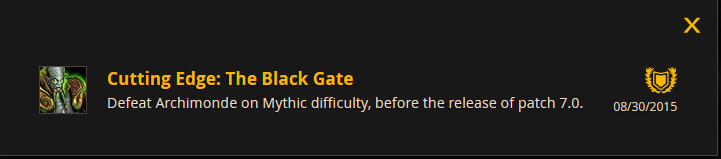
I earned a time limited achievement for clearing the hardest content on time, Cutting Edge, The Black Gate. That simply means I was part of a group that delivered at the top difficulty while it was current. I value it as a reminder of the people and the process, not as a trophy.
What that date and rank say in simple terms
- World rank Top 50 worldwide, specifically #49 on Mythic Archimonde, Hellfire Citadel.
- Percentile #49 out of about 2,656 guilds that eventually killed it, roughly the top 1.85 percent globally.
- Date context The clear on 30 Aug 2015 landed in the early wave. The 1,000th guild did not kill the boss until 8 Feb 2016.
- Mode Fixed 20 player Mythic, which means every seat carries weight and there are no passengers.
- Community reception Our speed kill videos picked up hundreds of thousands of views on YouTube and got shared across forums, which is why the guild’s runs became well known.
Glossary for non players
- Raid A 20 person team activity that requires coordination and timing.
- Mythic The highest difficulty, no extra players allowed, no easy mode.
- Pull One attempt at the challenge. Start to finish.
- Wipe The team fails, everyone resets, try again with a change.
- Logs Automatic records of what happened and when, used to learn and improve.
Thank you to the people
Leaders who stayed calm, players who told me the truth, friends who stuck around after the wipe, and the quiet ones who did their job perfectly without asking for credit. You helped me grow up. I am grateful.
For anyone coming up behind me
If you are a teenager who raids, take it seriously. Not for status, for the habits. Show up on time, own your mistakes, be kind and direct, and keep the group goal first. These habits travel. They can keep you out of places you do not want to go, and they can carry you into rooms you never thought you would reach.



Be First to Comment